
is native advertising ethical
Share This Post

An increasingly popular form of advertising that has the prospect of influencing consumer behaviour more than traditional advertising. Companies wanting to conduct a native ad campaign must know the various types of native advertisements and the ethical issues involved.

What is native advertising?

Native Advertising Definition - Advertising 101 - Advant Technology

Content by brands that looks and feels like the regular news we read on the web. It typically appears on news publishers as a form of marketing where ads are paid for by an advertiser.
If advertising is content that looks and feels like other content, then perhaps the average user cannot distinguish it as an advertisement; this is a problem. Therefore, this is potentially unethical. We will address this in more detail but first, let’s get to the basics, including why advertisers use native advertising.

Advertising industry definitions

The Native Advertising Institute define it as:

paid advertising where the ad matches the form, feel and function of the content of the media on which it appears.

The Interactive Advertising Bureau IAB, another trusted source on online advertising, has a definition that can be found here.

Is Native Advertising Ethical - Advertising 101 - Advant Technology

Where can you buy native placements?

Ads can be bought from publishers directly or via a programmatic auction.

The purpose of native ads

To promote awareness and drive sales for performance campaigns, the effects on consumer behaviour go beyond this.

Native advertising formats also seek to prevent users from turning to adblocking software for relief from irrelevant or obnoxious ads.

The benefits 
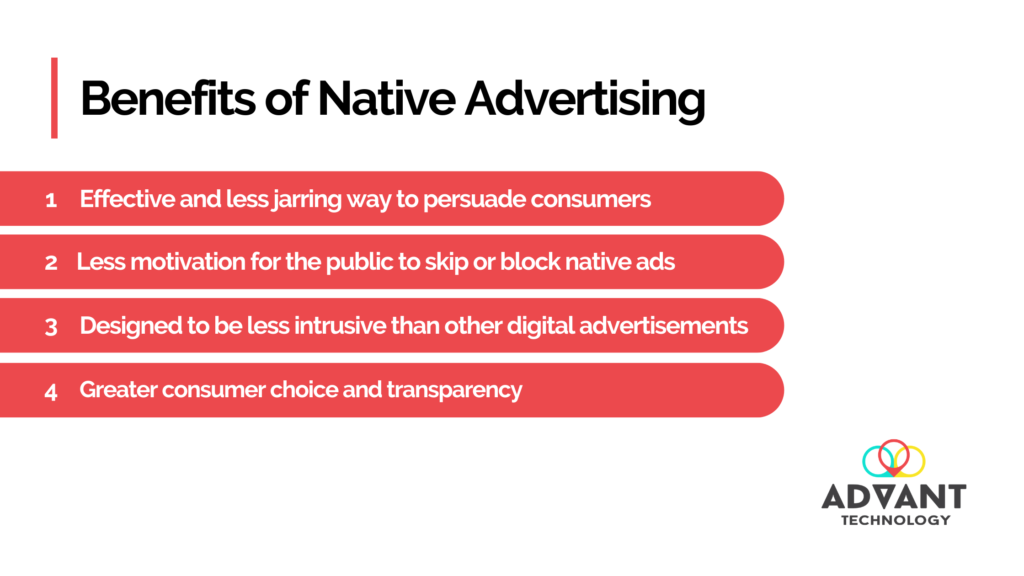
Benefits of Native Advertising - Are Native Ads Ethical - Advertising 101 - Advant Technology

They are designed to be more engaging than other forms of marketing. They may result in greater levels of brand awareness and engagement. Still, it’s essential advertisers recognise content should be clearly labelled.

There are many reasons for the increasing popularity:

  • It is efficient at targeting users who are likely to be interested in the advertised product or service. It can provide an effective and less jarring way to persuade consumers of a product or service benefit.
  • There is less motivation for the public to skip or block native ads than more invasive and forced ads. Forced ads, such as pre-roll video advertisements, are often considered annoying.
  • They are designed to be less intrusive than other digital advertisements because they attempt to blend in with the surroundings in which they appear. As a result, users may find them less frustrating and more relevant than other forms of digital advertising.
  • They enable greater consumer choice and transparency, native advertising may help to build trust.
    Now, let’s dive into ethics which is the crux of this content.

Examples of native ads

madeformums.com - Native Advertising Example - Advant Technology

Ethical native advertising

Ensuring audiences are aware that native ads exist is an integral part of protecting trust, transparency and honesty. This is especially true when advertising on journalistic sites such as news publishers.

Web users need to be informed and understand the difference between paid-for content and impartial recommendations or opinions, so a clear label is critical if you’re a publisher.

There are also concerns about ‘advertorials’—ads that masquerade as independent articles.

While such ads may be labelled as advertising, they are designed to look like legitimate content; thus, a conflict of interest is at play. Advertorials are also sometimes called branded content.

So, is native advertising ethical?

That depends, but our answer to that is, yes, as long as they conform to the necessary regulations ensuring it is clearly labelled.

The advertising industry needs to be held accountable. It must ensure that all the stakeholders within the supply chain of the delivery of native ads are doing their bit. Those stakeholders include:

  • The advertiser
  • The tech platforms including SSPs, DSPs and exchanges
  • The publishers

This lack of transparency is a primary source of frustration, with users often labelling native ads as ‘deceptive’.

Marketers that seek to advertise their products through native should ensure they are transparent about their affiliations.

Types of native advertising / native ad units

  • Paid Search Unit
    These types of placements/units are search results. They are commonly highlighted in different colours. They are positioned at the top of the page before other search results on search engines like Google, Yahoo, or Bing.
  • In-Feed Unit
    These advertisements appear in the middle of social media or editorial content on platforms such as BuzzFeed and Facebook.
  • In-ad with Native Element Units
    These advertisements contain content meant to look like the editorial content around it.
  • Promoted Listings
    These advertisements are product listings that might appear on search pages and shopping websites. They are promoted by sellers such as Google or Amazon.

Ethical questions stakeholders should ask themselves

  • Transparency and honesty – Is it clear to the consumer?
  • Are labels easily visible?
  • Is it possible for consumers to differentiate between an advertisement and other content?
  • Editorial independence – Does the website or social media platform publishing native ads operate independently from advertisers?
  • Interference – Are marketers seeking to interfere with consumers’ website use?

The future of ethical ads

While native advertising has been successful in the short term, it may be necessary for further improvements in transparency and ethical standards to remain effective long term.

Marketers should continue to work collaboratively with news websites and the ad-tech industry to promote accurate and ethical native advertising standards.

Conclusion

In summary, native advertising can be a powerful tool in the hands of marketers who are transparent and ethical. It is crucial to consider how your customers will react to it before using this form of marketing strategy for your business.

Suppose you need help planning an ethical campaign? Our international media experts can help strategise the best approach to ensuring trust and safety for your digital advertising campaigns.

Free Paid Media Review

We are a world-class programmatic marketing agency that can generate more sales and leads for you. Leave your email address, we will contact you for your free paid media review.

Market & Structure Tool

Advant Technology — LinkedIn Ads for Enterprise Technology

Which markets change your campaign, and how

A working companion to the multi-market playbook. Explore what actually differs between the UK, US, DACH and APAC — or answer four questions to see whether your account list needs one campaign structure or several.

United Kingdom

UK
Message-based formats
Available

Outside the EU/EEA/Switzerland exclusion since Brexit, so Conversation Ads (successor to Message Ads) are not caught by the EU restriction that applies to Germany.

Governing regime

UK GDPR. Standard UK GDPR employee-data handling applies; no equivalent to Germany's works-council co-determination layer.

Decision culture

Closer to US pace. Single decision-maker with committee sign-off is common; buying-group validation is typically faster than DACH.

Localization

English-native. No localisation tax on creative or landing pages for UK-only targeting.

United States

US
Message-based formats
Available

Conversation Ads run without the EU/EEA/Switzerland restriction.

Governing regime

CCPA / CPRA. California's B2B and employee-data exemptions expired 1 Jan 2023 (AB 25 / AB 1355 / AB 1281 not renewed). Business-contact data in ABM lists touching California residents is now in scope.

Decision culture

Fast-moving, champion-led. Often an internal champion drives the process with executive sign-off, rather than slower group consensus.

Localization

English-native. Tone and proof points differ from UK (ROI framing, case-study style) but no language barrier.

Germany-led DACH

DACH
Message-based formats
Unavailable in EU/EEA/CH

Following a Nov 2021 CJEU ruling that native inbox advertising needs direct-marketing consent under the ePrivacy framework, LinkedIn stopped EU-targeted Message/Conversation Ads (new campaigns blocked 15 Dec 2021, existing ones suspended 10 Jan 2022).

Governing regime

GDPR + BDSG. Germany's Federal Data Protection Act adds works-council (Betriebsrat) co-determination rights over some employee-data processing. A works agreement cannot itself legitimate otherwise-inadmissible processing (German court ruling reported Jan 2025).

Decision culture

Consensus-driven. Formal sign-off and longer internal validation typically precede commercial conversations — plan reporting windows accordingly.

Localization

German materially outperforms English. True below enterprise-only accounts; enterprise buying groups are more English-tolerant, but mid-market is not.

Singapore-led APAC

APAC
Message-based formats
Confirm in Campaign Manager

Singapore sits outside the EU/EEA/Switzerland exclusion, so formats are presumed available — but coverage isn't centrally documented by geography, so verify before planning.

Governing regime

PDPA (Singapore). A distinct consent-and-purpose-limitation regime, not equivalent to GDPR. Treat as its own compliance track, not a GDPR analogue.

Decision culture

Not representative of wider APAC. Singapore is English-language and Western-business-norm-adjacent; this does not extend to Japan, Korea or Greater China buying culture.

Localization

English viable — for Singapore only. Do not treat English-only creative as a proxy for the rest of APAC if the account list extends beyond Singapore/Hong Kong hubs.

Decision-culture notes are directional, not universal — treat as a planning prior, not a rule for every account.

Is the target account list evaluated by one centralised, cross-border buying committee, or by in-market/regional committees?

Does the plan rely on message-based formats (Conversation Ads) in any EU/EEA/Switzerland market?

Does language localisation materially change conversion quality in at least one target market (e.g. DACH below enterprise, or APAC beyond Singapore/Hong Kong)?

Is your target-account list in every market comfortably above LinkedIn's practical minimum audience size (commonly cited around 300)?

Recommendation

Answer the questions above

Select one answer for each question to see the recommendation.

Recommendation

A unified structure fits your answers

Your account list is centrally decided, doesn't depend on a restricted message format, and localisation isn't a material factor — the exception case for a single, unified campaign structure.

  • None of the market-splitting triggers apply — re-check this if your account list or market mix changes.

Recommendation

Split by market: separate campaign groups, budgets and thresholds

At least one structural factor makes a shared template unreliable across your markets.

  • Regional buying committees mean each market is a separate decision unit — a shared campaign group would blend distinct audiences.
  • A message-format plan cannot run as one structure if it includes an EU/EEA/Switzerland market — Conversation Ads aren't available there, so at minimum that market needs a different format mix.
  • Where localisation changes conversion quality, a shared budget and qualification threshold will misread the localised market's real performance.
  • At least one market may sit below the practical minimum audience size — consider folding that market into a regional structure rather than giving it a standalone campaign group.
  • Check each market's target-account list against LinkedIn's minimum audience guidance before finalising how many standalone campaign groups to build.

READY TO TAKE ADVANTAGE?

Ready for advertising that really works? Take advantage of our FREE programmatic or paid social review.