

Mastering Native Video Advertising: Benefits, types and common mistakes
In a world where consumers’ attention spans are constantly decreasing and more people are using ad blockers, it’s becoming increasingly difficult for brands to get their message across. One of the ad formats that can help bypass this and that we’ve seen brilliant results with here at Advant Technology is native video advertising. Today we thought we’d share our top tips for advertisers and agencies wanting to learn more about these types of ads.

What are native video ads?
Native video advertising integrates branded messages seamlessly into content, aligning with the format of the hosting platform. It’s generally an in-feed video ad that’s uploaded to various platforms targeted to your desired audience. Many in-feed video ads are click-to-play; meaning they play on their own without sound.

These types of ads are a form of native advertising that is more immersive than ever before and can be seen on Facebook, Instagram, Twitter, YouTube, Snapchat, and thousands of other apps and publishers across the globe.
Native video ads are regarded as “native” because they are formatted mainly for the platform that is hosting them, making them blend in with other content on the platform. They are promotional, can be engaging if done well, and are highly targeted if using the right data which would be applied when setting up your campaign.
Native advertising has risen to be one of the most influential these days due to its high engagement rate and non-disruptive nature, and many industry experts claim they are the future of advertising.
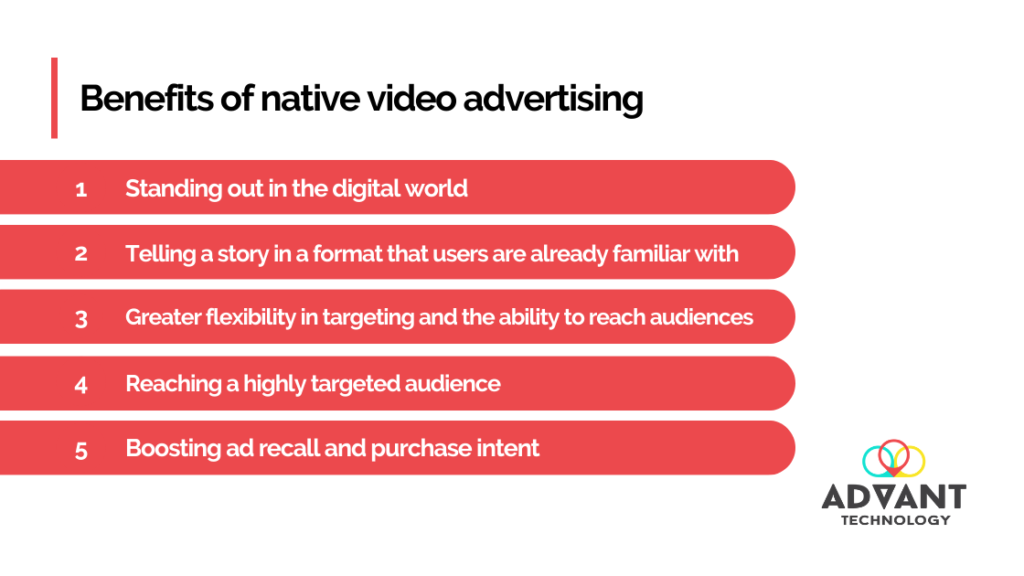
Benefits of native video advertising
Viewable video advertising is a way to stand out in the digital world and marketers are taking notice. With billions of video views across the web every day, it’s no wonder that advertisers want to take advantage of this trend. This native form of video ads offers a number of benefits including reaching a highly targeted audience. They also boost ad recall and purchase intent.
Businesses of any size can now focus on creating compelling content to reach their target audiences. Native video advertising allows advertisers to tell a story in a format that users are already familiar with and used to engaging with for years. They are especially beneficial for users, as they allow them to engage with related content without disrupting their current tasks.
Native video advertising provides an opportunity to tell a story in the form of text, images, or both, and brands can choose to use captions or voiceovers to convey messages about their products and services.
They allow for greater flexibility in targeting and the ability to reach audiences regardless of their device or platform of choice. Additionally, brands can now use multiple formats to tell personalised stories within one campaign.

Native Video vs. Pre-Roll
Pre-roll videos play before the video the user intends to watch and are often auto-play. Sometimes the sound starts playing on its own and sometimes users may need to activate it. Many people think that pre-rolls and native videos are the same, but in many ways, they are different.
Pre-roll video ads act as a barrier to the content that the user wants to see, meaning they have to view the advert before they can continue. Some people consider these short videos disruptive, and some advertisers, such as Nike, avoid them altogether.
Native video advertising is different in the way that it presents the option to just keep scrolling without any interruption or barrier. It’s an ad that fits the platform it is being viewed on. For example, Tastemade may have a native video ad about food content that only plays when someone watches one of their food channels. This type of video is becoming more prevalent because they are effective for both publishers and users.
Both types of ads aim to increase brand metrics and sales and there is an argument for both types depending on the objectives. We have found success with both formats over the years for our clients in influencing purchasing decisions.
A word on mobile and native ads
Native video ads allow viewers to continue browsing a site without interruption, which is especially useful if they are watching via mobile where changing screens takes effort. In-feed videos allow for maximum visibility on mobile devices, making it an ideal format to take advantage of.
Since users don’t have to stop to watch native ads and because they are not “forced” to watch it, it’s arguably more valuable if you do get a completed video view as it suggests the user choose to watch your ad, meaning you have a better chance of converting the user into a customer.
Native videos are typically published through programmatic channels, resulting in higher completion rates and lower bounce rates compared to direct media buys. Detailed reporting and instant optimizations further enhance their performance, a key advantage offered by Advant Technology.
Common mistakes with native video advertising
Many people make mistakes when trying to optimize native video. Here are the most common native video ads errors:
- Not having a strong call-to-action
- Making the copy too long
- Ignoring CTAs during editing
- Using clickbait and sensational headlines
- Making the video too salesy
- Not testing colors, images, copy, and length
- Not using the right targeting options
Top tips for native video advertising
Focus on one goal at a time
This helps to know whether the placement of a native ad is having a positive impact on business objectives or not. In order to track performance, it’s always good to have one clear KPI in mind and see the results in real-time. For example, don’t try to focus on CTR, view completion rate and sales all at one time, pick one!
Creative storytelling through video is more effective than simply showcasing a product or service
While the purpose of every ad is to shine the light on a product or service, consumers today are exposed to an endless amount of adverts. As a result, creativity plays an important role in grabbing the attention of audiences. For this reason, telling stories through video can create more engagement compared to just “showing off” products or services
Video length should be in line with the sales funnel
If the sales funnel is long, it’s a good idea to have a longer video. For example, when advertising a complex service that requires loads of explaining, then having a short video ad is unlikely to be effective. As the consumer gets closer to the purchase decision, it’s better to have a short video that can quickly illustrate the benefits of your product or service.
Quality content is always a good starting point
Brands should always strive for quality content. No matter what size budget is set aside for native ads, it is important that the script and images are engaging. We have found that a good starting point is to create a video ad made from high-quality images, scripted in no more than three short paragraphs. This ensures the messaging focuses on the brand message and value proposition.
Get the timing right for maximum engagement
Because native ads are contextually targeted, timing is critical to ensure it reaches the right audience at the right time. For this reason, native ads should be used more for communicating brand awareness rather than pushing sales messages.
Look towards programmatic native video ads as a way of reaching a broader audience
A new way for video ads to be targeted is through programmatic technology. Native video ads allow brands to reach a wider audience at scale while ensuring they have a more positive impact on the user experience, resulting in increased engagement.
Optimize for multiple video ad formats
Native video ads need to be optimized for every format available. This means that there should be separate videos made for Instagram, Facebook, and Twitter and various publishers bought through programmatic channels.
If done correctly, this approach will give brands the best opportunity to reach the right audience with the right format.
If you’re going to use a different creative for each platform, then make sure they share similar qualities such as colour schemes and copy. This way it’s not too jarring when you switch from one ad to the next. This is an art and science!
Provide value to users
While video ads work well as a branding and awareness tool, they also need to be targeted toward the end-user and provide them with some form of value. This is why it’s important that native videos are used as a method of adding value to the user, rather than simply using native video as a branding tool.

Why use native video ads for your advertising strategy?
Here are our top reasons why you should consider using native video ads:
They get a wider reach
When you upload your video ad instead of sharing a link to it, it will prompt social networks to promote the ad more than they would to a YouTube URL link. This is because social platforms have set up the algorithm of their news feed in a way that they give priority to native videos.
They attract attention
Nowadays, social media users are becoming more tech-inclined. As a result, they are beginning to value more discreet forms of advertising. This is the reason brands are now investing more in their display budgets and shifting them into native video ads.
More engagement
Native video ads are likely to create more engagement. The reason is, users who have already been attracted would want to go further to know what the link is about. Video ads are even more accessible to online users as many networks now offer autoplay functionality.
Conclusion
Marketing entails giving your audiences what they want, and today’s audiences want the ability to watch ads conveniently and unobtrusively, which can be made possible with the non-disruptive nature of native ads.
If you are planning a native video campaign, our team of media strategists, campaign managers and programmatic experts would love to help you. Speak to our team today to discuss your goals.
