
A guide to native vs display ads
Share This Post

Native and display ads are two of the most popular forms of digital advertising. Both ad formats aim to communicate information about a product or service in the online space.

Although both types of advertising share similarities, they have their respective differences. This article will explain the similarities and differences between native ads and display ads to help you decide which option could work best for your brand.

What is Native Advertising?

Native advertising embeds adverts and promotions within the main content of a web page. Instead of having a different look and feel, native ads tend to match the website’s structure that they appear on. And they are not as intrusive as other kinds of digital advertising.

Native ads appear in the form of listings on search engine result pages (SERP), as news feeds on social media or in the feed of news publishers.

Today, we will focus just on digital native ads that appear in-feed on web publishers vs digital display banner ads.

What is an in-feed native ad?

The difference between an in-feed native ad and other kinds of native advertising is that it’s situated within the feed of free, editorial content rather than presented as a banner above.

Native_Advertising_Example
Native Advertising Example (see blue world map with text, in the centre of the image)

Benefits of Native Advertising

High engagement

Native ads tend to have a higher click-through rate (CTR) than display ads and efficiently drive traffic to your website.

According to a survey, 53% of consumers view native ads more frequently than display ads. Our agency experience found that native ads can deliver a higher brand uplift and consideration than display ads. In a recent campaign we conducted with a leading tourism board, we saw a notable uplift in consideration.

Less affected by ad blockers

Native ads are less likely to be blocked by ad blockers because they are less intrusive.

Bypasses banner blindness

Banner blindness is a phenomenon where users visiting a website quickly scroll past any graphic ad banners without noticing it. This is because humans are often in “Skim Mode” when they visit web pages and have learned to ignore banners, but as native ads feel more like the content on the page, users may be less inclined to ignore native ads.

The human brain takes in visual information very quickly, but this information is processed with different parts of the brain at different speeds. The eyes tend to take in the entire picture on a page first – but it’s not until our minds process what’s actually happening that we notice anything.

Time to market & cost

Native ads are simpler to produce, generally consisting of an image and some text, therefore they are significantly cheaper. This means you can be in-market faster, allowing your team to produce more messages that could also be more tailored, allowing you to do more a/b testing of different themes and potentially see higher engagement rates and ultimately get higher performance, sales and a stronger ROI.
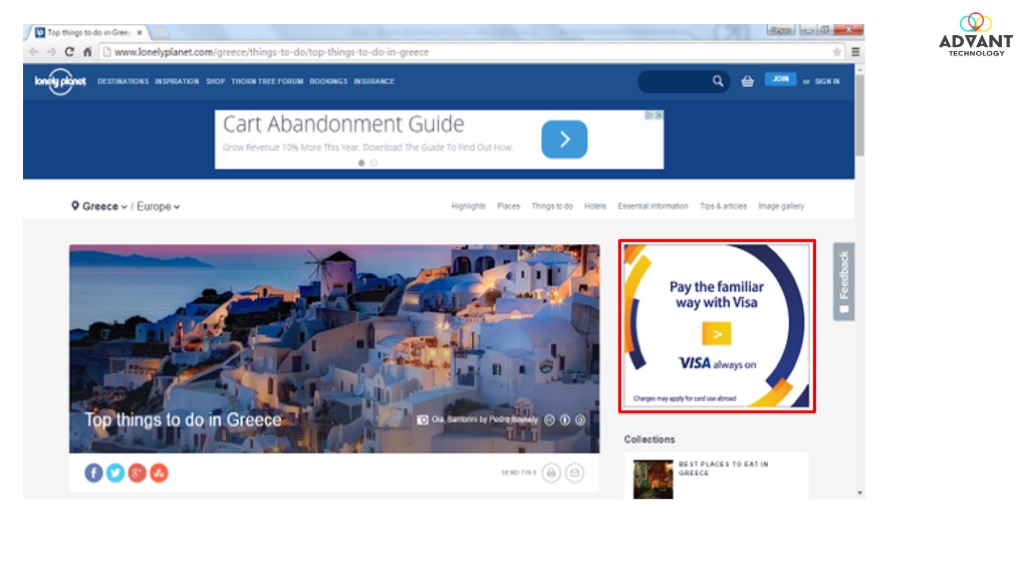
Display Ad Example
Programmatic Display Ad Example from Advant Technology client VISA

What is Display Advertising?

Display ads are a visual-centric form of online advertising that delivers and superimposes a commercial message through images, animations, videos, logos, or other graphics.

Display ads help promote brands and businesses whenever users browse the internet, check their emails, watch videos on YouTube, or use mobile apps.

Initially, display ads were called “banner ads,” They used to be hyperlinked and image-based ads shaped as strips and usually placed at the top of a web page.

Banner ads later evolved into display ads, which now appear in different sizes and shapes, and have different interactive elements such as pop-ups, videos, and more.

Benefits of display ads

Although display ads have lower click-through rates than native ads, they still have some benefits that can’t be overlooked.

If you’re considering running an advert online, but you’re not yet convinced to use display advertising, here are some benefits of using display advertising:

Display Ads are visually pleasing

Humans can be enticed by the things they see, and it’s hard to ignore a well-designed display that is appealing to the eye.

Potential for interactivity

Display advertising can include interactive elements and videos to make the experience more entertaining and eye-catching.

Which ad format to choose

One of the goals of these formats is to increase engagement or to present a more complex message. Advant Technology has run many campaigns on behalf of its advertisers, creating rich, interactive and immersive banners that allow the users to interact with the brand and not simply be a passive consumer in the digital environment.

Smart marketers will leverage the advantages of both native and display advertising to create an effective content strategy.

Free Paid Media Review

We are a world-class programmatic marketing agency that can generate more sales and leads for you. Leave your email address, we will contact you for your free paid media review.

Market & Structure Tool

Advant Technology — LinkedIn Ads for Enterprise Technology

Which markets change your campaign, and how

A working companion to the multi-market playbook. Explore what actually differs between the UK, US, DACH and APAC — or answer four questions to see whether your account list needs one campaign structure or several.

United Kingdom

UK
Message-based formats
Available

Outside the EU/EEA/Switzerland exclusion since Brexit, so Conversation Ads (successor to Message Ads) are not caught by the EU restriction that applies to Germany.

Governing regime

UK GDPR. Standard UK GDPR employee-data handling applies; no equivalent to Germany's works-council co-determination layer.

Decision culture

Closer to US pace. Single decision-maker with committee sign-off is common; buying-group validation is typically faster than DACH.

Localization

English-native. No localisation tax on creative or landing pages for UK-only targeting.

United States

US
Message-based formats
Available

Conversation Ads run without the EU/EEA/Switzerland restriction.

Governing regime

CCPA / CPRA. California's B2B and employee-data exemptions expired 1 Jan 2023 (AB 25 / AB 1355 / AB 1281 not renewed). Business-contact data in ABM lists touching California residents is now in scope.

Decision culture

Fast-moving, champion-led. Often an internal champion drives the process with executive sign-off, rather than slower group consensus.

Localization

English-native. Tone and proof points differ from UK (ROI framing, case-study style) but no language barrier.

Germany-led DACH

DACH
Message-based formats
Unavailable in EU/EEA/CH

Following a Nov 2021 CJEU ruling that native inbox advertising needs direct-marketing consent under the ePrivacy framework, LinkedIn stopped EU-targeted Message/Conversation Ads (new campaigns blocked 15 Dec 2021, existing ones suspended 10 Jan 2022).

Governing regime

GDPR + BDSG. Germany's Federal Data Protection Act adds works-council (Betriebsrat) co-determination rights over some employee-data processing. A works agreement cannot itself legitimate otherwise-inadmissible processing (German court ruling reported Jan 2025).

Decision culture

Consensus-driven. Formal sign-off and longer internal validation typically precede commercial conversations — plan reporting windows accordingly.

Localization

German materially outperforms English. True below enterprise-only accounts; enterprise buying groups are more English-tolerant, but mid-market is not.

Singapore-led APAC

APAC
Message-based formats
Confirm in Campaign Manager

Singapore sits outside the EU/EEA/Switzerland exclusion, so formats are presumed available — but coverage isn't centrally documented by geography, so verify before planning.

Governing regime

PDPA (Singapore). A distinct consent-and-purpose-limitation regime, not equivalent to GDPR. Treat as its own compliance track, not a GDPR analogue.

Decision culture

Not representative of wider APAC. Singapore is English-language and Western-business-norm-adjacent; this does not extend to Japan, Korea or Greater China buying culture.

Localization

English viable — for Singapore only. Do not treat English-only creative as a proxy for the rest of APAC if the account list extends beyond Singapore/Hong Kong hubs.

Decision-culture notes are directional, not universal — treat as a planning prior, not a rule for every account.

Is the target account list evaluated by one centralised, cross-border buying committee, or by in-market/regional committees?

Does the plan rely on message-based formats (Conversation Ads) in any EU/EEA/Switzerland market?

Does language localisation materially change conversion quality in at least one target market (e.g. DACH below enterprise, or APAC beyond Singapore/Hong Kong)?

Is your target-account list in every market comfortably above LinkedIn's practical minimum audience size (commonly cited around 300)?

Recommendation

Answer the questions above

Select one answer for each question to see the recommendation.

Recommendation

A unified structure fits your answers

Your account list is centrally decided, doesn't depend on a restricted message format, and localisation isn't a material factor — the exception case for a single, unified campaign structure.

  • None of the market-splitting triggers apply — re-check this if your account list or market mix changes.

Recommendation

Split by market: separate campaign groups, budgets and thresholds

At least one structural factor makes a shared template unreliable across your markets.

  • Regional buying committees mean each market is a separate decision unit — a shared campaign group would blend distinct audiences.
  • A message-format plan cannot run as one structure if it includes an EU/EEA/Switzerland market — Conversation Ads aren't available there, so at minimum that market needs a different format mix.
  • Where localisation changes conversion quality, a shared budget and qualification threshold will misread the localised market's real performance.
  • At least one market may sit below the practical minimum audience size — consider folding that market into a regional structure rather than giving it a standalone campaign group.
  • Check each market's target-account list against LinkedIn's minimum audience guidance before finalising how many standalone campaign groups to build.

READY TO TAKE ADVANTAGE?

Ready for advertising that really works? Take advantage of our FREE programmatic or paid social review.