a guide to in-stream advertising
Share This Post

Types of in-stream ads

In-stream video advertising is the most common form of video advertising and comes in three forms: pre-roll, mid-roll and post-roll. 

The in-stream format is designed to quickly and efficiently grab users’ attention, making it a firm favourite among many advertisers. 

In-Stream Video Advertising - Programmatic Advertising - Advant Technology In-Stream Video Advertising – Programmatic Advertising – Advant Technology

Benefits of in-stream video advertising

 
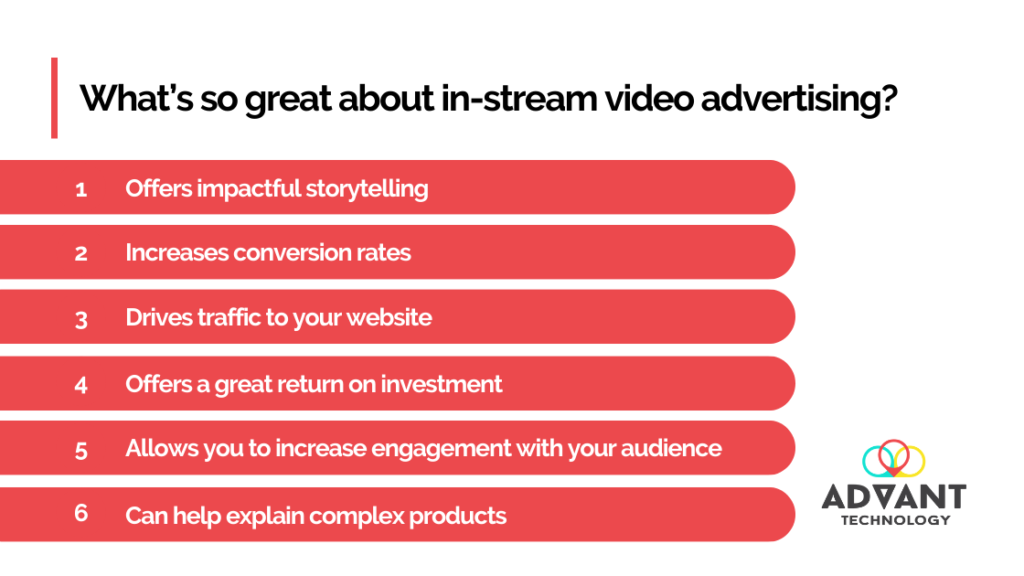
  • Offers impactful storytelling
  • Increases conversion rates
  • Drives traffic to your website
  • Offers a great return on investment
  • Allows you to increase engagement with your audience
  • Can help explain complex products
Why In-Stream Video Advertising - Programmatic Advertising 101 - Advant Technology
Why In-Stream Video Advertising – Programmatic Advertising 101 – Advant Technology

What’s the difference between pre-roll, mid-roll and post-roll?

In-Stream Video Advertising - Pre-roll _ Mid-roll _ Post-roll - Advant Technology
In-Stream Video Advertising – Pre-roll / Mid-roll / Post-roll – Advant Technology

Pre-roll

The most common type of in-stream video advertising. As the name suggests, pre-rolls are ads that are played before an intended video starts and are a great option for brands looking to increase awareness, recollection and purchase consideration.

These ads are typically 15, 30 or 60 seconds long and can be both skippable and non-skippable. To create a successful pre-roll video campaign, it is vital that the first few seconds of the video are as attention-grabbing and engaging as possible. In that way, even if a user doesn’t watch the full ad, they’ll leave with a good impression of your brand.

The right targeting can help display these ads in the right context so that users are likely to engage with the ad.

Mid-roll

Mid-roll video ads play in the middle of a video and tend to be shorter than pre-rolls. As the users have already invested time in watching the video, abandonment rates tend to be lower compared to pre-rolls.

Completion rates tend to be higher for mid-rolls and they are therefore a good option for brands wanting their full ad to be viewed.

Post-roll

Post-roll video ads are the least used in-stream format and play at the end of a video. It may seem counterintuitive to play the ad after a video, but under the right circumstances and with the right strategy, this format can go a long way.

Users are more likely to click through to your page after watching an intended video. They’ve already consumed the video they wanted to watch in the first place, and are ready to jump to another page, so why not yours? For this reason, post-rolls are particularly beneficial when you’ve got a clear CTA.

Interested in hearing more about in-stream video advertising? Speak to our sales team.

To read more about other types of video advertising, read our posts on outstream video advertising and rewarded video advertising.

In-Stream Advertising - Programmatic Advertising - Advant Technology

In-Stream Advertising – Programmatic Advertising – Advant Technology

Market & Structure Tool

Advant Technology — LinkedIn Ads for Enterprise Technology

Which markets change your campaign, and how

A working companion to the multi-market playbook. Explore what actually differs between the UK, US, DACH and APAC — or answer four questions to see whether your account list needs one campaign structure or several.

United Kingdom

UK
Message-based formats
Available

Outside the EU/EEA/Switzerland exclusion since Brexit, so Conversation Ads (successor to Message Ads) are not caught by the EU restriction that applies to Germany.

Governing regime

UK GDPR. Standard UK GDPR employee-data handling applies; no equivalent to Germany's works-council co-determination layer.

Decision culture

Closer to US pace. Single decision-maker with committee sign-off is common; buying-group validation is typically faster than DACH.

Localization

English-native. No localisation tax on creative or landing pages for UK-only targeting.

United States

US
Message-based formats
Available

Conversation Ads run without the EU/EEA/Switzerland restriction.

Governing regime

CCPA / CPRA. California's B2B and employee-data exemptions expired 1 Jan 2023 (AB 25 / AB 1355 / AB 1281 not renewed). Business-contact data in ABM lists touching California residents is now in scope.

Decision culture

Fast-moving, champion-led. Often an internal champion drives the process with executive sign-off, rather than slower group consensus.

Localization

English-native. Tone and proof points differ from UK (ROI framing, case-study style) but no language barrier.

Germany-led DACH

DACH
Message-based formats
Unavailable in EU/EEA/CH

Following a Nov 2021 CJEU ruling that native inbox advertising needs direct-marketing consent under the ePrivacy framework, LinkedIn stopped EU-targeted Message/Conversation Ads (new campaigns blocked 15 Dec 2021, existing ones suspended 10 Jan 2022).

Governing regime

GDPR + BDSG. Germany's Federal Data Protection Act adds works-council (Betriebsrat) co-determination rights over some employee-data processing. A works agreement cannot itself legitimate otherwise-inadmissible processing (German court ruling reported Jan 2025).

Decision culture

Consensus-driven. Formal sign-off and longer internal validation typically precede commercial conversations — plan reporting windows accordingly.

Localization

German materially outperforms English. True below enterprise-only accounts; enterprise buying groups are more English-tolerant, but mid-market is not.

Singapore-led APAC

APAC
Message-based formats
Confirm in Campaign Manager

Singapore sits outside the EU/EEA/Switzerland exclusion, so formats are presumed available — but coverage isn't centrally documented by geography, so verify before planning.

Governing regime

PDPA (Singapore). A distinct consent-and-purpose-limitation regime, not equivalent to GDPR. Treat as its own compliance track, not a GDPR analogue.

Decision culture

Not representative of wider APAC. Singapore is English-language and Western-business-norm-adjacent; this does not extend to Japan, Korea or Greater China buying culture.

Localization

English viable — for Singapore only. Do not treat English-only creative as a proxy for the rest of APAC if the account list extends beyond Singapore/Hong Kong hubs.

Decision-culture notes are directional, not universal — treat as a planning prior, not a rule for every account.

Is the target account list evaluated by one centralised, cross-border buying committee, or by in-market/regional committees?

Does the plan rely on message-based formats (Conversation Ads) in any EU/EEA/Switzerland market?

Does language localisation materially change conversion quality in at least one target market (e.g. DACH below enterprise, or APAC beyond Singapore/Hong Kong)?

Is your target-account list in every market comfortably above LinkedIn's practical minimum audience size (commonly cited around 300)?

Recommendation

Answer the questions above

Select one answer for each question to see the recommendation.

Recommendation

A unified structure fits your answers

Your account list is centrally decided, doesn't depend on a restricted message format, and localisation isn't a material factor — the exception case for a single, unified campaign structure.

  • None of the market-splitting triggers apply — re-check this if your account list or market mix changes.

Recommendation

Split by market: separate campaign groups, budgets and thresholds

At least one structural factor makes a shared template unreliable across your markets.

  • Regional buying committees mean each market is a separate decision unit — a shared campaign group would blend distinct audiences.
  • A message-format plan cannot run as one structure if it includes an EU/EEA/Switzerland market — Conversation Ads aren't available there, so at minimum that market needs a different format mix.
  • Where localisation changes conversion quality, a shared budget and qualification threshold will misread the localised market's real performance.
  • At least one market may sit below the practical minimum audience size — consider folding that market into a regional structure rather than giving it a standalone campaign group.
  • Check each market's target-account list against LinkedIn's minimum audience guidance before finalising how many standalone campaign groups to build.

READY TO TAKE ADVANTAGE?

Ready for advertising that really works? Take advantage of our FREE programmatic or paid social review.