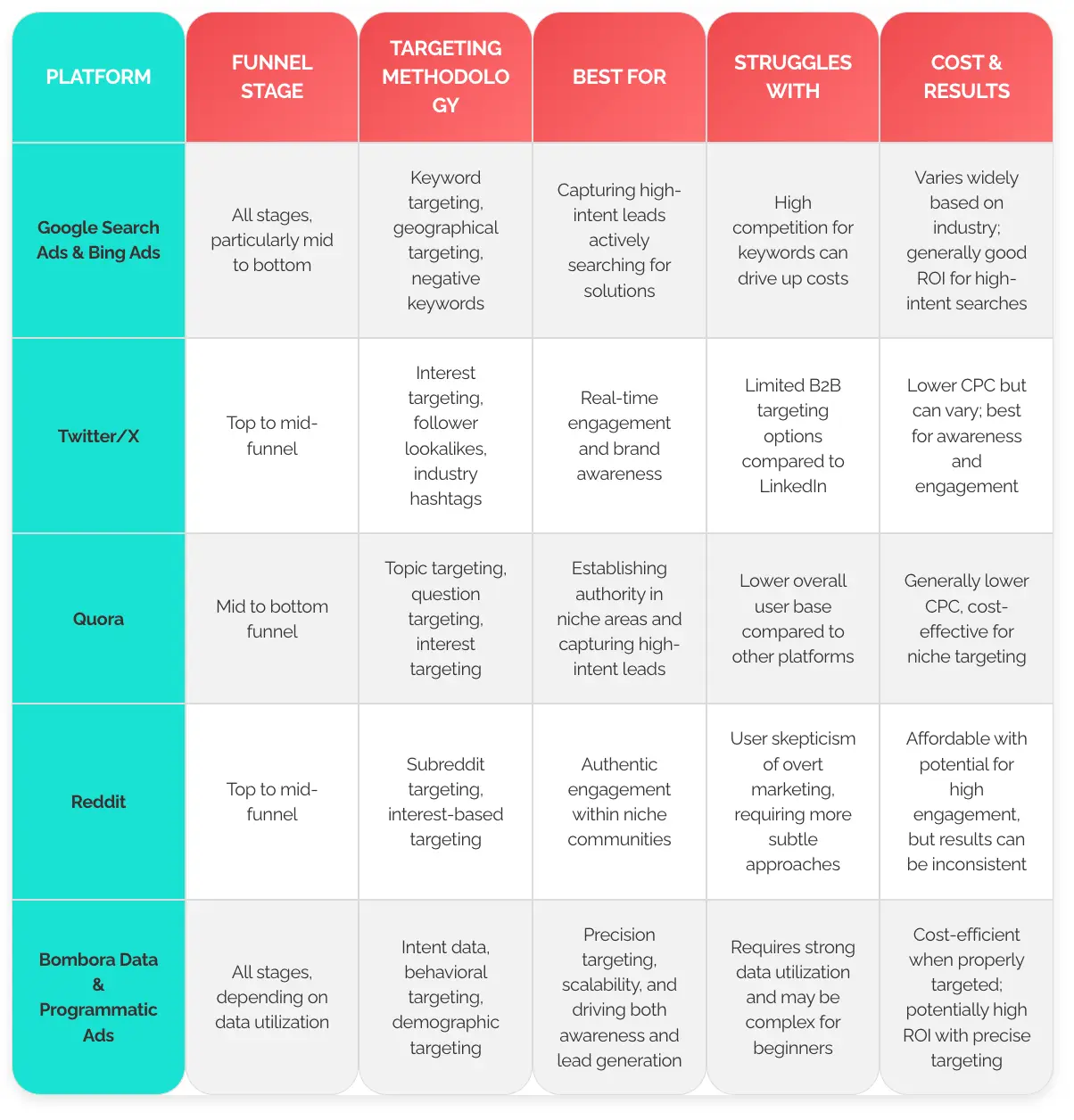

-
B2B Marketing - Alternatives to LinkedIn Ads for the Industrial & Manufacturing Sectors
- Google Search Ads & Bing Ads: Precision Targeting with High Intent
- Twitter/X: A Platform for Engagement and Awareness in the Industrial & Manufacturing Sectors
- Quora: Tapping into Niche Expertise and High-Intent Audiences
- Quora: Establishing Authority and Capturing High-Intent Leads
- Reddit: Engaging with Communities and Niche Segments
- Bombora Data & Programmatic Display, Native, and Video Ads: Leveraging Data for Targeted Outreach
B2B Marketing - Alternatives to LinkedIn Ads for the Industrial & Manufacturing Sectors
LinkedIn is not the only platform you can use to generate high-quality leads in the industrial and manufacturing sectors. While LinkedIn’s targeting capabilities are well-suited for reaching professionals, there are several other paid media channels that can be just as effective—or even more so—depending on your specific goals, whether they be brand awareness, pipeline growth, or lead conversion. Let’s explore some of these alternatives.
Google Search Ads & Bing Ads: Precision Targeting with High Intent
For companies in the industrial and manufacturing sectors—such as aerospace, automotive, or heavy machinery—Google Search Ads and Bing Ads offer unparalleled precision in targeting prospects at the moment they’re actively searching for solutions. When it comes to key performance indicators (KPIs) like marketing-qualified leads (MQLs), sales-qualified leads (SQLs), conversion rates, and cost per acquisition (CPA), search ads have long been a go-to strategy. However, it’s critical to approach these platforms with a data-led mindset, leveraging every bit of intent data and refining campaigns to maximize effectiveness.
Why Google and Bing Work for Industrial & Manufacturing
- High Intent: Users actively searching for terms like “industrial machinery leasing” or “automated manufacturing solutions” are typically further along in the buyer journey, making them prime candidates for high-quality leads.
- Targeting Specificity: Through keyword targeting, negative keyword exclusions, and geographical targeting, you can ensure your ads reach the right audience—whether you’re aiming for a niche sector like renewable energy equipment or broader industrial markets.
- Pipeline Growth: By focusing on specific search queries, your campaigns are likely to attract users who are not just browsing but are ready to engage with your sales team. This has been key in many of our client campaigns, where we’ve seen substantial increases in SQLs from targeted search ads.
Tips for Maximizing Success on Google and Bing
- A/B Testing: Regularly test ad creatives and headlines to identify what resonates best with your target audience. For example, we’ve seen significant improvements in CTR by tweaking headlines to include specific industry jargon or highlighting key benefits like “reduced downtime” or “increased efficiency.”
- Bid Strategies: Optimize bid strategies based on your funnel stage. For top-of-funnel keywords, consider using Target Impression Share to maximize visibility, while for bottom-of-funnel, focus on Target CPA to drive conversions efficiently. Learn more about the evolving B2B buyer journey.
- Audience Segmentation: Utilize audience segmentation based on previous site visits or engagement with other paid media. For instance, we’ve successfully employed RLSAs (Remarketing Lists for Search Ads) to re-engage prospects who have previously interacted with a product page but haven’t converted.
- Long-Tail Keywords: Don’t shy away from long-tail keywords, which often yield lower competition and higher conversion rates. For instance, targeting “custom CNC machining for aerospace” might bring fewer clicks but often results in higher lead quality.
- Negative Keywords: Continuously refine your negative keyword list to avoid wasting spend on irrelevant searches. In the industrial sector, this might include filtering out consumer-focused searches that don’t align with B2B objectives.
In the industrial and manufacturing sectors, where decision cycles can be long and complex, search ads play a crucial role in capturing demand at its peak. By focusing on high-intent keywords, refining audience targeting, and leveraging data to optimize bidding and ad creatives, you can ensure that your campaigns drive quality leads and contribute effectively to your sales pipeline.
Twitter/X: A Platform for Engagement and Awareness in the Industrial & Manufacturing Sectors
When considering alternatives to LinkedIn for B2B marketing, Twitter (now rebranded as X) might not be the first platform that comes to mind for industrial and manufacturing sectors like automotive, chemicals, or heavy machinery. However, when leveraged correctly, Twitter/X can be a powerful tool for brand awareness, engagement, and even lead generation. The key lies in understanding the platform’s unique strengths and tailoring your strategy to match your specific goals—whether that’s increasing LTV, driving MQLs and SQLs, or boosting overall brand visibility.
Why Twitter/X Works for Industrial & Manufacturing
- Real-Time Engagement: Twitter/X’s real-time nature allows you to engage with industry trends, conversations, and even potential customers as they happen. This is particularly valuable in sectors where staying ahead of technological advancements and market shifts is critical.
- Targeting Capabilities: While Twitter/X doesn’t offer the same granular targeting as LinkedIn, it provides robust options for reaching relevant audiences through industry-specific hashtags, follower lookalikes, and interest targeting. For example, targeting users who follow or engage with key industry influencers or major B2B brands can help position your company in front of decision-makers and procurement officers.
- Brand Awareness: In industries like renewable energy or smart manufacturing, where innovation drives the conversation, Twitter/X can be an ideal platform to showcase thought leadership, share case studies, or highlight new developments, contributing to your overall media buying strategy.
- Cost-Effective: In comparison to LinkedIn, Twitter/X often offers a lower cost-per-engagement (CPE), making it a cost-effective option for campaigns focused on awareness and engagement rather than direct conversions.
Tips for Optimizing Twitter/X Campaigns
- Leverage Industry Hashtags: Use relevant hashtags to increase the visibility of your tweets within industry-specific conversations. For instance, hashtags like #SmartManufacturing, #IndustrialAutomation, or #CNCmachining can connect your content with ongoing discussions in your sector.
- Promoted Tweets: Use Promoted Tweets to amplify your reach, especially for key content such as whitepapers, webinars, or case studies that position your company as a thought leader. We’ve seen success with promoting case studies that demonstrate tangible ROI, resonating with users looking for practical solutions in their industries.
- Engagement Targeting: Focus on engagement metrics rather than just impressions. Target users who are more likely to interact with your content, such as those who have engaged with similar content in the past. This approach can enhance the quality of your leads, even if they’re not immediately ready to convert into SQLs.
- A/B Testing: Continuously A/B test ad creatives, messaging, and CTAs. For example, testing a tweet that emphasizes a pain point like “Reduce Downtime with Our Industrial IoT Solutions” against one that highlights innovation such as “Next-Gen Automation for Smart Factories” can provide insights into what resonates best with your audience.
- Optimize for Mobile: Ensure your content is optimized for mobile, as a significant portion of Twitter/X’s traffic comes from mobile devices. This is particularly important for B2B campaigns, where decision-makers may be accessing content on-the-go.
- Utilize Twitter Polls: Engage your audience with Twitter Polls to gather insights or opinions on industry trends. This not only boosts engagement but can also provide valuable data that you can use to refine your marketing strategy.
- Retargeting: Implement retargeting campaigns to re-engage users who have interacted with your Twitter/X content but haven’t yet converted. This can be particularly effective for nurturing leads through the long sales cycles typical in industrial sectors.
Quora: Tapping into Niche Expertise and High-Intent Audiences
As we transition to discussing Quora, it’s important to recognize how this platform, often overlooked in B2B strategies, can offer unique advantages for industrial and manufacturing sectors. Quora allows you to position your brand as an expert in specific niches by answering relevant questions and targeting users who are actively seeking solutions. Check out some Quora B2B Case Studies here:
Quora: Establishing Authority and Capturing High-Intent Leads
Quora, a platform built around question-and-answer content, offers a unique opportunity for industrial and manufacturing companies to establish authority and engage with users who are actively seeking solutions. Unlike traditional social media platforms, Quora provides a more focused environment where users are searching for specific information, making it a fertile ground for capturing high-intent leads.
Why Quora Works for Industrial & Manufacturing Sectors
- High-Intent Audience: Users on Quora are often looking for solutions to specific problems, making them highly valuable leads. For example, a user searching for “best practices for industrial automation” is likely more interested in detailed, actionable insights than someone casually browsing industry news.
- Niche Expertise: The ability to provide in-depth answers and showcase your company’s expertise can position your brand as a thought leader in the industrial sector. This is particularly effective for industries like aerospace, robotics, or chemical manufacturing, where expert knowledge is crucial.
- Targeted Advertising: Quora’s ad platform allows you to target users based on the topics they follow, the questions they ask, and their search queries. This can help you reach decision-makers and influencers in specific industries or sectors.
- Cost-Effective Lead Generation: Quora often offers a lower cost-per-click (CPC) compared to other platforms, making it a cost-effective option for driving high-quality leads. This can be particularly advantageous when targeting specialized sectors where competition may drive up costs on other platforms.
Tips for Optimizing Quora Campaigns
- Target Topic Pages: Advertise on relevant topic pages or questions to reach users actively seeking information about your industry. For instance, targeting questions related to “lean manufacturing” or “industrial IoT solutions” can help you engage with an audience already interested in your field.
- Answer Questions: Regularly contribute detailed and helpful answers to relevant questions. This not only builds credibility but also increases visibility for your brand.
- Utilize Quora Ads: Leverage Quora’s ad targeting options to reach users based on their interests, questions, and browsing behavior. Testing different ad formats, such as Promoted Answers or Text Ads, can help you determine what resonates best with your target audience.
- A/B Testing: Continuously A/B test your ad copy and targeting options to optimize performance. For example, testing different headlines and calls-to-action (CTAs) can provide insights into what drives the most engagement and conversions.
- Content Alignment: Ensure your Quora ads and answers align with your overall content strategy and messaging. High-quality, relevant content that addresses user pain points can drive more meaningful interactions and lead to higher conversion rates.
- Monitor and Adjust: Regularly review performance metrics and adjust your strategy based on what’s working.
Reddit: Engaging with Communities and Niche Segments
Moving on to Reddit, this platform might seem unconventional for B2B marketing, especially in the industrial and manufacturing sectors. However, Reddit’s vast array of subreddits and community-driven discussions can provide unique opportunities for engagement, brand visibility, and lead generation.
Why Reddit Works for Industrial & Manufacturing Sectors
- Community Engagement: Reddit’s subreddit structure allows you to target niche communities and engage with users who are passionate about specific aspects of the industrial and manufacturing sectors. This can be particularly useful for reaching specialized audiences.
- Authentic Interaction: Reddit users value authentic and transparent interactions. By participating in relevant discussions and sharing valuable insights, you can build credibility and trust within these communities.
- Targeted Advertising: Reddit’s advertising platform allows for precise targeting based on user interests, subreddit memberships, and geographic location. This can help you reach decision-makers and influencers in specific industrial sectors.
- Cost-Effective: Reddit ads can be more affordable than other platforms, providing a cost-effective way to increase brand awareness and drive engagement.
Tips for Optimizing Reddit Campaigns
- Identify Relevant Subreddits: Research and identify subreddits that are relevant to your industry. Engage with these communities by sharing valuable content and participating in discussions. For instance, subreddits like r/Manufacturing or r/IndustrialEngineering can be good starting points.
- Craft Authentic Content: Focus on creating authentic, engaging content that adds value to the community. Avoid overly promotional content, as Reddit users are often wary of blatant advertising. Instead, provide insights, answer questions, and share useful resources.
- Utilize Reddit Ads: Leverage Reddit’s ad targeting options to reach specific audiences based on their interests and subreddit memberships. Experiment with different ad formats, such as Promoted Posts or Display Ads, to determine what works best for your goals.
- Monitor Community Feedback: Pay attention to community feedback and adjust your strategy accordingly. Engaging with user comments and responding to questions can help you build a positive reputation and foster deeper connections.
- A/B Testing: Continuously test different ad creatives, messaging, and targeting options to optimize performance. This can help you identify the most effective approaches for engaging with your target audience.
Bombora Data & Programmatic Display, Native, and Video Ads: Leveraging Data for Targeted Outreach
Finally, Bombora data combined with programmatic display, native, and video ads offer a powerful approach to targeting and engaging with prospects in the industrial and manufacturing sectors. By leveraging intent data and advanced targeting capabilities, you can optimize your media buying strategy to drive quality leads and enhance pipeline growth.
Why Bombora and Programmatic Ads Work for Industrial & Manufacturing Sectors
- Intent Data: Bombora’s intent data provides valuable insights into which companies are actively researching specific topics related to your industry. This data allows you to target prospects based on their interests and engagement with relevant content.
- Precision Targeting: Programmatic display, native, and video ads enable precise targeting based on user behavior, demographics, and intent. This can help you reach decision-makers and influencers in the industrial sector who are actively seeking solutions.
- Scalability: Programmatic advertising offers scalability and efficiency, allowing you to reach a broad audience with targeted messaging. This is particularly useful for driving brand awareness and generating leads in competitive markets.
- Cost Efficiency: By leveraging data-driven insights and automated bidding strategies, programmatic ads can be more cost-effective compared to traditional ad placements, providing better ROI for your media budget.
Tips for Optimizing Programmatic Campaigns
- Leverage Intent Data: Use Bombora data to target users based on their intent to purchase. For example, targeting companies showing high intent for “industrial automation solutions” can help you reach prospects who are actively researching and likely to convert.
- A/B Testing: Continuously test different ad formats, creatives, and targeting options to identify what drives the best results. For instance, testing various native ad formats against traditional display ads can provide insights into which approach is more effective.
- Optimize Bid Strategies: Utilize programmatic bidding strategies such as Target CPA or ROAS to optimize ad spend and maximize ROI. Adjust bids based on performance data and campaign goals to ensure cost-efficiency.
- Monitor Performance: Regularly review performance metrics and adjust your strategy based on insights. Metrics such as click-through rate (CTR), conversion rate, and cost per conversion can help you refine your approach for better results.
- Integrate with CRM: Integrate programmatic ad data with your CRM system to track lead quality and ROI. This can help you measure the effectiveness of your campaigns and make data-driven decisions for future strategies.
Real-World Application: What We’ve Seen
In our work with clients in the industrial sector, leveraging Bombora data and programmatic ads has been instrumental in driving high-quality leads.
By exploring these alternative platforms and strategies, you can create a well-rounded B2B marketing approach that goes beyond LinkedIn. Whether you’re aiming for awareness, engagement, or lead generation, each platform offers unique advantages that can help you achieve your goals. With a thoughtful, data-driven approach, you can effectively reach and engage with your target audience in the industrial and manufacturing sectors.
To wrap it all up, diversifying your B2B marketing strategy beyond LinkedIn is not just a smart move; it’s essential for maximizing your reach and effectiveness, especially in the industrial and manufacturing sectors. Each platform we’ve discussed—Google Search Ads & Bing Ads, Twitter/X, Quora, Reddit, and programmatic ads powered by Bombora data—offers unique strengths that can complement your LinkedIn efforts or even outperform them depending on your goals.
- Google and Bing Ads are your go-to for capturing high-intent leads at the precise moment they’re searching for solutions.
- Twitter/X allows for real-time engagement and cost-effective brand awareness.
- Quora is excellent for establishing authority and capturing niche, high-intent audiences.
- Reddit provides a platform for authentic engagement within industry-specific communities.
- Bombora data combined with programmatic ads offers precision targeting and scalability for both awareness and lead generation.
At Advant Technology, we’ve seen firsthand how these platforms can be harnessed to drive pipeline growth, boost lead quality, and ultimately enhance the ROI of your paid media campaigns. Whether you’re focused on awareness or direct conversions, the right mix of channels, supported by expert media planning and buying, can significantly impact your marketing success.