
Data-Driven Programmatic Display Advertising Agency for Brands
Share This Post

We are a data-driven programmatic display advertising agency that can help you reach your target audience with accuracy.

With a deep understanding of your market, audience and competition from in-depth research into the latest technology (like Pinterest Programmatic) trends as well as our own expertise across industries, we help you reach more potential customers with display ads.

We’ll build out your campaign from the ground up across all display channels. We’re experts in finding creative ways to reach potential customers.

Display Platforms

Display Platforms

  • Google DV360 & Xandr
  • Google Ads – Google Display Network
  • Facebook Ads
  • Apple Search Ads
  • Taboola
  • Pinterest
  • Quora
  • LinkedIn

Display Advertising Case Studies

We have worked with many different clients to increase the number of impressions using Display Advertising. Here are two examples from Chelsea FC and Aegean Airlines. You can click on them to learn more about the campaigns. 

Chelsea FC Aegean AirlinesRead more on the page: programmatic agency

Benefits of Display Advertising

Advant’s technology-driven growth marketing solutions are designed to deliver measurable results with an unprecedented return on investment. Our innovative strategies underpinned by data, as well as creative and informed media buying, will ensure your display ads reach the right audience at just the perfect time!

We’re not just a display advertising agency.

We create engaging campaigns that get results for some of the best-known brands in the world across digital channels, and we’ve been doing that since 2014.

What Is Display Advertising?

Display advertising is a type of online advertising that comes in several ad formats, including display banner ads, video ads, native ads, Connected TV and programmatic audio Ads.

Programmatic Advertising Agency

Display advertisements can be bought through programmatic advertising technology called a Demand Side Platform (DSP). Ads are normally bought in real time and paid for on a CPM basis.


Why Use Display Advertising?

There are many benefits of display advertising when used as part of an integrated marketing campaign.

Some of the key benefits include:

  • Reaching a large audience with your message
  • A cost-effective way to reach potential customers
  • Increase brand awareness and recall
  • Drive traffic to your website or landing page
  • Generate leads and sales

Build Brand Awareness

The journey to purchasing begins when you have first exposed the brand, and because display advertising has a high reach and excellent targeting, it is a useful tool for building that initial awareness.

The power of display ads can’t be overlooked. These innovative and creative formats help you reach new customers and build positive brand perceptions among consumers who see your advertisement on any device they use throughout the day – even if it’s not their computer!

The more visibility created, the better the recall rates for brands.

Reach Your Target Audience

With display advertising, brands can reach the right audience at scale with a range of ad formats that are relevant for every stage of your customer’s journey. The targeting capabilities of the display through programmatic are endless and go way beyond the Google Display Network (GDN), which is what most agencies use when running display campaigns.

Story Telling: Display advertising is a great way to tell your brand’s story and engage with customers in new and creative ways. Because there are so many different ad formats, you can really get creative with your display campaigns.

Rather than blending in with the other content on your site, display advertisements are designed to stand out and attract attention.

Adding animation allows you to tell a more complex story, which is great for B2B brands.

Display Retargeting Campaigns

Retargeting is one of the most effective uses of display advertising, and with our data-driven solutions, we can help you set up responsive display ads so that not only are you targeting the right audiences, you’re doing it with the right ads. Retargeting is great for moving users down the purchase funnel.

Display Formats our Agency Offers
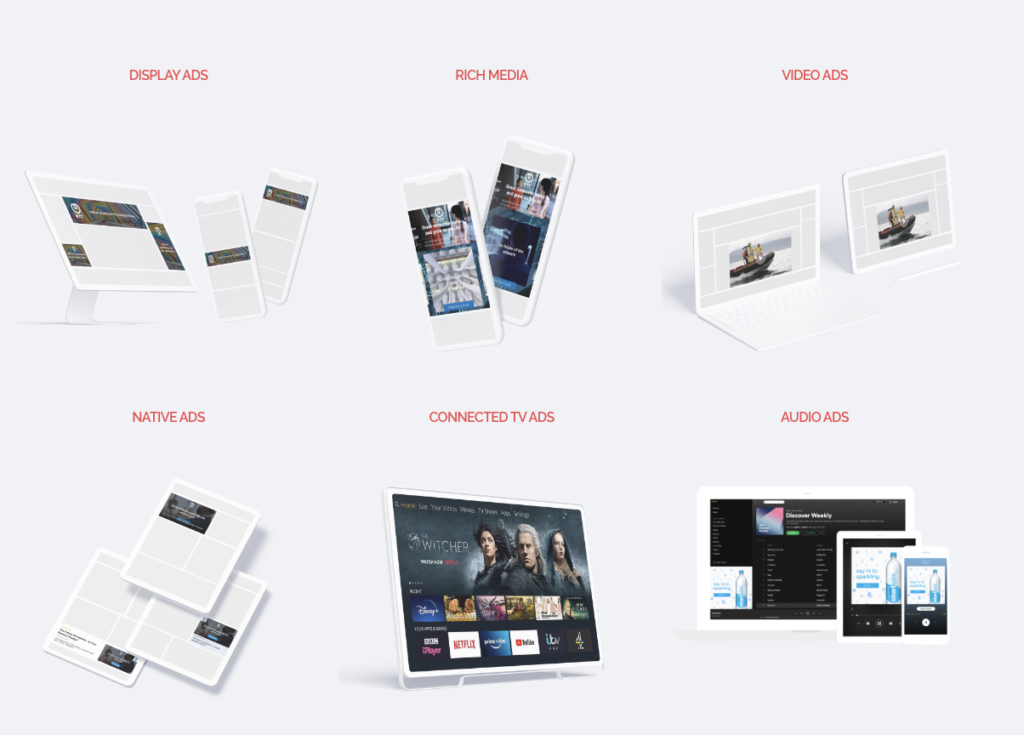
Display Formats our Agency Offers

The most common type of digital advertising that can be used to drive awareness and consideration with the highest reach across internet users. They have lower CPMs and are, therefore, great for use across the marketing funnel.

Video Ads

A fantastic way to create awareness, they are predominately used in the mid to upper funnel. Video is very powerful and can be used to tell a story (in 30 seconds or less) that engages viewers in an interactive way. We are experts in buying both instream and outstream and even offer video ads on a cost-per-completed view (CPCV).

Dynamic Display Ads

A great way to drive conversions as they are personalised for each user. They can be used as a retargeting tool or to increase brand awareness and consideration.

Native Ads

As the name suggests, these ads look very similar to the content that surrounds them on the publisher’s website, which can help to create a less intrusive experience.

Interactive Ads

Using specialist ad-serving technology to create ads that are highly engaging where users can fill out forms, play games and more, all inside the walls of a banner ad.

Audio Ads

A new, emerging ad format that enables brands to reach consumers through audio channels. Programmatic audio ads are generally non-clickable and are, thus, mostly a branding tool. They run across mobile apps such as Spotify, Deezer and Acast.

Connected TV Ads

The future of TV is here with the use of connected TV devices such as AppleTV, Amazon Firestick and Roku. CTV ads can be served across connected TV ads. 

Free Paid Media Review

We are a world-class programmatic marketing agency that can generate more sales and leads for you. Leave your email address, we will contact you for your free paid media review.

Market & Structure Tool

Advant Technology — LinkedIn Ads for Enterprise Technology

Which markets change your campaign, and how

A working companion to the multi-market playbook. Explore what actually differs between the UK, US, DACH and APAC — or answer four questions to see whether your account list needs one campaign structure or several.

United Kingdom

UK
Message-based formats
Available

Outside the EU/EEA/Switzerland exclusion since Brexit, so Conversation Ads (successor to Message Ads) are not caught by the EU restriction that applies to Germany.

Governing regime

UK GDPR. Standard UK GDPR employee-data handling applies; no equivalent to Germany's works-council co-determination layer.

Decision culture

Closer to US pace. Single decision-maker with committee sign-off is common; buying-group validation is typically faster than DACH.

Localization

English-native. No localisation tax on creative or landing pages for UK-only targeting.

United States

US
Message-based formats
Available

Conversation Ads run without the EU/EEA/Switzerland restriction.

Governing regime

CCPA / CPRA. California's B2B and employee-data exemptions expired 1 Jan 2023 (AB 25 / AB 1355 / AB 1281 not renewed). Business-contact data in ABM lists touching California residents is now in scope.

Decision culture

Fast-moving, champion-led. Often an internal champion drives the process with executive sign-off, rather than slower group consensus.

Localization

English-native. Tone and proof points differ from UK (ROI framing, case-study style) but no language barrier.

Germany-led DACH

DACH
Message-based formats
Unavailable in EU/EEA/CH

Following a Nov 2021 CJEU ruling that native inbox advertising needs direct-marketing consent under the ePrivacy framework, LinkedIn stopped EU-targeted Message/Conversation Ads (new campaigns blocked 15 Dec 2021, existing ones suspended 10 Jan 2022).

Governing regime

GDPR + BDSG. Germany's Federal Data Protection Act adds works-council (Betriebsrat) co-determination rights over some employee-data processing. A works agreement cannot itself legitimate otherwise-inadmissible processing (German court ruling reported Jan 2025).

Decision culture

Consensus-driven. Formal sign-off and longer internal validation typically precede commercial conversations — plan reporting windows accordingly.

Localization

German materially outperforms English. True below enterprise-only accounts; enterprise buying groups are more English-tolerant, but mid-market is not.

Singapore-led APAC

APAC
Message-based formats
Confirm in Campaign Manager

Singapore sits outside the EU/EEA/Switzerland exclusion, so formats are presumed available — but coverage isn't centrally documented by geography, so verify before planning.

Governing regime

PDPA (Singapore). A distinct consent-and-purpose-limitation regime, not equivalent to GDPR. Treat as its own compliance track, not a GDPR analogue.

Decision culture

Not representative of wider APAC. Singapore is English-language and Western-business-norm-adjacent; this does not extend to Japan, Korea or Greater China buying culture.

Localization

English viable — for Singapore only. Do not treat English-only creative as a proxy for the rest of APAC if the account list extends beyond Singapore/Hong Kong hubs.

Decision-culture notes are directional, not universal — treat as a planning prior, not a rule for every account.

Is the target account list evaluated by one centralised, cross-border buying committee, or by in-market/regional committees?

Does the plan rely on message-based formats (Conversation Ads) in any EU/EEA/Switzerland market?

Does language localisation materially change conversion quality in at least one target market (e.g. DACH below enterprise, or APAC beyond Singapore/Hong Kong)?

Is your target-account list in every market comfortably above LinkedIn's practical minimum audience size (commonly cited around 300)?

Recommendation

Answer the questions above

Select one answer for each question to see the recommendation.

Recommendation

A unified structure fits your answers

Your account list is centrally decided, doesn't depend on a restricted message format, and localisation isn't a material factor — the exception case for a single, unified campaign structure.

  • None of the market-splitting triggers apply — re-check this if your account list or market mix changes.

Recommendation

Split by market: separate campaign groups, budgets and thresholds

At least one structural factor makes a shared template unreliable across your markets.

  • Regional buying committees mean each market is a separate decision unit — a shared campaign group would blend distinct audiences.
  • A message-format plan cannot run as one structure if it includes an EU/EEA/Switzerland market — Conversation Ads aren't available there, so at minimum that market needs a different format mix.
  • Where localisation changes conversion quality, a shared budget and qualification threshold will misread the localised market's real performance.
  • At least one market may sit below the practical minimum audience size — consider folding that market into a regional structure rather than giving it a standalone campaign group.
  • Check each market's target-account list against LinkedIn's minimum audience guidance before finalising how many standalone campaign groups to build.

READY TO TAKE ADVANTAGE?

Ready for advertising that really works? Take advantage of our FREE programmatic or paid social review.