
The Best Global B2B PPC Agencies
Why PPC Works for B2B
Pay-Per-Click (PPC) advertising is a powerful tool in the B2B marketing arsenal due to its ability to target potential customers with high intent. Unlike traditional advertising, PPC allows businesses to reach their audience at the moment they are actively searching for solutions, thus capturing them further down the funnel. This high intent means that leads generated through PPC are often more qualified, leading to higher conversion rates and better ROI. In the B2B landscape, where sales cycles can be long and complex, PPC’s precision targeting can significantly streamline the lead generation process.
What to Look Out For When Choosing a B2B PPC Agency
Choosing the right B2B PPC agency can significantly impact your marketing success. Here are critical factors to consider:
1. Expertise in Account-Based Marketing (ABM)
A proficient B2B PPC agency should demonstrate expertise in ABM strategies. This includes creating highly targeted campaigns aimed at specific accounts, ensuring personalized engagement that resonates with high-value prospects.
2. Demand Generation Capabilities
An effective agency should excel in demand generation, crafting campaigns that not only attract but also engage potential customers. Look for agencies with a proven track record in generating quality leads through strategic PPC efforts.
3. Comprehensive Analytics and Reporting
Data-driven decision-making is crucial. A top-tier agency will offer detailed analytics and reporting, providing insights into key metrics like click-through rates (CTR), conversion rates, and cost per click (CPC). This transparency helps in assessing campaign performance and making informed adjustments.
4. Robust Retargeting Strategies
Retargeting is essential for nurturing leads and guiding them through the sales funnel. Ensure the agency has strong retargeting tactics to keep your brand top-of-mind for prospects who have previously interacted with your content.
What a Global PPC Agency Offers vs. Local
Broader Market Reach
Global PPC agencies have the resources and expertise to manage campaigns across multiple regions and languages, ensuring your brand reaches a diverse and international audience. They can execute omnichannel marketing strategies that resonate with different market segments, increasing your global footprint.
Advanced Market Segmentation
Global agencies possess sophisticated tools for market segmentation, allowing for more precise targeting and personalized campaigns. This capability ensures that your ads reach the right audience, improving lead quality and conversion rates..
Expertise in Diverse Markets
Global PPC agencies bring a wealth of experience from various industries and regions, providing insights that local agencies might lack. This diversity in expertise can lead to innovative strategies that drive higher engagement and customer retention.
Scalable Campaigns
Global agencies are equipped to scale campaigns efficiently, adapting to your business growth and expanding your reach without compromising on performance. This scalability is crucial for businesses aiming to enter new markets and grow their customer base.
Enhanced Brand Awareness
With extensive resources and a wide-reaching network, global PPC agencies can significantly enhance brand awareness on a larger scale. They can execute high-impact campaigns that increase visibility and establish your brand as a leader in the B2B space.
Comprehensive Analytics
Access to advanced analytics and reporting tools allows global agencies to provide deep insights into campaign performance. They can track metrics such as lifetime value (LTV), cost per acquisition (CPA), and return on investment (ROI), enabling continuous optimization and better decision-making.
The Agencies
Single Grain
Pros:
- Expertise in Digital Marketing: Single Grain has a strong reputation for its comprehensive digital marketing services, including PPC, SEO, and content marketing.
- High-Profile Clients: The agency has worked with well-known brands, providing credibility and proven success in managing large-scale campaigns.
- Educational Resources: Single Grain offers a wealth of educational content through blogs, podcasts, and webinars, which can be beneficial for client knowledge and transparency.
Cons:
- Premium Pricing: Their services are on the higher end of the pricing spectrum, which might be a barrier for smaller businesses or startups.
- Broad Focus: While they offer a wide range of services, their expertise may not be as deep in B2B-specific PPC strategies compared to specialized agencies.
KlientBoost
Pros:
- Conversion Rate Optimization (CRO): KlientBoost is known for its strong emphasis on CRO, ensuring that PPC campaigns are optimized for maximum conversions.
- Transparent Reporting: The agency provides clear and detailed reports, offering clients insights into campaign performance and ROI.
- Creative Approach: KlientBoost’s creative strategies and unique ad copywriting stand out, potentially leading to higher engagement rates.
Cons:
- Limited Industry Focus: Their broad client base means they might not have as deep a focus on B2B industries compared to more specialized firms.
- Potential Scalability Issues: While effective for small to mid-sized businesses, their approach may not scale as effectively for very large enterprises with complex needs.
Advant Technology
Pros:
- Personalized Service: As a smaller agency, they provide highly personalized and tailored services to meet specific client needs.
- Innovative Strategies: Known for their innovative approach, Advant Technology uses the latest tools and strategies to maximize campaign effectiveness.
- Highly Customized: B2B solutions that are designed around the clients needs.
- Transparent Reporting: The agency provides clear and detailed reports, offering clients insights into campaign performance and ROI.
Cons:
- Agency Size: As a smaller agency they won’t have a client list as large as say a Mediacom
- Resource Limitations: As a smaller agency, they may have limitations in terms of resources and scalability for annual media budgets over $15m a year.
WebFX
Pros:
- Full-Service Digital Marketing: WebFX offers a comprehensive range of services including PPC, SEO, content marketing, and web design, providing a holistic approach to digital marketing.
- Proven Track Record: With a large portfolio of successful case studies and high client satisfaction rates, WebFX demonstrates consistent performance.
- Advanced Analytics: The agency uses sophisticated analytics and reporting tools, offering detailed insights into campaign performance and ROI.
Cons:
- Potential Overextension: Given their wide range of services, there may be concerns about the depth of expertise in specialized B2B PPC strategies.
- Higher Costs for Custom Solutions: They are more of an off the shelf solution given their size and packaged process
Mediacom
Pros:
- Global Reach: Mediacom is a part of a global network, offering extensive resources and expertise in managing international campaigns.
- Data-Driven Strategies: The agency employs advanced data analytics and consumer insights to inform their PPC strategies, ensuring high effectiveness.
Cons:
- Large Agency Challenges: Being a large agency, clients might face challenges related to personalized attention and agility in campaign adjustments.
- High Minimum Spend Requirements: Mediacom might have higher minimum spend requirements, which could be a barrier for smaller B2B companies.
- Strong Media Buying Power: As a large media agency, Mediacom has significant buying power, potentially leading to better ad placements but this doesn’t hold true in PPC.
Starcom
Pros:
- Innovative Technology Use: Starcom leverages cutting-edge technology and data analytics to optimize PPC campaigns, offering high levels of precision and efficiency.
- Integrated Marketing Solutions: The agency provides integrated marketing services, combining PPC with other channels for a cohesive strategy.
- Strong Industry Reputation: With a strong industry presence and reputation, Starcom brings credibility and proven success to its clients.
Cons:
- Potential for Less Personalization: As a large, global agency, there might be less room for highly personalized service, which some clients may find necessary.
- Complex Communication Channels: Managing communication and coordination within a large agency can sometimes be complex and slower.
- Strong Media Buying Power: As a large media agency, Mediacom has significant buying power, potentially leading to better ad placements but this doesn’t hold true in PPC.
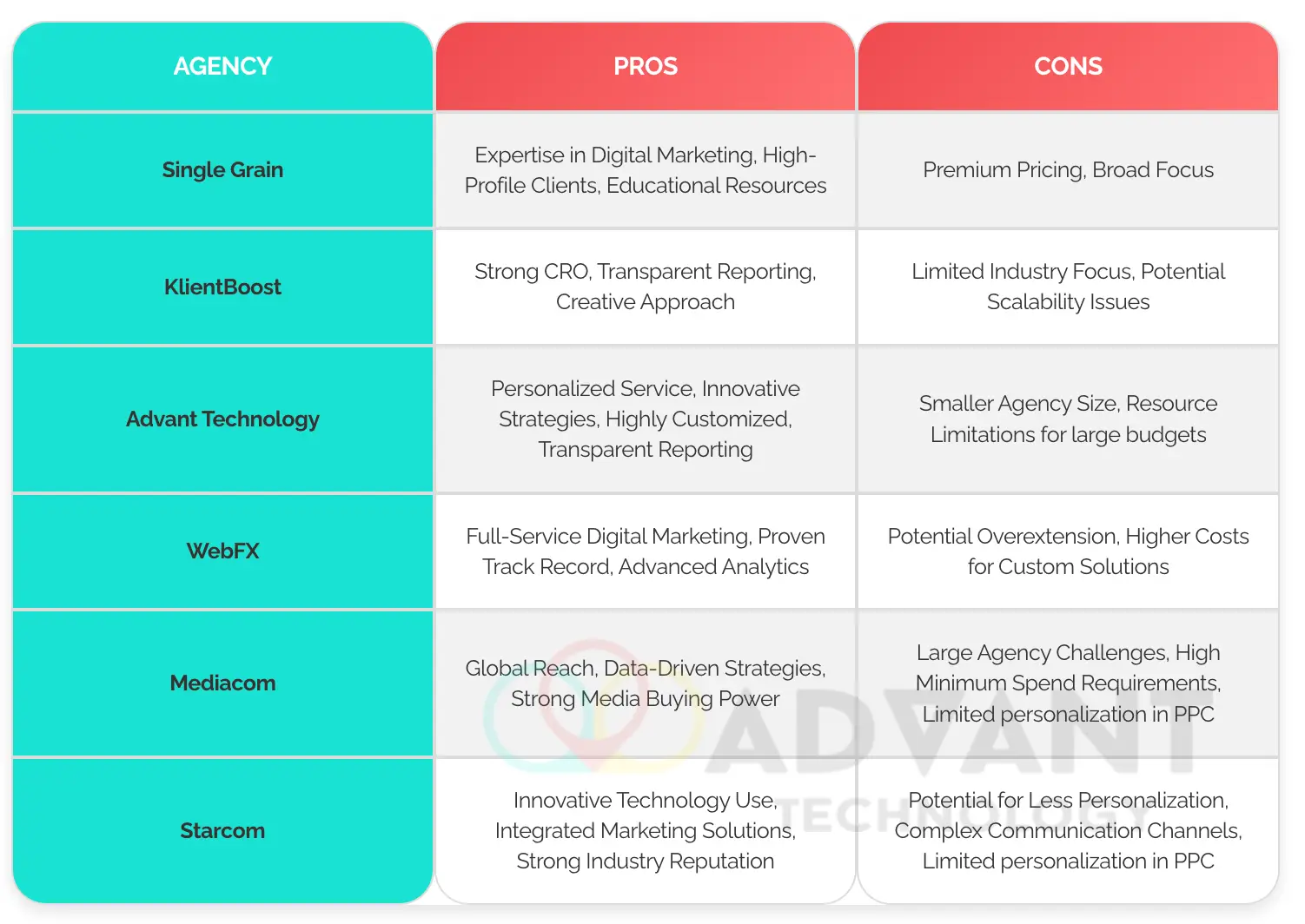
| Agency | Pros | Cons |
|---|---|---|
| Single Grain | Expertise in Digital Marketing, High-Profile Clients, Educational Resources | Premium Pricing, Broad Focus |
| KlientBoost | Strong CRO, Transparent Reporting, Creative Approach | Limited Industry Focus, Potential Scalability Issues |
| Advant Technology | Personalized Service, Innovative Strategies, Highly Customized, Transparent Reporting | Smaller Agency Size, Resource Limitations for large budgets |
| WebFX | Full-Service Digital Marketing, Proven Track Record, Advanced Analytics | Potential Overextension, Higher Costs for Custom Solutions |
| Mediacom | Global Reach, Data-Driven Strategies, Strong Media Buying Power | Large Agency Challenges, High Minimum Spend Requirements, Limited personalization in PPC |
| Starcom | Innovative Technology Use, Integrated Marketing Solutions, Strong Industry Reputation | Potential for Less Personalization, Complex Communication Channels, Limited personalization in PPC |
These tables provide a quick reference guide for understanding the benefits of PPC in B2B marketing, key considerations when selecting a PPC agency, and a comparison of top agencies with their respective advantages and drawbacks.
Conclusion
Pay-Per-Click (PPC) advertising is a crucial tool for B2B marketing, offering precision targeting and the ability to capture high-intent leads. The effectiveness of PPC in the B2B space lies in its ability to engage decision-makers at the moment they are actively seeking solutions, leading to higher conversion rates and improved ROI. When choosing a B2B PPC agency, it’s essential to consider factors such as expertise in Account-Based Marketing (ABM), demand generation capabilities, comprehensive analytics and reporting, and robust retargeting strategies.
Global PPC agencies offer advantages such as broader market reach, advanced market segmentation, expertise in diverse markets, scalability, enhanced brand awareness, and comprehensive analytics. However, local agencies may provide more personalized services and flexibility.