
Are LinkedIn Ads Expensive? IT and Tech Services Deep Dive
Share This Post

LinkedIn Ads: Whose best? Network Agency vs Independent Agency

If you’re thinking of choosing a paid media agency to run your LinkedIn ads, you have two agency options Network or Independent. We discuss some of the differences between them, so you can decide what’s best for you. 


  1. Flexibility and Agility
    • Independent Agency: Known for their agility, independent agencies can swiftly adapt to the ever-changing LinkedIn advertising landscape, implementing real-time adjustments to campaigns without bureaucratic delays.
    • Network Agency: Often slower to respond due to their larger size and corporate structure, leading to potential missed opportunities in fast-moving markets.
  2. Personalized Attention
    • Independent Agency: Clients receive more personalized service, with senior executives and experienced professionals directly managing LinkedIn ad campaigns, ensuring tailored strategies and high-quality execution.
    • Network Agency: Clients might experience less personalized service as they navigate through multiple layers of staff and standardized processes.
  3. Innovative Strategies
    • Independent Agency: More innovative and creative in their approach to LinkedIn advertising, independent agencies can experiment with new ad formats, targeting options, and engagement techniques.
    • Network Agency: Innovation may be hindered by the need to adhere to corporate guidelines and standardized procedures.
  4. Cost-Effectiveness
    • Independent Agency: Typically more cost-effective, offering competitive pricing and better ROI by focusing on efficiency and eliminating unnecessary overhead costs.
    • Network Agency: Higher fees due to extensive global operations and larger overheads, which can impact the overall budget for LinkedIn advertising.
  5. Specialization
    • Independent Agency: Often specialize in LinkedIn advertising, providing deep expertise and nuanced strategies tailored to the platform’s unique features and audience.
    • Network Agency: Offer a broad range of services but may lack the specialized focus required to fully leverage LinkedIn’s advertising capabilities.
  6. Client Relationships
    • Independent Agency: Build long-term, trust-based relationships with clients, leading to higher satisfaction and loyalty. Clients often feel like true partners in the campaign process.
    • Network Agency: Client relationships can feel more transactional due to the agency’s size and the formalized nature of interactions.
  7. Decision-Making Speed
    • Independent Agency: Faster decision-making and implementation of LinkedIn ad campaigns due to fewer bureaucratic layers and direct lines of communication.
    • Network Agency: Slower decision-making processes, as approvals often need to go through multiple levels of hierarchy.
  8. Transparency
    • Independent Agency: Greater transparency in operations, pricing, and campaign reporting, fostering trust and ensuring clients are always informed about their LinkedIn ad performance.
    • Network Agency: Transparency can be compromised by complex pricing structures and less direct communication, making it harder for clients to track progress.
  9. Cultural Fit
    • Independent Agency: Better at aligning with a client’s company culture and values, creating a cohesive and collaborative working relationship that enhances LinkedIn advertising efforts.
    • Network Agency: May struggle to align with diverse client cultures due to their standardized operating procedures and broader client base.
  10. Ownership and Accountability
  • Independent Agency: Owners and senior executives are directly involved in the business, leading to a higher level of accountability and commitment to the success of LinkedIn ad campaigns.
  • Network Agency: Ownership and accountability are diffused across a large organization, potentially diluting the commitment to individual client outcomes.

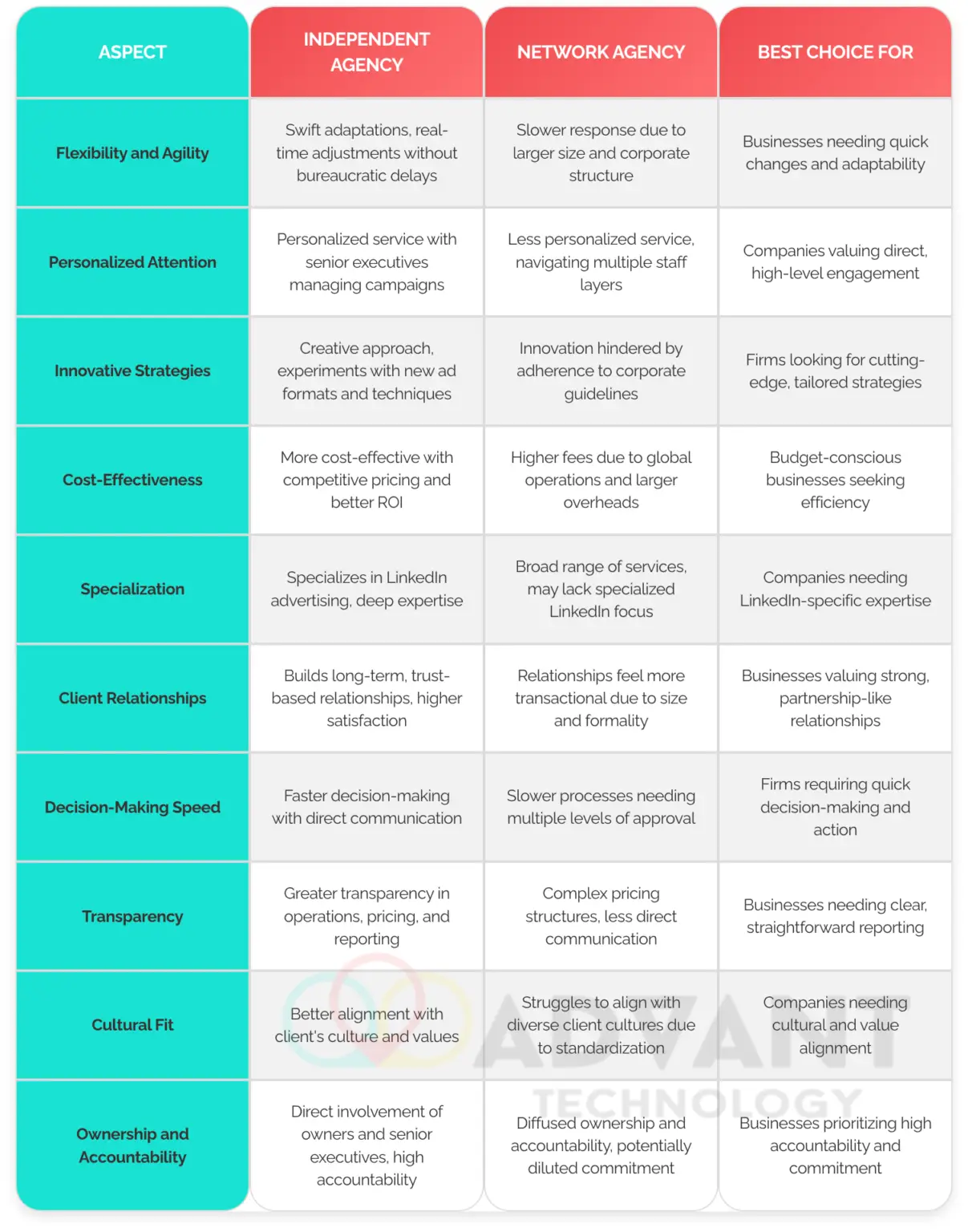
If you prefer a quick reference guide, we have that too, highlighting the key differences to help you decide what’s best for your needs.
Interactive Table Design
Aspect Independent Agency Network Agency Best Choice For
Flexibility and Agility Swift adaptations, real-time adjustments without bureaucratic delays Slower response due to larger size and corporate structure Businesses needing quick changes and adaptability
Personalized Attention Personalized service with senior executives managing campaigns Less personalized service, navigating multiple staff layers Companies valuing direct, high-level engagement
Innovative Strategies Creative approach, experiments with new ad formats and techniques Innovation hindered by adherence to corporate guidelines Firms looking for cutting-edge, tailored strategies
Cost-Effectiveness More cost-effective with competitive pricing and better ROI Higher fees due to global operations and larger overheads Budget-conscious businesses seeking efficiency
Specialization Specializes in LinkedIn advertising, deep expertise Broad range of services, may lack specialized LinkedIn focus Companies needing LinkedIn-specific expertise
Client Relationships Builds long-term, trust-based relationships, higher satisfaction Relationships feel more transactional due to size and formality Businesses valuing strong, partnership-like relationships
Decision-Making Speed Faster decision-making with direct communication Slower processes needing multiple levels of approval Firms requiring quick decision-making and action
Transparency Greater transparency in operations, pricing, and reporting Complex pricing structures, less direct communication Businesses needing clear, straightforward reporting
Cultural Fit Better alignment with client's culture and values Struggles to align with diverse client cultures due to standardization Companies needing cultural and value alignment
Ownership and Accountability Direct involvement of owners and senior executives, high accountability Diffused ownership and accountability, potentially diluted commitment Businesses prioritizing high accountability and commitment

This table offers a clear comparison of the strengths and potential drawbacks of both network and independent agencies, helping you make an informed decision on the best partner for your LinkedIn advertising campaigns.

Market & Structure Tool

Advant Technology — LinkedIn Ads for Enterprise Technology

Which markets change your campaign, and how

A working companion to the multi-market playbook. Explore what actually differs between the UK, US, DACH and APAC — or answer four questions to see whether your account list needs one campaign structure or several.

United Kingdom

UK
Message-based formats
Available

Outside the EU/EEA/Switzerland exclusion since Brexit, so Conversation Ads (successor to Message Ads) are not caught by the EU restriction that applies to Germany.

Governing regime

UK GDPR. Standard UK GDPR employee-data handling applies; no equivalent to Germany's works-council co-determination layer.

Decision culture

Closer to US pace. Single decision-maker with committee sign-off is common; buying-group validation is typically faster than DACH.

Localization

English-native. No localisation tax on creative or landing pages for UK-only targeting.

United States

US
Message-based formats
Available

Conversation Ads run without the EU/EEA/Switzerland restriction.

Governing regime

CCPA / CPRA. California's B2B and employee-data exemptions expired 1 Jan 2023 (AB 25 / AB 1355 / AB 1281 not renewed). Business-contact data in ABM lists touching California residents is now in scope.

Decision culture

Fast-moving, champion-led. Often an internal champion drives the process with executive sign-off, rather than slower group consensus.

Localization

English-native. Tone and proof points differ from UK (ROI framing, case-study style) but no language barrier.

Germany-led DACH

DACH
Message-based formats
Unavailable in EU/EEA/CH

Following a Nov 2021 CJEU ruling that native inbox advertising needs direct-marketing consent under the ePrivacy framework, LinkedIn stopped EU-targeted Message/Conversation Ads (new campaigns blocked 15 Dec 2021, existing ones suspended 10 Jan 2022).

Governing regime

GDPR + BDSG. Germany's Federal Data Protection Act adds works-council (Betriebsrat) co-determination rights over some employee-data processing. A works agreement cannot itself legitimate otherwise-inadmissible processing (German court ruling reported Jan 2025).

Decision culture

Consensus-driven. Formal sign-off and longer internal validation typically precede commercial conversations — plan reporting windows accordingly.

Localization

German materially outperforms English. True below enterprise-only accounts; enterprise buying groups are more English-tolerant, but mid-market is not.

Singapore-led APAC

APAC
Message-based formats
Confirm in Campaign Manager

Singapore sits outside the EU/EEA/Switzerland exclusion, so formats are presumed available — but coverage isn't centrally documented by geography, so verify before planning.

Governing regime

PDPA (Singapore). A distinct consent-and-purpose-limitation regime, not equivalent to GDPR. Treat as its own compliance track, not a GDPR analogue.

Decision culture

Not representative of wider APAC. Singapore is English-language and Western-business-norm-adjacent; this does not extend to Japan, Korea or Greater China buying culture.

Localization

English viable — for Singapore only. Do not treat English-only creative as a proxy for the rest of APAC if the account list extends beyond Singapore/Hong Kong hubs.

Decision-culture notes are directional, not universal — treat as a planning prior, not a rule for every account.

Is the target account list evaluated by one centralised, cross-border buying committee, or by in-market/regional committees?

Does the plan rely on message-based formats (Conversation Ads) in any EU/EEA/Switzerland market?

Does language localisation materially change conversion quality in at least one target market (e.g. DACH below enterprise, or APAC beyond Singapore/Hong Kong)?

Is your target-account list in every market comfortably above LinkedIn's practical minimum audience size (commonly cited around 300)?

Recommendation

Answer the questions above

Select one answer for each question to see the recommendation.

Recommendation

A unified structure fits your answers

Your account list is centrally decided, doesn't depend on a restricted message format, and localisation isn't a material factor — the exception case for a single, unified campaign structure.

  • None of the market-splitting triggers apply — re-check this if your account list or market mix changes.

Recommendation

Split by market: separate campaign groups, budgets and thresholds

At least one structural factor makes a shared template unreliable across your markets.

  • Regional buying committees mean each market is a separate decision unit — a shared campaign group would blend distinct audiences.
  • A message-format plan cannot run as one structure if it includes an EU/EEA/Switzerland market — Conversation Ads aren't available there, so at minimum that market needs a different format mix.
  • Where localisation changes conversion quality, a shared budget and qualification threshold will misread the localised market's real performance.
  • At least one market may sit below the practical minimum audience size — consider folding that market into a regional structure rather than giving it a standalone campaign group.
  • Check each market's target-account list against LinkedIn's minimum audience guidance before finalising how many standalone campaign groups to build.

READY TO TAKE ADVANTAGE?

Ready for advertising that really works? Take advantage of our FREE programmatic or paid social review.