Categories
Blog

Could Open AI introduce paid ads?

Could Open AI introduce paid ads?

Yes, OpenAI could potentially introduce paid ads, but there are several factors to consider given its status as a nonprofit organization. Here’s an analysis of how this might unfold:

1. Mission and Ethical Considerations

Alignment with Mission:

  • Nonprofit Goals: OpenAI’s mission is to ensure that artificial general intelligence (AGI) benefits all of humanity. Introducing paid ads would need to align with this mission and not compromise the integrity of their work.
  • Ethical Advertising: Any advertising would need to adhere to strict ethical guidelines to avoid misleading or manipulative practices.

2. Revenue Generation

Diversified Funding:

  • Sustainable Funding: Introducing ads could provide a steady revenue stream to support ongoing research and development without relying solely on donations and grants.
  • Investment in AI Safety: Additional funds could be directed towards ensuring AI safety and advancing beneficial AI applications.

3. User Experience Impact

Balancing Ads and Utility:

  • Ad Placement: Ads would need to be integrated in a way that does not detract from the user experience. This might involve non-intrusive ad formats or contextually relevant ads.
  • Quality Control: Ensuring high-quality, relevant ads that add value to the user experience rather than disrupt it.

4. Transparency and Trust

Maintaining Transparency:

  • Clear Disclosure: Transparent policies about the presence of ads and how ad revenue is used would be crucial in maintaining user trust.
  • User Control: Providing users with control over ad preferences and ensuring privacy protections.

5. Operational and Regulatory Challenges

Compliance and Fairness:

  • Regulatory Compliance: Adhering to advertising regulations and ensuring non-discriminatory ad practices.
  • Operational Complexity: Managing the operational aspects of ad sales, placement, and analytics within a nonprofit structure.

Potential Models for Ad Integration

  1. Sponsored Content:
    • Clearly labeled sponsored posts or responses that align with user queries without compromising informational quality.
  2. Subscription-Based Model:
    • Offering an ad-free premium subscription tier while maintaining a free version supported by ads.
  3. Ethical Partnerships:
    • Partnering with organizations that share OpenAI’s values and mission, ensuring that ads are for products and services that benefit users.

Conclusion

While OpenAI, as a nonprofit, has a primary mission to advance AI for the benefit of humanity, introducing paid ads could provide valuable funding. However, it would require careful implementation to align with ethical standards, maintain user trust, and ensure that the core mission is not compromised. Transparent practices and a focus on enhancing user experience would be critical to the success of such an initiative.

Categories
Blog

3 Ways ChatGPT to Supercharge B2B PPC Advertising

3 Ways Chat GPT to Supercharge B2B PPC Advertising

AI is a great tool, it can help ideate, speed up your workflow and deliver greater efficiency. In particular, we’re fans of Chat GPT, let’s take a look at how it can be used across your B2B PPC campaigns

Streamlining Ad Copy Creation

One of the biggest ways we use Chat GPT is for creating killer ad copy. Writing compelling ads that grab attention and drive clicks is time-consuming. With Chat GPT, we can whip up engaging, relevant ad copy in no time.

Example: Let’s say we’re running a PPC campaign for a client in the SaaS industry. The client, XYZ Cloud Solutions, is launching a new project management tool. Chat GPT helps us generate multiple versions of ad text, each tailored to different buyer personas, such as project managers, IT directors, and startup founders. Here are some example prompts you can use:

Prompt: “Write an ad for project managers promoting XYZ Cloud Solutions’ project management tool. Emphasize collaboration and meeting deadlines.”

Generated Ad: “Streamline your projects with XYZ Cloud Solutions. Collaborate effortlessly and meet deadlines with ease.”

Prompt: “Create an ad for IT directors focusing on the security and scalability of XYZ Cloud Solutions’ project management tool.”

Generated Ad: “Secure and scalable project management in the cloud. XYZ Cloud Solutions ensures your data is safe and accessible.”

Prompt: “Develop an ad for startup founders highlighting the affordability and power of XYZ Cloud Solutions’ project management tool.”

Generated Ad: “Get your projects off the ground with XYZ Cloud Solutions. Affordable, powerful, and easy to use.”

By testing these different versions, we quickly identify which messages resonate best with each audience, optimizing ad performance and maximizing ROI.

Enhancing Keyword Research

Finding the right keywords is crucial for any PPC campaign. Chat GPT helps us dive deep into keyword research, uncovering not just the obvious choices but also those hidden gems that competitors might miss.

Example: For one of our clients in the cybersecurity space, we use Chat GPT to brainstorm and validate keywords. We start with basic keywords like “cybersecurity solutions” and “data protection.” Chat GPT then suggests additional long-tail keywords. Here is an example prompt you can use:

Prompt: “Generate long-tail keywords for a cybersecurity company focused on small businesses, AI-driven threat detection, and cloud security compliance.”

Generated Keywords:

  • “Prevent data breaches for small businesses”
  • “AI-driven threat detection”
  • “Cloud security compliance”

Data-Driven Insights and Reporting

Lastly, we use Chat GPT to analyze campaign data and generate insights. It can sift through heaps of data to identify trends, spot issues, and suggest improvements, making our reporting more insightful and actionable.

Example: After running a PPC campaign for a logistics client, we ran, Chat GPT to help us create detailed reports highlighting key metrics. We might discover that ads targeting “same-day delivery” perform better in urban areas, while “cost-effective shipping solutions” resonate more in rural regions.

Example Prompt: “Analyze PPC campaign data for a logistics company and provide insights on ad performance, highlighting key trends and recommendations for improvement.”

Generated Insights:

  • Trend: “Ads targeting ‘same-day delivery’ perform better in urban areas.”
  • Recommendation: “Increase budget allocation for ‘same-day delivery’ ads in urban regions.”
  • Trend: “Ads promoting ‘cost-effective shipping solutions’ resonate more in rural areas.”
  • Recommendation: “Focus on ‘cost-effective shipping solutions’ ads in rural regions to boost engagement.”

With these insights, we adjust ad targeting and messaging to improve overall campaign performance.

Need help implementing these strategies like a pro for your B2B PPC campaigns? Drop us a line.

Categories
Blog

Siri vs. AI: The Gap

Siri vs. AI: The Gap

Siri, Apple’s virtual assistant, has fallen behind AI models like ChatGTP developed by OpenAI for several reasons. Here’s a detailed analysis, clarifying that while both are AI technologies, they serve different purposes and have different development trajectories:

1. Different Objectives and Use Cases

Siri:

  • Voice Assistant Focus: Siri was primarily designed as a voice assistant to help users perform tasks on their Apple devices, such as setting reminders, sending messages, and answering simple queries.
  • Device Integration: Its primary role is to integrate with Apple’s ecosystem, providing seamless functionality across iPhones, iPads, Macs, and other Apple products.

OpenAI Models:

  • General-Purpose AI: OpenAI’s models, like GPT-3 and GPT-4, are designed to understand and generate human-like text based on extensive training data. They are used for a wide range of applications, from natural language understanding and content generation to complex problem-solving.
  • Flexibility: OpenAI’s models are more flexible and can be fine-tuned for specific applications, making them more versatile than voice assistants like Siri.

2. Development and Innovation Strategies

Apple’s Approach:

  • Privacy Focus: Apple places a strong emphasis on user privacy, which limits the amount of data Siri can use to improve its algorithms. While this is beneficial for user trust, it can hinder Siri’s ability to learn and adapt quickly.
  • Conservative Innovation: Apple tends to adopt a more conservative approach to innovation, focusing on incremental improvements and maintaining stability within its ecosystem. This means fewer groundbreaking changes compared to more experimental AI projects.

OpenAI’s Approach:

  • Open Research: OpenAI benefits from a more open research culture, allowing it to experiment with new techniques and rapidly incorporate the latest advancements in AI.
  • Large-Scale Training: OpenAI models are trained on vast amounts of data, enabling them to understand and generate text with a high degree of sophistication and versatility.

3. Technological Limitations and Scalability

Siri:

  • Limited Conversational Depth: Siri’s ability to hold extended, coherent conversations is limited compared to advanced language models. It excels at short, task-oriented interactions but struggles with more complex dialogue.
  • Algorithm Constraints: The algorithms powering Siri are less advanced in terms of natural language processing and understanding compared to models like GPT-4.

OpenAI Models:

  • Advanced NLP Capabilities: OpenAI’s models are built on state-of-the-art natural language processing techniques, enabling them to understand and generate human-like text with greater depth and accuracy.
  • Scalability: OpenAI’s infrastructure allows for scaling up the training and deployment of large models, which can handle more complex tasks and interactions.

4. Resource Allocation and Prioritization

Apple:

  • Hardware and Ecosystem Focus: Apple allocates significant resources to hardware development and integrating its devices into a seamless ecosystem. While Siri is an important part of this ecosystem, it is not the sole focus.
  • Balancing Priorities: Apple’s AI development is balanced with other priorities, such as hardware innovation, software updates, and new product development.

OpenAI:

  • Dedicated AI Focus: OpenAI is solely focused on advancing AI technology, allowing it to allocate all its resources and talent to developing cutting-edge AI models.
  • Research and Development Investment: Heavy investment in R&D enables rapid progress and experimentation, leading to more sophisticated and capable AI systems.

5. Market and User Expectations

Siri:

  • Utility Over Innovation: Siri is designed to be a practical, reliable assistant for everyday tasks. User expectations are centered around its utility within the Apple ecosystem, not necessarily groundbreaking AI capabilities.

OpenAI Models:

  • Innovative Use Cases: Users and developers turn to OpenAI for innovative applications of AI, such as generating creative content, solving complex problems, and engaging in detailed conversations. The expectations are higher for novel and sophisticated interactions.

Conclusion

Siri’s lag behind OpenAI models is due to a combination of strategic choices, technological limitations, and differing objectives. While Siri excels in providing a stable, privacy-focused voice assistant within the Apple ecosystem, OpenAI’s models are designed for broader, more flexible applications in natural language understanding and generation. As AI technology continues to evolve, both Siri and OpenAI will likely continue to develop in ways that serve their distinct user bases and objectives.

Categories
Blog B2B

The Ultimate Guide to LinkedIn Document Ads

The Ultimate Guide to LinkedIn Document Ads

What are LinkedIn Document Ads?

LinkedIn Document Ads are a powerful ad format that allows businesses to showcase documents directly in the LinkedIn feed. These ads enable users to view and download content such as whitepapers, case studies, eBooks, and presentations without leaving the platform. This format is particularly effective for sharing in-depth information and generating leads through content marketing.

Why Use LinkedIn Document Ads?

  1. Increased Engagement: Document Ads are interactive and visually appealing, making them more likely to capture users’ attention and encourage engagement.
  2. Lead Generation: By gating valuable content with a lead form, businesses can collect valuable contact information from users who are genuinely interested in their offerings.
  3. Brand Authority: Sharing high-quality, informative documents positions your brand as a thought leader in your industry.
  4. Seamless User Experience: Users can view and download documents without navigating away from LinkedIn, ensuring a smooth and uninterrupted experience.

How do Document Ads Look?

LinkedIn Document Ads appear as Sponsored Content in the LinkedIn feed, seamlessly integrating with the user’s browsing experience. They typically feature:

  • Thumbnail Image: An eye-catching preview image of the document, enticing users to click and explore further.
  • Headline and Description: A concise, engaging headline accompanied by a brief description that highlights the value of the document.
  • Call-to-Action (CTA): A clear and compelling CTA button, such as “Download,” “Read Now,” or “Learn More,” prompting users to engage with the content.
  • Interactive Document Viewer: This is the key element of document ads. Upon clicking, users can view and scroll through the document directly within LinkedIn, offering a seamless, immersive experience without needing to leave the platform.

Why They Are Engaging:

  1. Interactive Experience: Users can interact with the document directly within their feed, offering a hands-on experience that is more engaging than static content.
  2. Value-Driven Content: These ads often provide valuable resources such as whitepapers, eBooks, case studies, or industry reports, which are highly appealing to professionals looking to gain insights or solve problems.
  3. Seamless Integration: The ads blend naturally into the LinkedIn feed, making them feel less intrusive and more like a part of the user’s content consumption journey.
  4. Visual Appeal: The use of compelling visuals and a professional layout makes the ads visually appealing, drawing users’ attention as they scroll through their feed.

By combining targeted reach, interactive elements, and valuable content, LinkedIn Document Ads effectively capture the attention of professional audiences, driving higher engagement and conversions.

How Valuable are Document Ads with Lead Gen Forms?

When paired with a lead gen form, LinkedIn Document Ads not only captivate users, but also streamline the lead capture process, driving better results for your marketing efforts. There are a few key reasons for this:

Streamlined Lead Capture:

Adding a lead gen form to a LinkedIn Document Ad provides a seamless and efficient way to capture valuable contact information from interested users. By integrating the form directly within the ad experience, you eliminate the need for users to navigate away to a separate landing page, reducing friction and increasing the likelihood of form completion.

Enhanced User Experience:

The convenience of a lead gen form enhances the user experience by allowing users to quickly and easily provide their information without interrupting their browsing flow. This user-friendly approach results in higher conversion rates, as users are more likely to engage with a simplified process.

Higher Quality Leads:

Lead gen forms can be tailored to request specific information relevant to your business needs, such as job titles, company sizes, or industry sectors. This targeted approach ensures that the leads you capture are highly qualified and more likely to convert into valuable opportunities for your business.

Immediate Access to Content:

By filling out the lead gen form, users can gain instant access to the document, providing immediate value. This immediate gratification encourages users to complete the form, knowing they will receive valuable content in return.

Data Integration and Follow-Up:

Lead gen forms can be seamlessly integrated with your Customer Relationship Management (CRM) system or marketing automation tools. This integration enables efficient data collection, ensuring that leads are automatically fed into your sales funnel for timely follow-up and nurturing. It also allows for better tracking and analysis of lead sources and campaign performance.

Increased Engagement and ROI:

The combination of engaging document content and an integrated lead gen form maximizes user interaction and lead capture efficiency. This approach not only increases the engagement rates of your Document Ads but also enhances the overall return on investment (ROI) by converting engaged users into actionable leads.

Customizable and Compliant:

LinkedIn’s lead gen forms are customizable, allowing you to tailor the questions to match your specific campaign goals. Additionally, LinkedIn ensures that the data collection process complies with privacy regulations, providing peace of mind for both you and your leads.

By adding a lead gen form to your LinkedIn Document Ads, you create a powerful tool for capturing high-quality leads efficiently and effectively, while also providing a seamless and valuable experience for your target audience.

Setting Up LinkedIn Document Ads

1. Define Your Objective

Before creating a Document Ad, it’s essential to define your campaign objective. Are you looking to generate leads, increase brand awareness, or drive traffic to your website? LinkedIn offers different campaign objectives such as Lead Generation, Brand Awareness, and Website Visits.

2. Prepare Your Document

Ensure your document is high-quality, informative, and relevant to your target audience. Accepted file formats include PDF, DOC, DOCX, PPT, and PPTX. The maximum file size is 100MB.

3. Create a Campaign

  • Step 1: Go to the LinkedIn Campaign Manager.
  • Step 2: Click on “Create Campaign” and select your campaign objective.
  • Step 3: Choose “Sponsored Content” as your ad format and then select “Document Ad.”

4. Set Up Your Ad

  • Upload Your Document: Select the document you want to upload. LinkedIn will generate a preview of your document for users to browse through.
  • Craft Your Ad Copy: Write a compelling headline and description to entice users to view and download your document.
  • Add a Call to Action (CTA): Choose a CTA that aligns with your campaign objective, such as “Download,” “Learn More,” or “Get the Guide.”

5. Define Your Target Audience

  • Use LinkedIn’s robust targeting options to reach your desired audience. You can target based on location, job title, industry, company size, and more.
  • Utilize matched audiences to retarget website visitors, upload contact lists, or target LinkedIn Group members.

6. Set Your Budget and Schedule

  • Define your budget and schedule for the campaign. LinkedIn allows you to set a daily or total budget and choose between CPC (cost-per-click) or CPM (cost-per-thousand-impressions) bidding strategies.

7. Launch Your Campaign

  • Review your campaign settings and launch your Document Ad. Monitor its performance through LinkedIn’s Campaign Manager to make necessary adjustments and optimizations.

Best Practices for LinkedIn Document Ads

  1. Offer Valuable Content: Ensure your document provides valuable insights and actionable information that addresses your audience’s pain points.
  2. Use Compelling Visuals: Incorporate high-quality visuals and a professional design to make your document more engaging.
  3. Optimize for Mobile: Make sure your document is easily readable on mobile devices, as many LinkedIn users access the platform via their smartphones.
  4. Test Different Ad Variations: Experiment with different headlines, descriptions, and CTAs to see what resonates best with your audience.
  5. Monitor and Optimize: Regularly check your campaign performance and adjust targeting, budget, and ad copy to optimize results.

Measuring Success

To evaluate the success of your LinkedIn Document Ads, consider the following metrics:

  • Engagement Rate: Measure how many users interacted with your ad.
  • Download Rate: Track the number of users who downloaded your document.
  • Lead Quality: Assess the quality of leads generated from your document ad by examining the collected contact information.
  • Conversion Rate: Monitor how many leads converted into customers or took the desired action after downloading the document.

What are the typical costs associated with Document Ads? 

The cost of running Document Ads on LinkedIn can vary based on factors like industry, audience targeting, ad relevance, competition, and the chosen bidding strategy. However, it’s important to note that LinkedIn Document Ads are particularly cost effective for awareness campaigns due to their higher engagement rates which can be as high as 10% when effectively executed. The costs of Document ads can vary drastically, here’s a breakdown of typical costs:

  1. Cost Per Click (CPC):
    • You can expect CPC to range anywhere from $7 to $150. However, the increased engagement rates with Document Ads often justify the higher costs, making them a great format for driving awareness.
  2. Cost Per Thousand Impressions (CPM):
    • If you’re using a CPM model, the cost usually ranges from $20 to $200 per 1,000 impressions. The engaging nature of Document Ads helps maximize the impact of these impressions, leading to better brand awareness.
  3. Cost Per Lead (CPL):
    • For lead generation, CPL can vary significantly from $30 to $200, depending on the quality and specificity of the leads. The higher engagement rates of Document Ads often result in better lead quality, which can justify the higher CPL.

What are the expected CTRs for LinkedIn Document ads?

Click-Through Rates (CTRs) for LinkedIn Document Ads can vary based on several factors, including industry and targeting precision. Document Ads tend to drive higher engagement, rather than clicks, as the document is available to view without having to leave the LinkedIn platform. This means the content is being viewed, but it generally needs a strong CTA (Call To Action) in order to drive clicks. You can expect to see a CTR of anywhere between 0.1% & 1%

How do Linkedin Ads differ from other ad formats?

LinkedIn Document Ads differ from other LinkedIn ad formats by allowing advertisers to directly showcase and share downloadable documents, such as whitepapers, eBooks, and case studies, within the LinkedIn feed. Unlike traditional Sponsored Content or Text Ads that focus on driving traffic to external landing pages, Document Ads provide a seamless experience where users can view and download valuable content without leaving the platform. This format is particularly effective for content marketing and lead generation, as it integrates lead forms directly within the ad, enabling businesses to capture contact information in exchange for high-value resources.


Conclusion


LinkedIn Document Ads offer a powerful way to share valuable content and generate quality leads for your B2B marketing efforts. However, setting up and managing these campaigns effectively can be time-consuming and complex. If all this sounds overwhelming and you want a dedicated LinkedIn agency to help you drive results for your B2B campaigns, reach out to us at Advant Technology.

At Advant Technology, we specialize in creating and managing LinkedIn advertising campaigns that deliver measurable results. Our team of experts has the experience and know-how to craft compelling Document Ads that capture attention and drive engagement. We offer tailored strategies, innovative solutions, and personalized service to ensure your campaigns succeed.

Don’t let the intricacies of LinkedIn advertising hold you back. Partner with Advant Technology and let us help you achieve your marketing goals. Contact us today to learn more about how we can elevate your LinkedIn advertising to the next level.

Categories
Blog

Google vs. ChatGPT: The Future of Search

Our Prediction: A Perfect Synergy Will Revolutionize Information Access

The question of whether Google Search still has a place in the era of advanced AI like ChatGPT is interesting and multifaceted. Let’s take a look:

1. Different Purposes and Strengths

Google Search is primarily designed for finding and indexing vast amounts of information on the web. It excels in:

  • Comprehensive Searching: Finding specific information, websites, articles, or data across the internet.
  • Up-to-Date Information: Providing the most recent information and news.
  • Source Verification: Offering multiple sources for users to cross-reference and verify information.
  • Search Algorithms: Using advanced algorithms to rank and display the most relevant search results.

ChatGPT, on the other hand, is an AI language model designed to generate human-like text based on the data it has been trained on. It excels in:

  • Natural Language Understanding and Generation: Holding conversations, answering questions, and providing explanations in a human-like manner.
  • Personalized Assistance: Offering tailored responses and advice.
  • Contextual Understanding: Maintaining context over a conversation for more coherent interactions.

2. Complementary Uses

  • Research and Fact-Checking: Users might start with Google Search to find sources and then use ChatGPT to understand or summarize complex information.
  • Interactive Learning: ChatGPT can provide explanations and engage in dialogue to enhance understanding, which complements static search results.
  • Content Creation: ChatGPT can help generate ideas, drafts, or refine content, which is different from searching for existing content.

3. Limitations and Challenges

Google Search:

  • Information Overload: Can return an overwhelming amount of information, requiring users to sift through results.
  • Quality of Sources: Not all search results are credible or high-quality.

ChatGPT:

  • Knowledge Cutoff: Limited to the data it has been trained on and may not have the latest information.
  • Accuracy: While it can generate plausible-sounding answers, they are not always accurate.
  • Dependence on Training Data: Its responses are based on patterns in the data it has seen, which can lead to inaccuracies or biases.

4. Evolution and Integration

The future likely holds more integration between search engines and AI models. For instance:

  • Enhanced Search Experiences: Search engines could integrate AI to provide more conversational interfaces.
  • Hybrid Models: Combining the strengths of both search engines and AI to offer a seamless user experience where users can search and get conversational responses in one place.

Conclusion

Google Search and AI models like ChatGPT serve different but complementary roles. While AI provides more interactive and personalized experiences, search engines remain indispensable for comprehensive, up-to-date, and source-verified information retrieval. The synergy between these technologies can lead to more powerful tools that enhance how we find and interact with information.

Categories
Blog

B2B vs B2C Paid Search

Introduction

Navigating the landscape of Pay-Per-Click (PPC) advertising requires a nuanced understanding of the distinct strategies needed for B2B (Business-to-Business) and B2C (Business-to-Consumer) markets. While both aim to drive traffic and conversions, the paths they take are notably different, reflecting the unique behaviors and decision-making processes of their target audiences. In this guide, we’ll delve into the critical differences between B2B and B2C paid search, offering insights that can help you tailor your campaigns to effectively reach and engage your desired audience.

How to Use This Table

When planning your PPC (Pay-Per-Click) advertising campaigns, understanding the distinct differences between B2B and B2C strategies is essential for success. This table comparing B2B and B2C paid search aspects serves as a quick reference to help you tailor your approach to the specific needs of your target audience. Here’s how to make the most of this comparison:

Strategic Decision-Making:

The table provides a clear snapshot of the key differences between B2B and B2C paid search strategies. Use this information to quickly assess which approach aligns better with your campaign objectives and allocate your budget accordingly.

Audience Targeting:

Understanding your target audience is crucial for any PPC campaign. The table highlights how B2B campaigns focus on businesses, professionals, and decision-makers, while B2C campaigns target individual consumers. This helps you determine which strategy fits your target market best.

Optimizing Resources:

Different campaigns require different levels of investment and expertise. The table shows the typical budget allocations and resource needs for B2B and B2C campaigns, helping you plan and optimize your resources effectively.

Goal Alignment:

Your marketing goals will influence your PPC strategy. Whether you aim for lead generation, direct sales, or brand awareness, the table indicates which type of campaign is more suitable for each goal, ensuring your efforts are aligned with your objectives.

Performance Metrics:

Tracking the right performance metrics is vital for evaluating campaign success. The table lists key metrics for both B2B and B2C campaigns, such as cost per lead (CPL) for B2B and click-through rate (CTR) for B2C. This helps you set clear benchmarks and measure the effectiveness of your campaigns.

Comprehensive Overview:

Having all this information in one place provides a complete overview at a glance. This is particularly useful during the initial planning stages, allowing you to compare options quickly and make informed decisions.

Resource Allocation:

The table gives you insights into the cost implications and potential returns for B2B and B2C campaigns. This helps you allocate your budget more effectively and ensure that you are investing in the strategies that will deliver the best results for your business.

Identifying Opportunities:

By comparing B2B and B2C strategies, the table may reveal new opportunities for your campaigns. For instance, you might find that incorporating certain B2B tactics into your B2C strategy, or vice versa, could enhance your overall approach.

Interactive Table Design
Aspect B2B Paid Search B2C Paid Search
Target Audience Businesses, professionals, decision-makers Individual consumers
Sales Cycle Longer, more complex Shorter, more straightforward
Decision-Making Process Multiple stakeholders involved Single or few individuals
Ad Copy Technical, industry-specific, benefit-driven Emotion-driven, focusing on immediate benefits
Keywords Niche, industry-specific, long-tail keywords Broad, general keywords, short-tail keywords
Budget Allocation Higher per lead cost, smaller audience targeting Lower per lead cost, broader audience targeting
Conversion Goals Lead generation, form submissions, whitepaper downloads Direct sales, online purchases, app downloads
Ad Platforms Google Ads/Bing/Quora Google Ads/Bing/Pinterest/Quora
Ad Extensions Call extensions, sitelinks, lead form extensions Price extensions, promotion extensions, sitelinks
Content Strategy In-depth content, case studies, whitepapers Promotional content, discounts, reviews
Retargeting Strategy Account-based marketing, CRM retargeting Dynamic retargeting, cart abandonment campaigns
Performance Metrics Cost per lead, lead quality, ROI Click-through rate (CTR), conversion rate, ROAS
Ad Scheduling Business hours targeting 24/7 targeting, peak shopping hours
Landing Pages Detailed information, contact forms, demo requests Simple, persuasive, clear calls-to-action
Remarketing Focus on nurturing leads through educational content Focus on bringing back lost customers with offers
Customer Journey Multiple touchpoints, high involvement Fewer touchpoints, lower involvement

This table highlights the primary differences between B2B and B2C paid search strategies, helping you understand how each approach should be tailored to meet the specific needs and behaviors of their respective target audiences.

Answer: B2B paid search generally has a higher cost per lead due to targeting a smaller, more specific audience, but this often results in higher value leads. B2C paid search usually involves lower cost per lead with broader audience targeting, aiming for high volume and quicker conversions.

Answer: The decision-making process in B2B paid search is more complex because it typically involves multiple stakeholders, each with their own set of criteria and approval processes. This contrasts with B2C, where the decision-making process usually involves a single individual or a small group, making it faster and less complicated.

What is the main difference between B2B and B2C PPC advertising?

Answer: The main difference lies in the target audience and the complexity of the sales cycle. B2B PPC targets businesses and professionals with longer, more complex sales cycles involving multiple stakeholders. In contrast, B2C PPC targets individual consumers with shorter, more straightforward sales cycles.

How should ad copy differ between B2B and B2C campaigns?

Answer: B2B ad copy should be technical, industry-specific, and benefit-driven, focusing on the needs and pain points of businesses. B2C ad copy should be emotion-driven, highlighting immediate benefits and appealing to consumer desires and preferences.

How do retargeting strategies differ between B2B and B2C PPC?

Answer: B2B retargeting focuses on account-based marketing and CRM retargeting, nurturing leads through educational content. B2C retargeting emphasizes dynamic retargeting and cart abandonment campaigns, aiming to bring back lost customers with offers and incentives.

Categories
Blog

CPC vs CPM Advertising on LinkedIn. Which is right for me? – 2024

CPC vs CPM Advertising on LinkedIn. Which is right for me?

When launching a LinkedIn advertising campaign, one of the crucial decisions you’ll face is choosing between Cost Per Click (CPC) and Cost Per Mille (CPM) bidding strategies. Both methods have their merits, but selecting the right one depends heavily on your specific campaign goals, budget constraints, and industry context. In this article, we’ll explore these two popular advertising models and provide a real-world example from our experience with a global ICT company to illustrate how to make this choice effectively.

Understanding CPC and CPM

CPC Advertising is where you pay for each click on your ads. This model is ideal if your goal is to drive specific actions, such as traffic to a landing page, generating leads, or completing sales. It ensures that you pay only when a user shows direct interest in your offering by engaging with your ad.

CPM Advertising, on the other hand, charges for every thousand impressions your ad receives. It’s best suited for goals related to increasing brand visibility, building awareness, or fostering brand loyalty. With CPM, you’re paying for exposure, regardless of whether that exposure leads to immediate action.

Choosing the Right Strategy

To determine which bidding strategy is right for your campaign, consider the following:

Campaign Objectives:

If you’re looking to generate direct responses or actions, such as filling out a form or signing up for a webinar, CPC may be the best option. However, if your goal is to build brand recognition or advertise a product launch widely, CPM might be more appropriate.

Budget Considerations:

CPC can often be more budget-friendly for smaller or more targeted campaigns because you only pay when someone clicks on your ad. CPM might be more cost-efficient for larger budgets aimed at maximum exposure.

Industry Influence:

In highly competitive industries, CPC costs can escalate as more advertisers bid for the same audience. Alternatively, in broad markets, CPM can provide extensive exposure without the necessity for immediate engagement.

Real-World Example from Our Global ICT Client

Our agency recently managed a campaign for a global ICT company aiming to promote their new cloud storage solution. Given the competitive nature of the cloud storage market, we initially considered a CPC model to drive conversions. However, after analyzing the client’s objectives to build broad market awareness alongside generating leads, we opted for a mixed strategy.

We used CPM bidding to cast a wide net and increase visibility among a broad audience of IT professionals. This approach ensured that the campaign gained significant exposure. Simultaneously, we implemented targeted CPC ads focused on specific demographics within the audience, which were more likely to convert into leads. This dual strategy allowed us to balance cost-efficiency with targeted engagement, optimizing the campaign’s overall performance.

Conclusion

Deciding between CPC and CPM on LinkedIn doesn’t have to be a binary choice. As demonstrated with our global ICT client, a mixed approach can sometimes offer the best of both worlds, allowing for both broad awareness and targeted conversions. When planning your LinkedIn advertising strategy, carefully consider your primary objectives, budget limitations, and the competitive landscape of your industry to choose the most effective bidding strategy. With the right approach, you can maximize both your visibility and your return on investment.

Categories
Blog

B2B Marketing: Quora vs PPC

B2B Marketing: Quora vs PPC

Strategic B2B Campaign Planning

Picture this: You’re about to embark on a digital marketing campaign, but the landscape is vast and varied. How do you choose the most effective platform to achieve your goals? Enter our detailed comparison table, a tool designed to illuminate the distinct pathways of Quora Ads and Paid Search (Google Ads & Bing). This isn’t just about listing features; it’s about understanding the unique strengths each platform brings to your B2B marketing efforts. Dive into the nuances of how Quora’s knowledge-driven environment can foster trust and engagement, versus the expansive reach and precision targeting offered by Paid Search. This table is crafted to help you make strategic, informed decisions, ensuring your marketing efforts hit the mark with precision.

Example of PPC Ads


Example of Quora Ads

How to Use This Table for Strategic B2B Campaign Planning: Quora vs. PPC

When planning your B2B marketing campaign, having a quick reference can be incredibly useful. This table comparing Quora Ads and Paid Search (Google Ads & Bing) helps you quickly start thinking about which platform might be best for your needs. Here’s how to utilize it effectively:

Strategic Decision-Making

The table provides a clear snapshot of each platform’s strengths and features. This allows you to quickly assess where you might want to allocate your budget based on your specific campaign needs. Whether you’re aiming to leverage Quora’s knowledge-driven environment or the expansive reach of Paid Search, the table helps you make an informed choice.

Audience Targeting

Understanding the types of audiences each platform reaches is crucial. At a glance, you can see that Quora engages users seeking knowledge and answers, often B2B professionals, while Paid Search captures a broad audience pool, including businesses and consumers. This helps you decide which platform aligns better with your target market.

Optimizing Resources

By highlighting management costs and necessary expertise, the table helps you plan your resources efficiently. For example, if you need a platform that’s easier to manage with strategic content, Quora Ads might be your choice, whereas Paid Search offers automated tools for potentially lower ongoing costs.

Goal Alignment

Different marketing goals might be better served by different platforms. The table shows which platform excels in areas like brand awareness, lead generation, or sales, helping you align your goals quickly. For instance, Quora Ads are effective for establishing thought leadership, while Paid Search is versatile for various goals.

Performance Metrics

The key performance indicators (KPIs) listed for each platform allow you to quickly understand how success will be measured. This helps you set clear benchmarks and track the effectiveness of your campaigns. For example, Quora Ads might focus on engagement rate and cost per lead, while Paid Search emphasizes return on ad spend (ROAS) and cost per acquisition (CPA).

Comprehensive Overview

Having all this information in one place provides a complete overview at a glance. This is particularly useful during the initial planning stages, allowing you to compare options quickly. You can see how each platform integrates with other tools, their bid strategies, and the types of ad formats available.

Resource Allocation

The table gives you an idea of the cost implications and potential returns for each platform, helping you allocate your budget more effectively right from the start. Quora Ads might be more cost-effective for niche B2B audiences, while Paid Search offers flexible budgeting options.

Identifying Opportunities

The comparison might spark new ideas and opportunities you hadn’t considered. For instance, you might discover that Quora’s environment is ideal for building relationships through continued content engagement, or that Paid Search is particularly effective for capturing broad business search intent.

Ultimately, this table serves as a quick reference to help you begin thinking about which advertising platform is best for your marketing campaign. It simplifies the decision-making process, providing a clear and concise comparison that guides your initial strategy.


Here’s a detailed table comparing Quora Ads vs. Paid Search (Google Ads & Bing) for B2B marketing:

Interactive Table Design
Aspect Quora Ads Paid Search (Google Ads & Bing) Pros of Quora Ads Pros of Paid Search (Google Ads & Bing)
Target Audience Users seeking knowledge and answers, B2B professionals Broad reach, including businesses and consumers Engages users in a knowledge-sharing environment, relevant B2B context Large audience pool, captures broad business search intent
Ad Formats Text ads, image ads, promoted answers, lead gen forms Search ads, display ads, video ads, shopping ads, call-only ads, responsive ads Engages users with relevant content in a Q&A format, interactive Variety of formats, suitable for various B2B strategies
KPIs Click-through rate (CTR), conversion rate, cost per click (CPC), cost per lead (CPL), engagement rate Click-through rate (CTR), conversion rate, cost per click (CPC), return on ad spend (ROAS), cost per acquisition (CPA), impression share High engagement metrics, quality lead tracking Detailed metrics tracking, real-time data
Goals Brand awareness, lead generation, thought leadership Lead generation, website visits, product inquiries, brand awareness, retargeting, sales Effective for establishing thought leadership, high engagement Versatile goals, wide reach
Objectives Increase brand visibility, generate qualified leads, drive content engagement Increase website traffic, generate high-quality leads, boost brand visibility, drive sales Engages users in an educational context, builds trust Broad objectives including both direct and indirect B2B conversions
Cost Generally lower CPC, cost-effective for niche targeting Generally lower CPC, flexible budgeting options Cost-effective, especially for niche B2B audiences Lower overall cost, potential for high-volume traffic
Management Cost Requires moderate optimization, benefits from strategic content Requires regular optimization, can use automated tools, potential for lower management costs Moderate management costs, strategic content focus Efficient with automated tools, potentially lower ongoing costs
Ease of Use User-friendly interface, integrates with Quora content User-friendly interface, extensive help resources, widely adopted Easy to create and manage ads, leverages existing content Easy to get started, comprehensive support
Lead Quality Generally high, due to contextually relevant engagement Varies based on keyword and targeting strategy, can be highly qualified with proper targeting High-quality, relevant leads due to engaged audience Potential for high volume of leads with targeted strategies
Funnel - Top Promoted answers, image ads, awareness campaigns Broad keywords, display network, awareness campaigns Engages users early with educational content Effective for broad reach and initial awareness
Funnel - Mid Lead gen forms, text ads, content-focused campaigns Specific keywords, remarketing, targeted display ads Nurtures leads with relevant answers and content Engages interested prospects, nurtures leads
Funnel - Lower Conversion-focused ads, retargeting, lead gen forms Long-tail keywords, shopping ads, call-only ads Converts high-quality leads, contextually relevant Drives conversions, targets ready-to-buy customers
Platform Integration Integrates with Quora content, supports third-party analytics Integration with other Google and Bing services (Google Analytics, Tag Manager, Optimize) Seamless with Quora's Q&A environment, enhances content strategy Seamless with Google and Bing tools, widespread use, enhances marketing efficiency
Bid Strategies Manual CPC, automated bidding, target CPA Manual CPC, automated bidding, enhanced CPC, target CPA, target ROAS Flexible bidding strategies, cost-effective Flexible bid strategies that can be optimized for B2B goals
Content Strategy Promoted answers, sponsored content, relevant to user queries Search intent-driven, keyword-focused, relevant B2B solutions Engages users with high-quality, relevant content Captures active search intent, customizable to B2B keywords and queries
Lead Nurturing Builds relationships through continued content engagement Retargeting ads, nurturing campaigns through search and display ads Effective for thought leadership, sustained engagement Effective for maintaining visibility and engagement through different stages of the funnel

FAQs: Quora Ads vs Paid Search (Google Ads & Bing)

Q: Are there any industries that perform particularly well on Quora Ads? A: Industries that thrive on knowledge sharing and thought leadership, such as technology, healthcare, finance, and education, often perform well on Quora Ads due to the platform’s emphasis on providing valuable answers and insights.

Q: How can Quora Ads benefit my content marketing strategy? A: Quora Ads can enhance your content marketing strategy by allowing you to promote your answers and articles directly to users who are actively seeking information related to your industry. This can increase your brand’s visibility and establish thought leadership in your niche.

Q: How do user intent and behavior differ between Quora and Paid Search platforms? A: On Quora, users are typically seeking answers and engaging in discussions, which means they are in a learning or research phase. In contrast, users on Paid Search platforms are often actively searching for specific products, services, or information, indicating a higher intent to convert.

Q: Can Quora Ads be used for local marketing campaigns? A: While Quora Ads are generally more suited for broader audience targeting, they can be tailored for local marketing by focusing on questions and topics relevant to a specific geographic area coupled with geo targeting ads to the location you are interested in targeting. 

Q: How does the ad approval process differ between Quora and Paid Search platforms? A: Quora Ads typically go through a review process to ensure they comply with community guidelines and provide value to users. Paid Search platforms like Google Ads and Bing have their own review processes to check for compliance with advertising policies, which can be more stringent due to the larger audience reach.

Q: How important is ad copy in Quora Ads compared to Paid Search? A: Ad copy is crucial in both Quora Ads and Paid Search, but it serves slightly different purposes. On Quora, the focus is on providing informative, valuable content that resonates with users’ questions. In Paid Search, ad copy needs to be more direct and compelling to capture users’ intent-driven searches.

Q: Can Quora Ads be integrated with CRM systems for lead management? A: Yes, Quora Ads can be integrated with CRM systems to manage and nurture leads effectively. This allows businesses to track leads generated from Quora Ads and follow up with them through their existing CRM workflows.

These additional FAQs provide deeper insights into aspects of Quora Ads and Paid Search that aren’t directly covered in the comparison table, helping marketers understand the broader context and potential applications of each platform.

Categories
Blog

Top Programmatic Agencies in the World

Top Programmatic Agencies in the World

Programmatic advertising has become a cornerstone of digital marketing. It leverages data and technology to automate the buying of ads and target the most relevant audience segments. Here’s a look at some of the top programmatic agencies globally, each offering unique capabilities and services.

WPP

As one of the largest advertising and marketing services conglomerates worldwide, WPP stands out with its vast network of agencies, including GroupM and Xaxis. WPP harnesses cutting-edge technology and vast datasets to provide tailored programmatic solutions, ensuring optimal reach and efficiency for advertisers. With a minimum monthly budget requirement of approximately $50,000, WPP caters to large-scale advertisers seeking a global outreach.

Omnicom Media Group (OMG)

Operating under the Omnicom Group umbrella, Omnicom Media Group is renowned for its extensive global presence and strategic media capabilities. Through its agencies like OMD and PHD, OMG offers sophisticated programmatic advertising services, focusing on efficiency and effectiveness. OMG’s approach integrates deep market insights with advanced analytics, helping brands to engage their target audiences thoughtfully and dynamically. The agency is ideal for businesses with a monthly programmatic budget starting at $50,000.

Publicis Media

Publicis Media, a key player in the Publicis Groupe ecosystem, offers comprehensive programmatic solutions via its agencies Starcom, Zenith, and Digitas. Known for its strategic prowess and innovative use of technology, Publicis Media excels in delivering highly targeted advertising campaigns that are both creative and impactful. With services tailored to large enterprises, Publicis requires a minimum budget of $50,000 per month, ensuring a suite of premium services and global reach.

Advant Technology Ltd

Based in the UK, Advant Technology Ltd distinguishes itself as a leader in data-driven programmatic advertising. Founded in 2014, the agency specializes in B2B marketing and harnesses proprietary data analytics to offer personalized ad solutions. With a focus on transparency and performance, Advant provides unique services such as real-time bidding and audience segmentation, making it an excellent choice for businesses looking to maximize their advertising ROI. The agency is well-suited for medium to large-sized companies, with a suggested minimum budget of $10,000 per month. Advant Technology Ltd is dedicated to providing innovative and effective programmatic solutions tailored to each client’s specific needs and goals, ensuring optimal outcomes and strategic growth.

IPG Mediabrands

IPG Mediabrands is a powerhouse in media and marketing solutions, operating under the Interpublic Group. The agency leverages its global network to deliver sophisticated programmatic advertising through its agencies, such as UM and Initiative. Known for its strategic integration of technology and media, IPG Mediabrands offers comprehensive services that enhance audience engagement and campaign performance. With a minimum budget requirement of $50,000 per month, it targets large-scale enterprises seeking extensive market reach and innovative advertising solutions.

Dentsu Group

Originally a Japanese advertising and public relations powerhouse, Dentsu has expanded its reach globally, mainly through its Dentsu Aegis Network. It provides a full suite of programmatic advertising services through agencies such as Carat and iProspect. Dentsu is revered for its precision in digital strategy and its ability to leverage global data insights to drive successful campaigns. Catering primarily to major brands with significant advertising needs, Dentsu requires a minimum monthly budget of $50,000, positioning itself as a top choice for international campaigns.

The Trade Desk

While primarily recognized as a demand-side platform (DSP), The Trade Desk also excels as an independent programmatic advertising agency. It offers a broad range of services that go beyond traditional DSP functions, including advanced targeting and real-time analytics. The Trade Desk is ideal for advertisers who seek granular control over their campaigns, with tools that allow for precise audience targeting and optimization. The platform is accessible to a wider range of budgets, typically starting from $10,000 per month, making it a versatile option for both medium-sized and large enterprises.

Centro

Centro provides a comprehensive digital advertising platform that simplifies digital media management, including programmatic buying. Known for its user-friendly software, Centro supports both self-serve and managed services, appealing to businesses that prefer a hands-on campaign approach. With a focus on streamlining advertising operations and enhancing efficiency, Centro is suitable for companies looking for robust, yet manageable programmatic solutions. The starting budget for Centro’s services is around $10,000 a month, catering to both medium-sized businesses and larger organizations.

Choozle

Choozle offers a user-friendly and accessible programmatic advertising platform that enables advertisers to manage and optimize their digital campaigns efficiently. Its self-service interface allows clients to easily control their advertising, from planning to execution. Choozle’s platform is designed for advertisers who appreciate simplicity and transparency in their programmatic endeavours. With budget requirements starting as low as $10,000 per month, Choozle is an excellent choice for small to medium-sized enterprises looking to explore programmatic advertising.

Beeswax

Beeswax stands out with its customizable programmatic advertising platform, tailored to meet the specific needs of advertisers and media companies. The platform offers high control and flexibility, allowing users to create and optimize their programmatic campaigns precisely. Beeswax’s approach particularly appeals to tech-savvy marketers and companies that desire a hands-on role in their digital advertising strategies. Suitable for a range of budgets, Beeswax typically recommends a starting budget of around $10,000 per month.

Jellyfish

Jellyfish, based in the UK, is a digital marketing agency that extends its expertise to programmatic advertising. It specializes in crafting data-driven strategies that enhance the effectiveness of digital campaigns. Jellyfish’s approach integrates creative services with robust analytics, providing a comprehensive package that boosts visibility and engagement. Ideal for businesses that value a holistic approach to digital marketing, Jellyfish’s services are accessible with a starting budget of approximately $20,000 per month.


For marketing directors tasked with navigating the complex and dynamic realm of digital advertising, the selection of a programmatic agency is a critical decision that can significantly impact the success of your campaigns. The agencies detailed here, including global giants like WPP and specialized platforms such as Beeswax, offer tailored programmatic solutions designed to align with varied strategic goals and budgetary constraints. 

Interactive Table Design
Agency Key Features Minimum Monthly Budget
WPP Large network (GroupM, Xaxis), cutting-edge technology, vast datasets $50,000
Omnicom Media Group Extensive global presence (OMD, PHD), deep market insights, advanced analytics $50,000
Publicis Media Strategic prowess (Starcom, Zenith, Digitas), innovative technology, highly targeted campaigns $50,000
Advant Technology Ltd Data-driven, B2B marketing, proprietary analytics, real-time bidding $10,000
IPG Mediabrands Global network (UM, Initiative), strategic tech-media integration, enhanced audience engagement $50,000
Dentsu Group Full suite services (Carat, iProspect), precision digital strategy, global data insights $50,000
The Trade Desk Demand-side platform, advanced targeting, real-time analytics $10,000
Centro Comprehensive digital ad platform, self-serve and managed services, streamlined ad operations $10,000
Choozle User-friendly platform, self-service interface, simplicity and transparency $10,000
Beeswax Customizable platform, high control and flexibility, hands-on approach $10,000
Jellyfish Data-driven strategies, creative services integrated with analytics, holistic digital marketing $20,000

This table summarizes the key features and budget requirements for each of these top programmatic agencies, helping you to quickly compare and choose the one that best suits your needs.

By carefully evaluating each agency’s strengths and aligning them with your brand’s unique needs, marketing directors can effectively harness the power of programmatic advertising to secure a competitive advantage and propel their company’s marketing success forward.

Categories
Blog LinkedIn

Is LinkedIn Good for Lead Generation or Is It Too Expensive

Is LinkedIn Good for Lead Generation or Is It Too Expensive

LinkedIn is an excellent platform for lead generation, particularly for B2B businesses, but it does come with a higher price tag compared to other social media platforms. Here’s a more detailed look at why LinkedIn is still good for lead generation and considerations around its cost:

Why LinkedIn is Good for Lead Generation

  1. Highly Targeted Audience
    • LinkedIn allows for precise targeting based on job title, industry, company size, skills, and more. This means you can reach decision-makers and key influencers within your target companies, improving the quality of leads.
  2. Professional User Base
    • LinkedIn is used by professionals and businesses, making it an ideal platform for B2B lead generation. Users are often in a business mindset, which increases the likelihood of engagement with your ads and content.
  3. Robust Ad Formats
    • LinkedIn offers various ad formats tailored for lead generation, including Sponsored Content, Message Ads, and Lead Gen Forms. Lead Gen Forms, in particular, simplify the process of capturing lead information by allowing users to submit their details directly within the LinkedIn interface.
  4. Content Sharing and Engagement
    • The platform’s focus on professional content sharing and engagement means that high-quality, informative content can perform very well, attracting and nurturing leads over time.
  5. Integration with CRM and Marketing Tools
    • LinkedIn’s advertising platform integrates well with major CRM and marketing automation tools, making it easier to manage and track leads through your sales funnel.

Considerations Around Cost

  1. Higher CPC and CPM
    • LinkedIn typically has higher cost-per-click (CPC) and cost-per-thousand-impressions (CPM) rates compared to platforms like Facebook or Google Ads. This is due to the high-value audience and the competitive nature of advertising to business professionals.
  2. Budget Requirements
    • Due to the higher costs, a larger budget is often required to achieve significant results. This can be a barrier for smaller businesses or those with limited marketing budgets.
  3. Effective Campaign Management
    • To maximize ROI, it’s crucial to have well-managed campaigns with precise targeting, compelling ad creatives, and ongoing optimization. This often requires expertise in LinkedIn advertising, which is why many businesses opt to work with specialized LinkedIn advertising agencies, like Advant Technology Ltd.

When considering platforms for lead generation, it’s essential to evaluate each based on various factors such as audience targeting, cost, engagement, and overall effectiveness. Below is a comparative analysis of LinkedIn versus other popular platforms like Facebook, Google Ads, and Twitter.

Interactive Table Design
Aspect LinkedIn Facebook Google Ads Twitter
Audience Targeting Highly targeted, based on job title, industry, company size, and professional interests. Broad targeting options, including demographics, interests, and behaviors. Extensive keyword targeting, remarketing, and audience segmentation based on search behavior. Targeting based on interests, behaviors, and follower lookalikes.
User Base Primarily professionals and businesses, ideal for B2B. Diverse user base, more B2C-oriented but can target B2B as well. Wide range of users searching for specific products/services, suitable for both B2B and B2C. Mixed user base, more informal, suitable for B2B and B2C.
Ad Formats Sponsored Content, Message Ads, Lead Gen Forms, Dynamic Ads. Image/Video Ads, Carousel Ads, Collection Ads, Messenger Ads, Lead Ads. Search Ads, Display Ads, Shopping Ads, Video Ads. Promoted Tweets, Promoted Accounts, Promoted Trends.
Cost Higher CPC and CPM rates due to premium audience. Generally lower CPC and CPM rates, more cost-effective for broad reach. Varies widely by industry and keyword competition, can be cost-effective with proper optimization. Typically lower CPC and CPM, but variable depending on targeting and competition.
Engagement Quality High engagement from a professional audience, higher likelihood of conversion for B2B. High engagement, but often lower conversion rates for professional leads compared to LinkedIn. High intent engagement due to search-based targeting, high conversion rates for specific queries. Moderate engagement, good for brand awareness and driving traffic, but lower conversion rates.
Content Sharing Focused on professional and industry-specific content, higher organic reach for valuable content. Broad range of content types, higher potential for viral reach, especially for visual content. Content limited to search queries, display network, and YouTube; less organic sharing. High potential for engagement with timely and trending content, but less focus on professional content.
Integration with Tools Seamless integration with CRM and marketing automation tools. Good integration with marketing tools, robust analytics. Excellent integration with Google Analytics and other marketing tools, detailed performance tracking. Integrates with various marketing tools, but less emphasis on professional lead management.
Analytics and Insights Detailed analytics, focusing on professional metrics and lead quality. Comprehensive analytics with a focus on user engagement and conversion tracking. In-depth analytics, especially for conversion tracking and ROI measurement. Robust analytics for engagement and reach, but less detailed for lead quality compared to LinkedIn.
Scenario Advantages Best for targeting decision-makers in B2B, professional services, and high-value client acquisition. Ideal for brand awareness, consumer products, and reaching a broad audience. Effective for capturing high-intent leads actively searching for specific solutions. Suitable for real-time engagement, brand building, and driving traffic to content.

Scenarios Where LinkedIn is More Beneficial Despite Higher Costs

  1. Targeting High-Value B2B Leads
    • LinkedIn’s targeting capabilities allow you to reach senior decision-makers and key influencers within specific industries, ensuring higher-quality leads for B2B marketing efforts.
  2. Professional Services Marketing
    • For industries such as consulting, finance, and IT services, LinkedIn’s professional user base provides a relevant and engaged audience more likely to convert.
  3. Recruitment and Employer Branding
    • LinkedIn is unmatched in its ability to target professionals for recruitment purposes, making it ideal for HR campaigns and employer branding.
  4. Networking and Relationship Building
    • The platform’s focus on professional networking helps businesses build relationships and engage with potential leads in a meaningful way, beyond traditional advertising.
  5. Content Marketing and Thought Leadership
    • LinkedIn’s emphasis on professional content allows companies to establish thought leadership, share industry insights, and engage with a knowledgeable audience, fostering trust and credibility.
  6. Higher Engagement from Business-Minded Users
    • Users on LinkedIn are generally in a business mindset, increasing the likelihood of meaningful engagement with your ads and content compared to more casual browsing on other platforms.

LInkedIn ROI

To understand the effectiveness of LinkedIn campaigns, it’s essential to calculate the Return on Investment (ROI) accurately. Below are detailed examples of how to calculate ROI for LinkedIn campaigns using somewhat realistic campaign metrics. 

ROI Calculation Examples for LinkedIn Campaigns

Basic ROI Calculation Formula

Example 1: Lead Generation Campaign

  • Total Campaign Cost: $15,000
  • Number of Leads Generated: 30
  • Conversion Rate (leads to customers): 10%
  • Average Revenue per Customer: $20,000

Calculations:

  1. Customers Generated: 30 leads * 10% = 3 customers
  2. Total Revenue: 3 customers * $20,000 = $60,000
  3. Net Profit: $60,000 – $15,000 = $45,000
  4. ROI: ($45,000 / $15,000) * 100 = 300%

Example 2: Content Engagement Campaign

  • Total Campaign Cost: $10,000
  • Number of Downloads: 100
  • Conversion Rate (downloads to customers): 5%
  • Average Revenue per Customer: $15,000

Calculations:

  1. Customers Generated: 100 downloads * 5% = 5 customers
  2. Total Revenue: 5 customers * $15,000 = $75,000
  3. Net Profit: $75,000 – $10,000 = $65,000
  4. ROI: ($65,000 / $10,000) * 100 = 650%

Example 3: Brand Awareness Campaign

  • Total Campaign Cost: $5,000
  • Increase in Website Traffic: 500 visitors
  • Conversion Rate (visitors to leads): 2%
  • Conversion Rate (leads to customers): 10%
  • Average Revenue per Customer: $25,000

Calculations:

  1. Leads Generated: 500 visitors * 2% = 10 leads
  2. Customers Generated: 10 leads * 10% = 1 customer
  3. Total Revenue: 1 customer * $25,000 = $25,000
  4. Net Profit: $25,000 – $5,000 = $20,000
  5. ROI: ($20,000 / $5,000) * 100 = 400%

Contact us today to learn more about how we can support your LinkedIn advertising efforts.


Categories
Blog

Introduction: The Evolving Landscape of B2B Media Buying

Diving into B2B Advertising: An Overview

Introduction: The Evolving Landscape of B2B Media Buying

The B2B advertising landscape is shifting rapidly, with digital becoming more central to an organisation’s route to market. Advant Technology is at the forefront, focusing on delivering its client’s leads and sales through paid media.

What is B2B Advertising? Decoding the Basics

B2B advertising promotes products and services directly to other businesses. Unlike B2C advertising targeting general consumers, B2B targets working professionals, decision-makers, and stakeholders within companies.Demystifying B2B Advertising: Fundamentals Explained

More information on our website: https://advanttechnology.com/

B2B Advertising: The Key to Business Growth and Success

B2B digital advertising is, today, integral for businesses to build brand awareness, generate leads, and drive sales. While the fundamentals might echo B2C advertising – such as the importance of understanding the target audience – the execution often differs. For instance, in B2B advertising sales strategies might focus more on solution-based messaging, understanding organizational pain points, and providing clear ROI evidence.

The Role of a B2B Advertising Company:

A B2B advertising company, aka B2B media agency, can play a pivotal role in crafting and executing successful campaigns. By leveraging market research, industry trends, and deep-seated expertise, these agencies ensure that advertisements resonate with the intended audience. Advant Technology is a key agency player with their innovative and proprietary data-led approach to media buying.

Leveraging Social Media: The Impact of LinkedIn on B2B Advertising

Social media platforms are increasingly influential in B2B advertising, with LinkedIn as the primary platform. LinkedIn uniquely accesses a focused group of professionals, key decision-makers, and sector leaders. Its precise targeting capabilities let businesses engage their desired audience using criteria like industry, job role, and company size. Furthermore, LinkedIn’s detailed analytics equips advertisers with the data needed to adjust campaigns, evaluate outcomes, and enhance ROI through appropriate adjustments. Harnessing LinkedIn for B2B Advertising Success: LinkedIn's Impact and Targeting Precision

Programmatic Advertising and its Role in B2B

Programmatic advertising automates the ad-buying process, allowing businesses to serve ads against a specific set of critera. ABM (Account-Based Marketing) tools have been the game changer in recent years, allowing you to target specific high-value accounts. This is done via integrating platforms such as Bombora’s intent data, making it feasible to deliver highly relevant messaging to the audiences at the right time and in the right context.

Google Ads is a pivotal player in B2B advertising, capitalizing on the power of search intent. When professionals actively seek solutions, Google Ads, when set up correctly, can get your business visibility when relevancy is highest. By targeting industry-specific keywords, advertisers can place their ads directly in front of decision-makers, optimizing both reach and budget efficiency. This real-time alignment with a user’s search intent translates to higher-quality leads and an increased chance of conversion.

Real-Time Reporting and Campaign Optimisation

Real-time reporting has been a big part of what makes digital campaigns more effective. It provides advertisers with up-to-the-minute data on campaign performance, allowing for prompt adjustments and refinements. Key metrics like click-through rate (CTR), conversion rate, cost per click (CPC), and return on ad spend (ROAS) are just some of the indicators of a campaign’s effectiveness. Monitoring these metrics closely helps advertisers identify high-performing segments and underperforming ones. By doing so, agencies like Advant Technology can reallocate budgets in real-time to optimize for maximum ROI.

Final Words:

B2B advertising is evolving partly due to the way in which the customers choose to buy products and solutions, as part of that change, B2B entities need to look ahead and focus on solutions and technologies that get their message across the buyer journey.

Categories
Blog

9 Reasons Why B2B Brands Need To Be Using Quora Ads

9 Reasons Why B2B Brands Need To Be Using Quora Ads

Introduction

In the world of B2B digital advertising, every marketing director seeks innovative channels that offer targeted reach, cost efficiency, and robust lead generation. Enter Quora Ads, a powerful tool that leverages the platform’s community-driven nature to engage potential customers uniquely and effectively. In this article, we’ll explore why Quora Ads should be essential to your B2B marketing strategies. We’ve even thrown in some example B2B Quora Ads to give you some inspiration of what other brands are doing on the platform. or

Reason 1: Hyper Targeted Advertising

Quora’s community-based platform enables B2B advertising that’s precision-focused. Utilize B2B data segmentation, account targeting, and industry-specific advertising to reach the right decision-makers within relevant industries. Your B2B ad campaigns will resonate with a highly engaged audience. Image of B2B ad – Describe the brand and the product / service they are promoting Hyper Targeted Advertising

Reason 2: Thought Leadership 

Position your brand as an industry leader by integrating thought leadership content into your Quora Ads. You can share whitepapers, webinars, and insights that align with B2B branding to build credibility and trust within your targeted communities. Image of B2B ad – Describe the brand and the product/service they are promoting. Thought Leadership

Reason 3: Effective Lead Generation / Demand Gen

Quora Ads are not just about visibility; they drive conversions. With powerful lead generation tools and strategic demand generation capabilities, you can tailor your ads to guide potential clients through the B2B sales funnel, maximizing B2B conversion optimization. Image of B2B ad – Describe the brand and the product / service they are promoting. Effective Lead Generation / Demand Gen

Reason 4: Content Marketing and B2B Native Advertising

Quora offers a unique blend of content marketing and B2B native advertising. Craft compelling content that feels organic to the platform and engages readers, fostering a seamless customer experience that encourages conversion. Image of B2B ad – Describe the brand and the product / service they are promoting. This can be done using the questions ad format. Content Marketing and B2B Native Advertising

Reason 5: Multi-Channel Marketing and CRM Integration

Enhance your multi-channel marketing approach by integrating Quora Ads with your existing CRM integration. This creates a cohesive marketing ecosystem, driving customer acquisition and aligning with your B2B marketing funnels. Image of B2B ad – Describe the brand and the product/service they are promoting. Multi-Channel Marketing and CRM Integration

Reason 6: ROI Tracking and Marketing Analytics

With Quora’s robust ROI tracking and marketing analytics, you have access to real-time insights that allow for continuous optimization of your campaigns. Make data-driven decisions that align with your marketing KPIs and business goals. Image of B2B ad – Describe the brand and the product / service they are promoting ROI Tracking and Marketing Analytics

Reason 7: Retargeting B2B Leads and Customer Engagement

Quora Ads offer powerful retargeting tools to reconnect with potential leads. Engage with your audience through personalized content, fostering B2B customer engagement and building long-term relationships. Image of B2B ad – Describe the brand and the product / service they are promoting Retargeting B2B Leads and Customer Engagement

Reason 8: Cost-Efficient B2B Social Media Advertising

Quora Ads offer an economical approach to B2B social media advertising. With targeted reach and effective lead generation, you can drive sales without investing too much. We recomend a budget of $10,000 to begin with. It complements other channels like LinkedIn advertising, providing a holistic marketing approach. Image of B2B ad – Describe the brand and the product / service they are promoting Cost-Efficient B2B Social Media Advertising

Reason 9: Integration with B2B Video Marketing and Email Marketing

Expand your B2B video marketing and email marketing strategies by incorporating Quora Ads rich media formats. Share video content or create exclusive offers to drive leads to sign up for newsletters or webinars, enhancing your overall marketing reach. Image of B2B ad – Describe the brand and the product / service they are promoting Integration with B2B Video Marketing and Email Marketing

Conclusion

Quora Ads are not just another advertising platform; they offer a rich, community-driven approach to B2B advertising that can redefine your lead generation and sales strategy. By leveraging targeted advertising, content marketing, analytics, and more, Quora Ads provide a versatile and cost-efficient avenue for B2B brands.
Categories
Blog

B2B Display Advertising: 9 Reasons You Need To Get Involved

B2B Display Advertising: 9 Reasons You Need To Get Involved

Introduction

In the ever-changing digital world, programmatic advertising has taken centre stage. You could be missing out if you’re a marketing director with a vision to grow your B2B brand and aren’t currently using display advertising. Advant Technology works extensively in the B2B space, and we’re here to give you 9 reasons you should get on board the programmatic display advertising train. The display ads revolution is now, and it’s happening in part due to data. Let’s dive in:

Reason 1: Precision and Efficiency with Real-Time Bidding

Programmatic advertising isn’t a buzzword. It’s a method that streamlines the buying and placement of display ads, making it efficient and precise. Through real-time bidding, we at Advant Technology enable your brand to buy ad impressions on an ad exchange instantaneously. This eliminates the need for traditional human negotiations, allowing for ad optimization and an improved ROI.

Precision and Efficiency with Real-Time Bidding

Reason 2: Targeted Advertising Through Advanced Technologies

With our extensive experience in programmatic analytics and ad verification, Advant Technology empowers B2B brands with targeted advertising that actually converts. Leveraging audience segmentation, behavioural targeting, geotargeting, and contextual targeting, we ensure that your ads reach the right audience at the right time. This highly targeted approach can increase click-through rates (CTR) and conversion tracking, aligning with your demand generation and account-based marketing (ABM) strategies.

Targeted Advertising Through Advanced Technologies

Reason 3: Data-Driven Marketing and Compliance

In a world where data privacy and GDPR compliance are paramount, Advant Technology ensures that your B2B programmatic advertising adheres to all legal requirements without sacrificing efficiency. Our data-driven marketing approach utilizes both first-party data and third-party data to fuel campaigns while ensuring brand safety. Our ad fraud detection capabilities further protect your investment. At the same time, our programmatic creative process ensures that dynamic ads are developed in alignment with your brand’s values and goals.

Data-Driven Marketing and Compliance

Reason 4: Enhanced Brand Safety and Viewability

With Advant Technology, brand safety and ad viewability are essential for our B2B brands. Utilizing top-tier ad verification tools like IAS and double verify, we ensure that your display ad formats are placed in environments that align with your brand values. We also carefully analyze ad placements and ad networks to maximize viewability, enhancing the likelihood of conversion.

Enhanced Brand Safety and Viewability

Reason 5: Dynamic Ad Inventory Management

Managing ad inventory can be overwhelming, but not when you have Advant Technology’s expertise, knowledge and experience. Leveraging our programmatic analytics, we dynamically manage ad spend across various networks, ensuring optimal ad placements and efficiency. This means more leads through more efficient media buying.

Dynamic Ad Inventory Management

Reason 6: Multi-Touch Attribution for Comprehensive Analysis

Understanding your customer’s journey is vital. Our multi-touch attribution modelling provides a comprehensive view of how your display ads perform across the marketing funnel. This holistic approach allows for more informed decision-making, aligning with your broader demand generation and account-based marketing (ABM) strategies.

Multi-Touch Attribution for Comprehensive Analysis

Reason 7: Engagement Metrics and Lead Generation

Using sophisticated engagement metrics, Advant Technology helps you understand how your display ads resonate with your audience. Combined with strategic lead generation and marketing automation, we turn impressions into meaningful connections, fueling your sales funnel with leads.

Engagement Metrics and Lead Generation

Reason 8: Adherence to Data Privacy Regulations

Navigating data privacy and GDPR compliance can be challenging. Advant Technology’s commitment to compliance ensures that your programmatic advertising efforts are aligned with the latest regulations without sacrificing creativity or reach.

Improved Data Privacy and Compliance

Reason 9: Innovative Programmatic Strategies and Optimization

Innovation is at the core of what we do. By exploring and implementing cutting-edge programmatic strategies and ad optimization, Advant Technology ensures that your B2B brand stays ahead of the curve. We leverage the latest trends like programmatic creative, dynamic ads, and geotargeting to deliver results that exceed expectations.

Innovative Programmatic Strategies and Optimization

Conclusion

Programmatic display advertising is more than a digital marketing trend; it’s an essential tool for B2B brands aiming for growth, efficiency, and innovation. With Advant Technology’s tailored approach, international presence, and commitment to excellence, we offer unparalleled expertise in transforming advertising campaigns.

Don’t just follow the trend; lead it.

Categories
LinkedIn

Are LinkedIn Ads worth it?

Are LinkedIn Ads Worth It? A Complete 2025 Guide to LinkedIn Advertising

Should Your Business Use LinkedIn Ads?

The business game has shifted, and so has how professionals connect. Enter LinkedIn – not just a platform for networking, but a platform for people to scout for jobs, get their daily scoop, and for advertisers, a way to put their brand out there.

LinkedIn Advertising is not just about targeting an audience; it’s about building relationships with future partners, customers, and advocates.

Are you all set to take your business up a notch? Not just be a part of the chit-chat, but lead it? LinkedIn Advertising is where it’s at, and the opportunities?

To answer the question as to whether LinkedIn ads are worth it, we need to look at a number of things, and ultimately that will depend on your brand’s B2B objectives. We’re going to shed some insight into what the ads platform is all about, and hopefully, with this greater understanding, you’ll be in a better position to see where you want to run a test campaign, either in-house or with a LinkedIn agency like ours.

Are LinkedIn Ads worth it?

Scale: Tap into LinkedIn’s Extensive User Base

LinkedIn is home to over 930 million professionals worldwide. This impressive user base includes executives from every Fortune 500 company, decision-makers in various sectors, and many young professionals eager to engage with forward-thinking brands. We help businesses tap into this extensive user base, crafting tailored advertising strategies that resonate with specific audience segments. Our efforts amplify your brand’s message, guaranteeing its precise delivery to the right recipients and, in the process, transforming passive observers into engaged customers.

Precise Targeting Options Using LinkedIn Ads

Precise Targeting Options

LinkedIn’s targeting options allow for precise audience segmentation based on:

  • Job titles and functions
  • Industry sectors
  • Company size and name
  • Professional skills
  • Group memberships
  • Geographic location

LinkedIn Ads perform due to their exceptional targeting capabilities. When it comes to LinkedIn, you’ve got an arsenal of options to narrow down your audience. You can slice and dice audiences based on factors like where they’re located, their job title, their industry, the size of their company, and even specific skills or groups they’re a part of. This surgical precision in targeting guarantees that your ads land right in front of the folks most likely to be interested in your offering. This approach sits within the school of marketing called Account Based Marketing or ABM.

Advant Technology excels in exploiting these targeting options. We delve deep into audience analysis, understand your ideal customers and their wants, and devise media strategies to reach them in the best and most efficient manner.

Generate High-Quality Leads

Generate High-Quality Leads

Thanks to its professional vibe and massive reach, LinkedIn is a real B2B lead generation powerhouse. LinkedIn Ads can significantly improve the quality of your leads, but only if you set up the campaigns properly. If you work as a B2B marketer, you’ll know how important it is to give quality leads to your sales team; they’ll thank you for it. Because of this, we have a two-fold focus, increasing the number of your leads and improving their quality. It’s achieved through better data targeting and optimization. Our data-driven approach and rigorous optimization techniques ensure your LinkedIn Ads capture high-intent leads, leading to improved conversion rates and more sales.

Lead Gen Formats

LinkedIn excels in B2B lead generation through:

  • Document ads
  • Lead generation forms
  • Image and video ads
  • Landing page conversions

The platform’s professional context typically results in higher-quality leads compared to other digital channels.

Which format is right will depend on the content and product service, among other factors, which we will analyze. 

Build and Showcase Your Brand

LinkedIn Ads are not simply about positioning your product; they’re a vehicle for narrating your brand’s ethos and vision. Sure, leads are important, but we also recommend investing in brand awareness. Do it right, and businesses will recognize your brand’s voice amidst the digital chatter. It’s about building trust, positioning yourself as top of mind in the industry, and building more profound connections with your audience. Lead generation: On the flip side, we’re all looking for immediate results, right? The budget allocation between brand and lead gen is a difficult one to navigate and takes careful media planning. How you choose to invest between these approaches will depend on your company’s objectives. In a nutshell, while building brand equity is the marathon, lead gen is the sprint. In the B2B scene on LinkedIn, you’ve got the track for both.

Amplify Content Through Sponsored Posts

LinkedIn’s feature of boosting content via Sponsored Posts offers a powerful avenue to ensure your top-performing posts reach a wider segment of your intended audience. This goes beyond merely expanding your reach; it’s about aligning content with the distinct interests of your audience, turning engagement into a two-way conversation. By identifying the content that resonates and then amplifying it through LinkedIn’s Sponsored Posts, you can significantly enhance engagement, drive traffic, and multiply the leads for your business while fostering a meaningful relationship with your customers.

Want more traffic?

Want more traffic?

LinkedIn Ads offer a straightforward yet versatile way to achieve the common business goal of increasing website traffic, especially compared to traditional Pay-Per-Click (PPC) advertising. While PPC focuses on immediate click-based results, LinkedIn Ads enable you to craft visually engaging ads that catch the eye and motivate users to click through. By targeting the right professional audience and aligning your ads with their specific interests, LinkedIn Ads can be more precise in driving quality visitors to your website, blog, or designated landing pages. This strategic alignment with your target audience’s needs and preferences sets LinkedIn Ads apart from generic PPC strategies, leading to a boost in traffic, enhanced engagement, and a more effective transformation of visitors into valuable leads. The ability to resonate with the professional audience and LinkedIn’s robust analytics offer a more tailored and potentially rewarding approach to online advertising.

Got An Event You Want to Promote?

LinkedIn Ads are a powerful tool for promoting webinars, seminars, or corporate events. The platform’s precise targeting capabilities enable you to pinpoint those most likely interested in your events. By creating engaging ads that spark curiosity and inspire action, you can tap into LinkedIn’s influential advertising tools to elevate awareness and engagement. This focused strategy ensures that your promotions find the right eyes, maximizing attendance and transforming casual interest into meaningful participation.

Test To Improve Ad Performance

Test To Improve Ad PerformanceThe key to success in digital advertising often lies in continuous testing and optimization. With LinkedIn Ads, A/B testing is a highly effective method for determining what works best for your target audience. By comparing two versions of an ad to see which performs better, you can continuously improve your campaigns for maximum impact. At Advant Technology, we believe in regular testing and experimentation to uncover new opportunities. We leverage A/B testing to fine-tune your LinkedIn Ads, helping you discover the most effective messages, visuals, and strategies to resonate with your target audience and drive the desired actions.

Who Can You Reach?

Unlike those old-school ad channels where you’re shouting into the void, LinkedIn Ads let you have a direct convo with the movers and shakers in your industry. We’re talking laser-focused strategies that hit the right note with these power players.

Businesses can spark genuine interest and drive decisive action by employing tailored strategies that use relevant and impactful messaging. This precise targeting and personalized approach helps build meaningful connections and offers an advantage over broader methods. 

LinkedIn Ads’ Best Kept Secret

LinkedIn Ads and Bombora’s programmatic advertising bring fresh and creative ways to reach audiences, but they have different focuses and approaches. LinkedIn’s Account-Based Marketing (ABM) approach zeroes in on specific client accounts within its professional network, delivering a super personalized ad experience. The platform’s data richness ensures meaningful interactions with high-value accounts and decision-makers.

On the flip side, Bombora is like a guru of B2B intent data. It helps businesses figure out the buying intentions of organizations across various platforms, giving insights into what products and services companies are actively looking into. Both tools are dynamite when used correctly, depending on your business’s goals. Mixing LinkedIn with Bombora’s full-on intent data could create an awesome combo, making your marketing even smarter and more effective.

Access Detailed Performance Analytics

Access Detailed Performance AnalyticsAds can only be deemed worth it if you’re measuring campaign performance. LinkedIn provides detailed analytics that offers valuable reporting insights into the effectiveness of your campaigns. At Advant Technology, we’re all about the magic of data-driven choices. 

Our campaign managers provide clients with custom performance dashboards that cover all bases. These dashboards are fine-tuned for specific goals and give live updates on how your campaigns are doing. Armed with these insights, we can keep making intelligent moves that keep your LinkedIn Ads rocking the charts.

Lead Qualification

Tracking leads isn’t enough; you also need to monitor the quality, as not all leads are of equal value. Lead qualification helps identify which leads are most likely to become customers. This isn’t something we normally get involved in, but we highly recommend you review lead quality on your side. 

LinkedIn Consultancy

So are LinkedIn ads worth it? 

You see, LinkedIn Ads aren’t just a tool; they’re a resource that can put your brand on the map, engaging the very people who matter most to your business. With precise targeting, high-quality lead generation, robust analytics, and diverse ad formats, you’ve got everything you need to drive results. But it’s not just a matter of throwing an ad out there; it’s about crafting a strategy that fits your goals and speaks directly to your audience.

At Advant Technology, we’re tuned into that frequency. We know the lay of the land and the pulse of the market. We’ve seen businesses grow and thrive through LinkedIn Ads. Whether it’s brand-building, lead generation, event promotion, or a bit of everything, we’ve got the insights and expertise to make it happen.

If you’re ready to step up, test the waters, and see what LinkedIn Ads can do for your business, drop us a line. Let’s innovate and strategize together. Because in this fast-paced digital world, staying still isn’t an option!

Categories
Blog

8 Reasons Why Bombora and Display Advertising the Perfect Match

Reasons Why Bombora and Display Advertising the Perfect Match

Introduction

In the ever-changing landscape of digital advertising, we at Advant Technology recognize that B2B brands like yours are constantly on the lookout for inventive methods to connect with your target audiences accurately and effectively. Having worked with Bombora and programmatic DSPs, we’re experts in helping b2b brands reach their audience efficiently.

By fusing Bombora’s intent data insights with our seasoned expertise in programmatic display advertising, we’ve crafted a strategy that has proven to be a game-changer for many of our clients. Here are 8 compelling reasons your business should consider leveraging this robust combination, guided by our commitment to innovation, collaboration, and proven results.

Reason 1: Enhanced Targeting with Intent Data

Bombora’s intent data provides invaluable insights into what your target audience is actively researching online. When paired with programmatic display’s targeting capabilities, you can craft B2B ad campaigns that resonate with prospects precisely when they are most receptive.

Targeting with Intent Data

Reason 2: Optimized Account-Based Marketing (ABM)

You can supercharge your account-based marketing (ABM) strategy by integrating Bombora’s data with programmatic advertising. Target specific accounts with tailored content, driving engagement and conversion through data-driven marketing.

Maximize Your New Account Based Marketing Strategy

Reason 3: Increased Lead Generation Efficiency

Utilize Bombora’s insights to identify high-potential leads that match your ideal customer profile. Target them with programmatic display ads to maximize lead generation, guiding them through the B2B sales funnel with minimal wasted effort.

Increased Lead Generation Efficiency

Reason 4: Customized Multi-Channel Marketing

When used in tandem with programmatic display, Bombora’s data allows for seamless multi-channel marketing. Ensure consistent channel messaging, build your B2B branding, and enhance customer acquisition through targeted strategies.

Customized Multi-Channel Marketing

Reason 5: Innovative B2B Content Distribution

Leverage Bombora’s insights for strategic B2B content distribution across programmatic display networks. Whether it’s whitepapers, webinars, or thought leadership content, programmatic display can promote a range of content from your landing pages.

Innovative B2B Content Distribution

Reason 6: Real-time ROI Tracking and Analytics

With our real-time data and programmatic analytics you can access immediate ROI tracking. Optimize your B2B ad placements and monitor performance in real-time, aligning with your marketing KPIs.

Real-time ROI Tracking and Analytics

Reason 7: Enhanced B2B Conversion Optimization

Understanding your audience’s intent enables you to align your ad content with their needs, leading to improved B2B conversion optimization. Provide solutions before they even know they need them, driving conversions and boosting ROI.

Enhanced B2B Conversion Optimization

Reason 8: Improved Data Privacy and Compliance

Combining Bombora’s compliant intent data with programmatic display ensures adherence to regulations such as GDPR compliance. Target your audience without compromising on data privacy, maintaining trust, and brand integrity.

Improved Data Privacy and Compliance

Conclusion

In the competitive world of B2B digital advertising, integrating Bombora with programmatic display advertising provides a strategic edge that’s hard to beat. This combination offers unparalleled advantages, from precise targeting and enhanced ABM to real-time analytics and content distribution. Help us help you, reach out now.

Categories
Blog B2B

What is Bombora Intent Data and Why is it Important for B2B Advertising?

Bombora Intent Data. Why is it Important for B2B Advertising

Bombora Intent Data Explained

Bombora stands at the forefront of the intent data space, offering invaluable insights into which businesses are actively researching specific products, services, or subjects. By observing content consumption behaviours across a comprehensive network of B2B publishers, Bombora can pinpoint surges in specific interests, enabling advertisers to connect with businesses precisely when they’re most open to engagement.

Advant Technology has partnered with Bombora to offer this data to our B2B clients.

What exactly is “intent data”?

Intent data provides insights into the online behavior of potential buyers, such as the content they’re engaging with, indicating their buying intentions. This data can be captured from various sources, including search behavior, web visits, and content engagement.

What is Bombora Intent Data

The Importance of Intent Data in B2B Advertising

  1. Enhanced Precision: Dive deep into the exact needs and interests of businesses to tailor messaging effectively against a specific list of topics.

  2. Synchronized Engagement: Engage potential clients at the right time, amplifying the chances of conversion.

  3. Maximized ROI: Channel resources towards high-intent leads, ensuring that advertising spends are used most efficiently.

  4. Stay Ahead: Knowledge is power by knowing what potential clients are seeking and when you gain a competitive advantage.

Bombora’s Intent Levels serve as an instrument to pinpoint when businesses display a spike in interest in particular topics, potentially hinting at a forthcoming purchase decision. Here’s an overview:

  1. Spotting the Surge: Bombora has a mechanism to spot an uptick in the engagement of a particular Intent Topic. It monitors users’ depth, frequency, and volume from a firm diving into that subject. A surge indicates that a business might be in the decision-making phase.

  2. Understanding Company Surge®: Company Surge® by Bombora evaluates intent by juxtaposing recent 3-week data against a 12-week historical frame. An anomaly in this period denotes heightened interest.

  3. The Rating Mechanism: Every Intent Topic is graded on a scale from 0-100. A score beyond 60 suggests a rising interest in that topic. To make this data actionable, RollWorks classifies these numbers into categories: “Medium”, “High”, or “Very High”.

  4. Categorizing Topics: With the help of machine learning, Bombora systematically arranges these Intent Topics. This structured approach lets us align our strategies with topics relevant to your product/service or target audience interests .

  5. Keeping Data Fresh: Bombora believes in working with the latest insights, hence the data undergoes a weekly refresh.

At Advant Technology, we focus on harnessing tools like Bombora for accuracy and relevancy in our campaigns. The value of identifying elevated interest should be considered in B2B campaigns. We’re here to ensure that these nuances are not just captured, but actively utilized.

Bombora Intent Data FAQs

bombora

How much does it cost to use Intent Data?

Bombora prices its intent data on a CPM (Cost Per Thousand) basis. This means that clients are charged based on the number of impressions or data points they access or utilize, multiplied by the CPM rate. While the exact CPM can vary depending on the depth, specificity, and volume of the data required, it is generally within the $1.50 – $3.00 range, reach out to us get more details on pricing. The return on investment when using intent data often outweighs the initial cost, as the insights provided can lead to more targeted and effective marketing campaigns, potentially driving higher conversion rates and improved sales performance.

How do I measure the ROI of using intent data in my campaigns?

You can gauge its impact and ROI by comparing metrics like conversion rates, lead quality, and sales performance before and after the integration of intent data.

What about data privacy and GDPR compliance?

Bombora is GDPR compliant, ensuring that all data is ethically sourced with user privacy in mind. Always ensure any intent data provider respects global data protection regulations.

How reliable is intent data?

The reliability of intent data depends on the sources from which it’s derived and the methodologies used to interpret it. Bombora uses advanced algorithms and a broad base of data sources to ensure accuracy.

How is Bombora’s intent data different from others in the market?

Bombora aggregates intent data from a cooperative of B2B publishers, providing a broad and comprehensive view of organizational content consumption.

Categories
Blog

How To Choose a LinkedIn Marketing Agency

How To Choose a LinkedIn Marketing Agency

LinkedIn isn’t just another social media platform; it’s a powerhouse for business-to-business marketing. With over 930 million professionals, it’s the go-to platform for brands wanting to establish their position, drive thought leadership, and generate high-quality leads. 

The right agency can make all the difference in executing an effective campaign that delivers quality leads from your target audience or a bunch of wasted media spend. 

Selecting the right LinkedIn marketing agency begins with understanding your objectives and ensuring the agency aligns with these ambitions.

LinkedIn Marketing Agency 

We’ve got some short but sweet things to consider when you’re looking for a LinkedIn Paid Media agency:

  1. Self-Assessment: Recognize where your brand stands and what you hope to achieve. This helps in selecting an agency that aligns with your growth stage.
  2. Audience Targeting: The right agency should accentuate the importance of audience insights. With Advant Technology’s 8-step process, for example, “Target Audience Insights, Research & Education” sits prominently as a pivotal step.
  3. Ask About Their Approach: Investigate the agency’s methodologies. Do they, for example, like us, emphasize data analytics and real-time optimization.
  4. Transparency and Collaboration: Ensure your agency values collaboration and transparency. Agencies like Advant Technology, which consider collaboration and honesty as their pillars, often translate these values into more synchronized and successful campaigns.
  5. Strategize with the End in Mind: Visualize the desired outcome while setting objectives. Your chosen agency should not just offer you a strategy but also detailed reporting, continuous optimization, and innovative solutions, ensuring your goals are not just met but exceeded.
  6. Budget: Understand your budgetary constraints. Some agencies like ours have minimum monthly budgets. At Advant Technology, that’s generally around $10k per month. 
  7. Pricing: An agency’s pricing model should be clear. Clarity ensures no hidden costs or surprises, whether it’s a fixed fee, percentage of spend, or another model.
  8. Experience: Investigate the agency’s track record. Advant Technology’s programmatic campaigns since 2014, and their results-oriented approach, testify to their expertise.
  9. Location: While many agencies operate globally like ours, understanding their base location can be necessary for communication, cultural alignment, and potential face-to-face meetings. Advant Technology’s UK base with an international team ensures we cater to a global clientele while maintaining a solid local presence in the UK. Still, we also partner with regional affiliated partner offices if we need on-the-ground support in other markets.
  10. Reporting: Comprehensive and transparent reporting is key. Ask how often you’ll receive updates on your campaigns. Advant Technology, for instance, ensures performance monitoring with data-led decisions, helping clients understand the ROI of their campaigns.
  11. Lead Generation: For B2B brands, LinkedIn can be a goldmine for lead generation. The agency should have proven tactics to drive potential business leads, from sponsored content, gated or ungated document ads or even InMail strategies.
  12. Industry Experience: Does the agency have experience in your sector? This can offer insights and tailored strategies that others might miss. An agency’s familiarity with specific industries ensures a more nuanced approach.
  13. LinkedIn within a Comprehensive Channel Strategy: In today’s digital ecosystem, an effective B2B marketing strategy isn’t confined to one platform. An agency’s strength could lie in their ability to integrate LinkedIn with broader paid media strategies, encompassing tools like Google Ads and programmatic platforms. When considering an agency, it’s imperative to choose one that not only understands the unique strengths of LinkedIn but also knows how to harmonize it with other platforms for a synchronized, multi-faceted approach. With firms like Advant Technology, you get the expertise of melding LinkedIn’s professional network with the expansive reach of Google Ads and the precision of programmatic, ensuring a cohesive and robust digital strategy.
  14. Integrating Bombora Data Sync for a Robust LinkedIn Strategy: As the B2B landscape grows more complex, incorporating intent data like that from Bombora becomes paramount. When seeking a LinkedIn marketing agency, evaluating their experience syncing Bombora’s rich data insights directly into LinkedIn campaigns is very important. An agency’s track record of such integrations and its relationship with Bombora speaks volumes about its capacity to effectively harness intent data. Partnering with agencies that have a solid affiliation with Bombora ensures that your LinkedIn strategy is continually informed and refined by real-time, intent-driven insights, maximizing relevance and engagement.

As you set clear objectives for your B2B LinkedIn marketing, it’s equally crucial to pick an agency that embodies these aspirations. An agency’s proficiency, represented by its tools, approach, and values, should echo your goals.

To help you get started, here are a few questions you could ask the agency?

To help you get started, here are a few questions you could ask the agency?

  1. What is your experience with B2B LinkedIn advertising campaigns?
  2. Can you provide examples of successful campaigns with similar businesses or industries?
  3. How do you integrate Bombora Data Sync into your LinkedIn strategies?
  4. What tools and platforms do you use alongside LinkedIn Ads, and why?
  5. What are your lead generation strategies specific to LinkedIn, and how do you measure success?
  6. Can you explain your onboarding strategy in detail?
  7. How do you incorporate LinkedIn into an overall channel strategy, including Google Ads & programmatic advertising?
  8. What ad formats have you found most effective on LinkedIn, and how do you decide which to use?
  9. Can you share case studies demonstrating your ability to high quality traffic?
  10. How do you ensure collaboration, transparency, and continuous innovation with your clients?
  11. How do you measure ROI, and what analytics and reporting tools do you utilize?
  12. What support do you provide for ad optimization and A/B testing on LinkedIn?
  13. How do you stay ahead of changes to LinkedIn’s algorithm, ad formats, or other platform updates?
  14. Can you explain your pricing model?
  15. How do you handle creative aspects of LinkedIn advertising, including visuals, copy, and audience targeting?
  16. What kind of LinkedIn support and relationship do you maintain with the platform, and how does it benefit your clients?

Other FAQs:

What tools does Advant Technology use in conjunction with LinkedIn Ads?

  • A: Alongside LinkedIn Ads, Advant Technology leverages tools such as Google DV360, Taboola, mobile app DSPs, Google Ads, Meta ads, Quora Ads, Reddit Ads, and Bombora. This array of tools reflects the agency’s commitment to a diversified and adaptable digital marketing strategy.

How does Advant Technology approach LinkedIn marketing differently from other agencies?

  • A: Advant Technology takes a programmatic approach, using advanced data analytics for real-time optimization and performance tracking. With a proven track record in integrating tools like Bombora, and a methodical 8-step process including goals, strategies, content, reporting, optimization, and continuous learning, our agency provides a unique, results-driven approach to LinkedIn marketing.

What does a LinkedIn Marketing Agency do?

What does a LinkedIn Marketing Agency do?A LinkedIn Paid Media agency should specialize in leveraging LinkedIn’s advertising platform to amplify your brand’s visibility, engagement, and lead-generation efforts within the professional audience of the platform.

They should devise and execute paid advertising campaigns tailored to the unique B2B environment of LinkedIn. This involves selecting appropriate ad formats— be it Sponsored Content, Video Ads, InMail, or document Ads—based on the brand’s objectives. Leveraging advanced targeting features, they should pinpoint specific demographics, industries, job titles, and even company names to reach the most relevant audience. They should leverage programmatic buying techniques, ensuring efficient budget utilization and maximum ROI. Continuous monitoring, A/B testing, and real-time optimization are part of their strategies, adapting to audience responses and platform changes. Furthermore, with analytical tools, they provide clients with in-depth performance reports, ensuring transparency and data-driven decision-making.

Categories
Blog

Strategies for Mastering Media Buying in B2B Marketing

Strategies for Mastering Media Buying in B2B Marketing


Introduction: The Evolving Landscape of B2B Media Buying

In B2B commerce, we’re experiencing seismic shifts that redefine the norms of how buyers engage and make decisions. The paradigm is moving from traditional sales teams of individual sellers to a more comprehensive model of organizational digital sales. As buyers grow more digitally enabled and their decision-making becomes increasingly complex, the quintessential sales model is showing cracks. Advant Technology recognizes that the real challenge for B2B sales organizations isn’t merely to boost individual seller performance and instil confidence in customers, ensuring they believe they’re making the best business decisions.

The Evolving of B2B Media Buying

For Advant Technology, this means not just being ahead in programmatic advertising but understanding that our client’s audience now demands richer, more informative digital experiences. Like B2C consumers enjoy seamless online retail experiences, B2B buyers now expect a similar, intuitive digital interface, even if the products and services are more complex.

Cross-Channel Integration: Maximizing Reach and Impact

Cross-Channel IntegrationEmbracing a digital-first mindset doesn’t negate the importance of conventional channels; it’s about weaving them into a consolidated strategy where digital media channels are central. As the digital landscape flourishes, platforms like Google DV360, LinkedIn Ads, Meta Ads, Quora Ads, Reddit Ads, and Taboola, among others, are becoming critical. Buyers can be found across many platforms; there is no silver bullet to finding these customers. These platforms empower brands to maintain a consistent presence across multiple digital touchpoints, which is essential, especially for complex high-value ticket items prevalent in the manufacturing, finance and IT industries.

Building Effective Buyer Personas for Precise Ad Targeting

Building Effective Buyer Personas for Precise Ad Targeting

We combine advanced data analytics with our extensive experience in B2B media buying. Crafting insightful buyer personas is paramount. Here’s why and how:

  1. Tailored Messaging: Detailed personas reveal motivations and challenges, allowing for precise, impactful messaging.
  2. Optimized Ad Spend: Knowing your audience ensures efficient allocation of advertising resources.

Crafting Impactful Buyer Personas:

  1. Engage and Listen: Gain insights from direct interactions with existing clients.
  2. Stay Updated: Continually refine personas to reflect evolving market needs.
  3. Diverse Data Sources: Utilize sales data, customer feedback, and market research for a comprehensive view.

Account-Based Marketing (ABM) and B2B Media Buying in 2023

Account-Based Marketing (ABM) in 2023 is about zeroing in on high-value accounts with unmatched precision and integrating tools for maximum impact.

  1. Precision Targeting with LinkedIn: LinkedIn Ads have become a powerful ABM tool, allowing businesses to directly pinpoint and engage specific company stakeholders.
  2. Insight-Driven Engagement with Bombora: Leveraging Bombora’s intent data ensures that your messages reach accounts showing a genuine interest in your offerings.
  3. Cross-Platform Synergy: Overlaying Bombora’s insights onto platforms like Facebook, Twitter, and programmatic platforms ensures a harmonized approach, providing consistent and relevant messaging wherever your targets are active.

Advant Technology’s Edge: We understand the intricacies of ABM. By integrating platforms like LinkedIn and Bombora with broader digital tools such as Facebook, programmatic display and Twitter, we can craft bespoke strategies that resonate with your target account list (TAL).

Measuring Success: KPIs and Metrics for B2B Media Buying

In 2023, the metrics chosen to evaluate campaigns will be more critical than ever. Here’s what stands out for our clients:

  1. Return on Investment (ROI): A direct measure of the financial impact of your advertising efforts.
  2. Cost per Lead (CPL): Understanding the investment needed for each quality lead.
  3. Brand Awareness: A gauge of your brand’s recognition and visibility among potential clients.

Video Advertising: A Powerful Tool in B2B Media Buying

Video Advertising: A Powerful Tool in B2B Media BuyingVideo has rapidly emerged as a preferred medium in B2B marketing. Here are five compelling reasons why video is indispensable in a B2B setting:

  1. Complexity Simplified: B2B products or solutions can often be intricate. Videos provide a platform to break down and explain these complex topics in a visually engaging and easily digestible manner. This makes understanding product functionality or service value propositions quicker and more intuitive.
  2. Emotional Connection: Unlike written content, videos have the power to evoke emotion. They can humanize your brand, showcase real people, and tell compelling stories. This fosters trust, crucial in B2B relationships where transactions often involve significant investments.
  3. Enhanced Engagement: Video content tends to retain viewers’ attention longer than textual content. With captivating visuals and narratives, potential clients are more likely to watch a video in its entirety, leading to better message retention.
  4. SEO Benefits: Search engines prioritize content that engages users. Videos, known for their high engagement rates, can improve a website’s SEO, driving more organic traffic and increasing the potential for lead generation.
  5. Versatile Application: Videos can be leveraged across multiple stages of the B2B buying journey. The applications are vast and varied, from explainer videos that introduce products to testimonial videos that build trust to in-depth webinars that nurture leads.

Native Advertising: Seamlessly Blending with B2B Content

Native Advertising: Seamlessly Blending with B2B ContentNative advertising has become a cornerstone for B2B marketers, offering ads that integrate smoothly with the user’s content experience.

  1. Non-Intrusive Approach: Unlike traditional ads, native advertisements are designed to match the platform they’re on, leading to a less disruptive user experience.
  2. Higher Engagement: Because native ads don’t “feel” like ads, they tend to have higher engagement rates, making them particularly effective for B2B audiences.
  3. Platform Diversity: Platforms like Taboola and Quora Ads offer robust native advertising options, ensuring your B2B content reaches the right eyes in a familiar and engaging format.

The B2B Buying Process has Changed, Has Your Sales Strategy?

As digital channels redefine the way buyers acquire information, sales teams are finding it increasingly challenging to influence their decisions. According to Gartner’s research, when B2B buyers are in the contemplation phase, they spend a mere 17% of their time conversing with potential suppliers. And if they’re comparing various suppliers? The time drops to 5% or 6% with any single sales representative.

This shift can be attributed to the wealth of quality information available online, empowering buyers to research independently. The graphically presented data from Gartner showcases that 77% of B2B buyers find their recent purchasing experiences to be complex or challenging. This complexity arises from the typical B2B solution purchasing scenario where there’s not just one decision-maker but a group of six to ten, each equipped with different pieces of independently gathered information.

Gartner identifies six pivotal “jobs” that B2B customers need to address during their buying journey:

  1. Problem Identification: Recognizing a need or challenge.
  2. Solution Exploration: Researching potential solutions.
  3. Requirements Building: Specifying what the solution should achieve.
  4. Supplier Selection: Choosing the supplier that aligns with their requirements.
  5. Validation: Ensuring the chosen solution is indeed the right fit.
  6. Consensus Creation: Getting buy-in from all decision-makers.

However, these “jobs” are anything but linear. Buyers loop through these stages, often revisiting each step multiple times before making a final decision.

This non-linear and intricate journey underscores the importance of information. Information that’s easily digestible and accessible can significantly simplify the buying process. Gartner’s research further substantiates this, revealing that customers who felt suppliers provided useful information were 2.8 times more likely to find the buying process easy and were three times more likely to make larger purchases with minimal regrets.

Conclusion:

In the dynamic world of B2B marketing, mastering media buying is no longer just about securing the best ad spots; it’s about understanding the evolving nuances of buyer behaviours, leveraging the most impactful media channels, and delivering a seamless and meaningful experience to potential clients. As the digital landscape continuously evolves, so does the complexity of B2B purchasing decisions.

Strategies that prioritize rich virtual experiences, data-driven insights, and authentic storytelling through mediums like video not only position brands at the forefront but also foster trust and deeper connections. Recognizing that the B2B buying journey is more intricate and less linear than ever before, businesses need to meet their audience where they are, delivering relevant content that aids their decision-making process.

As we navigate the future of B2B media buying, we must remain agile, informed, and customer-centric. The brands that succeed will be those that not only adapt to the shifting sands of digital marketing but also anticipate and shape the future needs of their audience.

Categories
Blog B2B

Diving into B2B Advertising: An Overview

Diving into B2B Advertising: An Overview

Interactive Content: Breathing Life into B2B Advertising

Hey there! In a world where there’s so much content flying around, you can’t just throw some well-written stuff out there and hope it sticks. Nah, you gotta step up the game and get interactive – turn that one-way street into a two-way chat. That’s where interactive content swoops in like a superhero, grabbing the attention of those big-shot decision-makers and getting them involved instead of them just sitting back and watching.

Think about quizzes, polls, and those cool interactive infographics. They’re not only gonna make your content pop but also spill the beans on what your audience really digs. It’s not just about skimming the surface – these tools set up a sweet talk between you and your audience. Your message? It’s gonna hit home way harder.

Totally, right?

Breathing Life into B2B Advertising

More information on our website: https://advanttechnology.com/

Dynamic Banners: The Future of Responsive B2B Advertising

Whoa, hold up! In our crazy digital world that’s changing every second, dynamic banners are like the rockstars of B2B advertising. These aren’t your grandpa’s static banners – no way. These banners are smart cookies that change their looks on the fly, depending on what’s happening right now. Imagine showing off a product that someone was just checking out, talking to folks in their language, and updating prices as we speak. These banners aren’t just pretty pictures; they’re like your online buddies, making sure they show you the stuff you’re actually interested in.

At Advant Technology, we’re totally vibing with dynamic banners. We think they’re where the cool ideas and tech smarts meet, making B2B advertising not just smoother but also way more exciting for all those people tuning in.

Hooking Audiences with Interactive Content: B2B Advertising’s Cool New Trend

Picture this: B2B audiences today are looking for more than just plain info – they want experiences. It’s not enough for them to read or watch; they want to get their hands moving, their screens swiping, and their voices heard. And the marketing world is totally on board, bringing in interactive webinars and even cool augmented reality demos for products.

But what’s really turning heads is the digital out-of-home campaigns. Companies like Advant Technology are leading the pack here. They’re making ads that you don’t just look at; you can actually play with them. The idea is pretty smart: every interaction becomes a chance to start a conversation. Imagine ads that change based on what you like, or ones that take you to a virtual meeting room. This interactive content thing is quickly becoming the gold standard in B2B advertising, and it’s changing the game.

B2B Advertising's Cool New Trend

Unleashing the Power of AI and Machine Learning in B2B Advertising

Here comes the cool stuff: Artificial Intelligence (AI) and Machine Learning. They’re like the superheroes shaking up B2B advertising. These tech wonders are like data wizards, helping advertisers understand, predict, and react to what users are doing right now.

And guess what? AI isn’t just about crunching numbers. It’s like a personalization guru. Imagine a potential client checking out your website. Instead of seeing a generic homepage, they get content customized just for them. It’s like the site knows their past actions, likes, and even their mood – thanks to mood analysis. This high-level personal touch, thanks to AI, turns passive visitors into excited potential customers.

Changing the Game with AI in B2B Advertising

AI’s impact is huge as it takes over the advertising world. Remember those programmatic campaigns you heard about? They’re the real deal now. They make sure ads hit the right people at the perfect time on the best platforms. Plus, in the world of B2B, data is everywhere, and it can get kinda overwhelming. But that’s where Machine Learning steps in. It spots patterns, gives you smart ideas, and keeps making your campaigns better.

Changing the Game with AI in B2B AdvertisingAdvant Technology is right in the middle of this AI revolution. They’re using AI’s superpowers to totally shake up how B2B advertising works.

To wrap it up, the B2B advertising scene is changing super fast. Stuff like interactive content and AI aren’t just making things cooler; they’re changing the whole game. As we go through this new adventure, one thing is crystal clear: tech and creativity are the compasses guiding B2B advertisers to victory. We’re stoked about what’s coming next and dedicated to pushing the limits of what we can do.

In conclusion, the B2B advertising landscape is evolving at a breakneck pace. Interactive content and AI are not just enhancing the user experience but redefining it. As we navigate this brave new world, one thing remains clear: innovation, driven by technology and creativity, will be the lighthouse guiding B2B advertisers to success. We’re excited about the journey ahead and are committed to pushing the boundaries of what’s possible.

Categories
Blog Programmatic

Programmatic Native Advertising: Key Concepts & B2B Benefits

Programmatic Native Advertising: Key Concepts & B2B Benefits

A new age of media buying in the B2B domain, a seismic shift is redefining buyer engagement. The blend of traditional and digital approaches is vital; few understand this better than Advant Technology. 

So, what is programmatic native advertising, and why should B2B marketers care?

Understanding the Basics of B2B Programmatic Native Advertising

At its core, programmatic native advertising is the automated buying and selling of online advertisements, where ads fit seamlessly into the user experience. It’s not about the ad’s content but the ad’s format, look, and feel. Native ads are designed to feel like a seamless extension of the platform’s content. Traditionally this involves an image, a short headline and a short description. The B2B element refers to businesses targeting other businesses as opposed to consumers directly.

BNP Paribas native ad example

Why Native Programmatic Ads Matter in B2B Marketing

In the world of B2B, the buying process is intricate. Decision-makers often cycle through stages of problem identification, solution exploration, and supplier validation. Native programmatic advertising aids this journey, providing tailored content at the right touchpoints (if done well), using platforms like Google DV360 or other DSPs.

The Benefits of Native Programmatic Advertising in the B2B Sphere

  • Non-Intrusive & Engaging: Unlike traditional ad formats, native ads blend in, offering a less disruptive experience. This means higher engagement and better Click-Through Rates (CTR).
  • Cost-Efficient: With programmatic buying, you’re often securing better Cost Per Click (CPC) and Cost Per Thousand (CPM) rates, ensuring better budget utilization vs direct IO media buys. 
  • Enhanced Targeting: Data-driven insights from platforms like Bombora allow for precise targeting, ensuring your content reaches decision-makers at the right time.
  • Remarketing & Retargeting: Stay top of mind by serving ads to users who’ve already shown interest, increasing chances of conversion.

Strategies for Successful B2B Programmatic Native Advertising

  • Craft Detailed Buyer Personas: Understand motivations and challenges to refine ad messaging.
  • Incorporate A/B Testing: Continuously optimize your ads to ensure better performance and higher Conversion Rates.
  • Lean on Marketing Automation: Streamline your campaigns, from lead nurturing to conversion.

Integrating Account-Based Marketing (ABM) with Data Partners like Bombora for Precision in B2B Advertising

Account-Based Marketing (ABM) has emerged as a strategic approach that focuses on targeted accounts instead of casting a wide net. At its core, ABM personalizes marketing strategies to engage specific accounts or account segments. Within the context of programmatic advertising, this is done via data partners like Bombora, who add an extra layer of sophistication to this process. Let’s delve deeper into how this integration enhances media efficiency. 

With Bombora’s intent data insights, marketers get a precise understanding of which businesses are actively searching for their offerings when applied to paid ads, this results in ultra-targeted ads, minimizing unnecessary media spending. By zeroing in on stakeholders with genuine interest and intent, conversion rates inevitably increase. 

Bombora provides an array of targeting options, such as:

  • Company Surge Data: Identity which businesses show increased interest in your products or services based on their online behaviours.
  • Industry Segmentation: Target companies based on industry types, ensuring relevancy in messaging.
  • Company Size and Revenue Data: Focus on businesses that align with your ideal customer profile regarding size and revenue.

Marketers can overlay Bombora’s insights onto platforms like Facebook, Twitter, and programmatic platforms. This ensures a harmonized approach, allowing for consistent and relevant messaging across various channels.

To conclude, in the evolving digital landscape of B2B marketing, programmatic native advertising stands out as a game-changer, offering a blend of automation and precision targeting.

It’s time you get started!

The New Wave of B2B Media Buying

The landscape of B2B media buying is evolving rapidly. Businesses are blending traditional approaches with modern, data-driven strategies to better connect with decision-makers. Advant Technology is working at the forefront of this shift, helping brands navigate this transformation.

Programmatic native advertising plays a central role in this new era. For B2B marketers, it represents a powerful, scalable way to reach professional audiences with relevance and precision.

At its core, programmatic native advertising refers to the automated buying and selling of online ad placements that integrate seamlessly with the surrounding content. Rather than standing out as traditional ads, native formats match the platform’s look and feel. And in the B2B context, the goal is to create meaningful engagement between businesses—not general consumers.

Why Native Advertising Is an Increasingly Important Tool in B2B Marketing

The B2B buying journey is complex. From identifying challenges to evaluating solutions and choosing a partner, decision-makers move through multiple research stages. Native programmatic advertising supports this journey by delivering relevant, helpful content at the right touchpoints. Platforms such as Google DV360 and other DSPs make this possible at scale.

The Key Benefits of Native Advertising in B2B

  • Non-Intrusive & Engaging: Native ads blend into the content environment, making them more likely to be noticed and interacted with.
  • Efficient Spend: Programmatic buying helps secure competitive CPCs and CPMs, ensuring budgets go further.
  • Data-Driven Targeting: Intent data providers like Bombora enable highly precise audience targeting, ensuring messages reach the right stakeholders at the right time.
  • Remarketing & Retargeting: Stay present in the consideration set by reconnecting with users who have already shown interest.

Strategies for Effective B2B Native Campaigns

  • Know Your Audience: Develop clear buyer personas to guide messaging and creative.
  • Leverage A/B Testing: Experiment with variations to continually improve campaign performance.
  • Use Marketing Automation: Streamline lead nurturing and campaign workflows across the funnel.

Enhancing Precision With Account-Based Marketing & Bombora

Account-Based Marketing (ABM) focuses on targeting specific high-value accounts with tailored messaging. When combined with intent data from partners such as Bombora, ABM becomes even more effective.

Bombora provides insight into which companies are actively researching topics related to your solution. This makes it possible to reach the right accounts at the right moment with hyper-relevant messaging. Their data allows you to target based on interest level, industry, company size, and more—all aligned with your ideal customer profile.

These insights can also be activated across platforms like Facebook, Twitter, and programmatic DSPs, ensuring consistent and targeted messaging across channels.

In today’s dynamic B2B environment, programmatic native advertising stands out as a highly effective approach—combining automation, relevance, and precision targeting.


Categories
Blog B2B

Inspiring B2B Advertising Ideas: Rethinking Your Strategy

Inspiring B2B Advertising Ideas: Rethinking Your Strategy

The digital realm is always on the move, and as it evolves, so does the world of B2B advertising. As brands navigate this dynamic landscape, adapting becomes the name of the game. Over at Advant Technology, we pride ourselves on staying ahead of the curve, crafting fresh, innovative strategies for our clients. With a track record of running campaigns worth more than $20 million in spend, we’ve gathered a treasure trove of insights. Ready to explore some game-changing B2B advertising tactics? Let’s jump in.

How B2B buyers are changing in the face of the digital ecosystem

B2B buyers these days aren’t just waiting around. They’re taking the reins, using tools like Google Search, LinkedIn, Reddit, and Quora to actively research and find the best solutions that resonate with their needs. With a world of options just a click away, their journey has become both intricate and empowered.

Acoustic

With the ongoing changes, brands like yours really should consider a programmatic way of buying media. It’s a more cost-effective approach, and let’s face it, in the B2B scene, everyone wants more leads and sales.

Creating Your B2B Brand’s Story

So, in this world of constant digital content, why should anyone notice your brand? Your unique brand story makes all the difference. Here at Advant Technology, we’re all about making stories that stick. We keep things clear, flexible, and honest so that your brand’s story isn’t just catchy but genuine.

Pinterest

You know, today’s B2B customers want more than just services. They want experiences, connections, and relatable stories. Having an engaging story isn’t a “nice-to-have”; it’s an absolute must.

B2B Podcasts – Get tuned in

The power of podcasts cannot be understated. Their unique blend of storytelling and expertise makes them an ideal medium for B2B brands. Imagine sharing your brand’s innovations, values, and expertise through a series of engaging podcasts.

Looking to gain a more thorough understanding of a particular topic? Podcasts are the perfect solution, providing listeners with in-depth insights rather than just scratching the surface. And thanks to advancements like Programmatic Audio, advertising on podcasts has never been easier.

Search off the Record

Programmatic Digital out of Home B2B for Trade Events

Trade events have always been a cornerstone of B2B marketing. However, with advancements in programmatic advertising, brands can now amplify their presence at these events with programmatic digital out-of-home (DOOH) advertising. Picture this: Your brand message displayed dynamically across multiple screens at an event, changing in real-time based on data analytics and audience behaviour. You don’t even have to exhibit.

LinkedIn advertised in the airport

LinkedIn advertised in the airport

LinkedIn advertised in the airport

Leveraging Data for Personalized B2B Advertising

In the ever-evolving world of B2B marketing, data has become the cornerstone of crafting compelling campaigns. With the influx of MQL leads that businesses strive to generate, understanding and segmenting this data is essential. Personalized advertising, driven by rich insights, is the key to engaging your audience effectively.

Chart showing the massive growth in B2B programmatic advertising spending

The steep rise in spending highlights how businesses recognise the power of data-driven campaigns in digital advertising. 

User journeys – The key to success

As a B2B buyer, you embark on a unique journey from the moment you realize a need to the point of conversion. This journey is filled with multiple touchpoints that are crucial to your decision-making process. However, in many cases, you might not even be aware of your own needs because you don’t know how a solution can solve your problems. This is why awareness campaigns are so important. Understanding user journeys can significantly impact a brand’s conversion rate. Successful B2B brands craft a marketing strategy that caters to these diverse paths. To succeed, a B2B or marketing agency must map out these journeys and deliver tailored content at each stage. If your agency isn’t doing this, consider doing a user journey analysis with an agency that can help you, like us 🙂

Example of a user journey we performed for a B2B client

Image: Example of a user journey we performed for a B2B client

Video Advertising in the B2B Space

It’s no secret that video advertising has seen a meteoric rise in recent years. It offers a medium that can convey complex B2B offerings in an engaging, digestible format. Insert Image: Forecast of global ad spending in the ‘Video Advertising’ segment, showcasing a consistent increase as sourced from statista.com. This growth is not just a trend; it signifies the shift in consumption patterns, especially in the B2B sector. With platforms like Meta Ads – Facebook & Instagram, and LinkedIn, video content can be precisely targeted, ensuring that your message resonates with the right audience.

LinkedIn Video Ad

Data-driven Strategies: Creating Customized Experiences in B2B Advertising

As touched upon, data is integral to creating customized experiences. Digital advertising, especially in the B2B arena, demands a blend of creativity and analytics. By leveraging platforms such as Google DV360, Taboola, and more, businesses can deliver ads that are not just eye-catching but also deeply relevant. The surge in ad spending, as evidenced by data from www.insiderintelligence.com, further underscores the trust businesses are placing on data-driven strategies. Their report shows a steady climb with US B2Bs expected to spend over $30 billion on advertising by 2023. This showcases the renewed confidence in B2B marketing post a brief slump in 2020.

By leveraging real-time data, we at Advant Technology can anticipate shifts in interests and preferences, ensuring that our campaigns resonate deeply with our target audience.

Precision in Platform Selection: Each advertising platform serves a unique purpose, and understanding this nuance is crucial. For instance, while Google DV360 offers vast reach, platforms like LinkedIn Ads can cater to specific niches. It’s about ensuring that every ad spend is maximized for impact!

Optimizing with Real-time Insights

The beauty of digital advertising lies in its agility. With regular checks and a keen eye on performance metrics, brands can pivot their strategies for maximum impact.

Analytics – GA4

In an era of sophisticated advertising, understanding the intricacies of your campaigns is paramount. Enter GA4, the latest analytics model from Google. With its more user-centric approach and machine learning capabilities, it provides businesses with enhanced insights into their audiences’ behaviors. For B2B businesses, this means getting a clearer picture of how potential business partners interact with their content, thereby refining their messaging and delivery for optimum engagement.

Final Words

B2B advertising isn’t just about reaching businesses; it’s about connecting with the individuals behind them. In a world inundated with content, standing out requires a blend of data-driven strategies, platform-specific expertise, and a deep understanding of the ever-evolving B2B buyer. As you rethink your advertising strategies, remember that innovation, authenticity, and agility will help keep you ahead of the curve.

Advant Technology prides itself on its commitment to innovation and results-driven approach. Our dedication to understanding and adapting to shifts ensures our clients remain at the forefront. Whether through programmatic systems, rigorous testing, or collaborative efforts, our goal remains unchanged: delivering digital media campaigns that meet and exceed expectations. The right agency partner, equipped with the tools and expertise, can make all the difference. 

Learn more about App Install Advertising Agency.

Categories
Blog

Master Google Ads for B2B SAAS Campaigns

A Guide to Google Ads Campaigns for B2B SaaS Companies in 2025

Running successful Google Ads campaigns for B2B SaaS products requires a strategic approach that differs significantly from traditional B2C advertising. The Google Ads platform is an incredibly powerful tool for those seeking to gain an advantage in B2B marketing. Advant Technology is a B2B SaaS marketing agency specializing in data-driven strategies that help businesses achieve real results through targeted Google Ads campaigns.

Whether you’re launching a new SaaS platform or scaling an established B2B technology solution, this guide will help you optimize your Google Ads strategy for maximum ROI.

Master Google Ads

Understanding B2B SaaS Advertising Fundamentals

Define your audience

B2B SaaS buyers have unique characteristics that set them apart from consumer audiences. Focus on:

  • Decision-maker pain points and business challenges
  • Technical requirements and integration needs
  • Procurement processes and buying cycles
  • Industry-specific compliance and security concerns

Keyword Strategy

Effective B2B SaaS advertising relies on targeting high-intent keywords that capture decision-makers at various stages of the buying journey:

  • Problem-awareness terms (e.g., “enterprise workflow automation solutions”)
  • Product comparison keywords (e.g., “best B2B project management software”)
  • Technical specification searches (e.g., “SaaS security compliance requirements”)
  • Integration-related queries (e.g., “CRM integration with accounting software”)


Maximizing your B2B SAAS campaigns

Advanced Google Ads Optimization Techniques

Campaign Structure

Create dedicated campaign structures for:

  • Brand awareness and consideration
  • Product features and capabilities
  • Technical documentation and support
  • Integration possibilities
  • Security and compliance

Ad Copy Optimization

Differentiate your SaaS solution with compelling ad copy that:

  • Highlights unique value propositions
  • Emphasizes ROI and business impact
  • Addresses specific industry pain points
  • Features social proof and credibility markers

Performance Enhancement Strategies

Maximize campaign effectiveness through:

  • Custom audience segments based on company size and industry
  • Remarketing to site visitors across the Google Display Network
  • Regular A/B testing of ad variations
  • Strategic use of ad extensions for additional site links and callouts

Conversion Optimization

Landing Page Best Practices

Create high-converting landing pages by:

  • Matching ad message to landing page content
  • Featuring clear value propositions
  • Including trust signals and case studies
  • Optimizing form length and placement
  • Implementing clear calls-to-action

Performance Tracking

Monitor key B2B SaaS metrics:

  • Cost per qualified lead
  • Sales pipeline contribution
  • Customer acquisition cost (CAC)
  • Lifetime value to CAC ratio
  • Demo request conversion rates

Final Thoughts

Successful B2B SaaS advertising requires continuous optimization and a deep understanding of your target market’s needs. Regular monitoring and adjustment of your Google Ads campaigns will help ensure optimal performance and ROI for your SaaS business.

Need expert help optimizing your B2B SAAS Google Ads campaigns? Our team specializes in data-driven PPC strategies for technology companies. Contact us for a comprehensive campaign audit and customized optimization plan.

Free Paid Media Review

We are a world-class programmatic marketing agency that can generate more sales and leads for you. Leave your email address, we will contact you for your free paid media review.

Categories
Blog Programmatic

How to calculate viewability for programmatic display & video ads

How To Calculate Ad Viewability for Programmatic Display & Video Ads

In programmatic advertising, viewability is a key metric that determines whether or not an ad was actually seen by a user. If you’re investing in digital ads—whether on Pinterest, Google, or other programmatic platforms—you want to ensure your ads are visible to the audience. In fact, viewability is often directly tied to campaign performance metrics like click-through rate (CTR) and return on ad spend (ROAS).

In this guide, we’ll explain how to calculate viewability and offer insights into how it affects the success of programmatic display and video ads.

What is Viewability in Programmatic Advertising?

Viewability measures the percentage of served impressions that were in a visible area of the user’s screen. In programmatic advertising, viewability is especially important because many ads are automatically served across multiple publishers and placements. To optimize your campaigns, you need to ensure that these ads are actually being viewed—not just served.

Let’s look at an example, if a programmatic video ad loads at the bottom of a webpage but isn’t visible to the user, it counts as an impression but not a viewable impression.

Why is Ad Viewability Important?

  • Campaign Performance: High viewability ensures that your ads are seen by your target audience, leading to higher engagement, more clicks, and conversions.
  • Ad Budget Optimisation: Low viewability leads to wasted impressions, where you pay for ads that users never see. Optimising for viewability reduces ad spend waste.
  • Brand Safety and Trust: Advertisers who focus on viewability build trust with publishers and platforms by ensuring that their ads meet quality standards.

How to Calculate Viewability for Programmatic Ads

To calculate viewability for programmatic display ads, you need to access the data provided by the platform you are using (Demand Side Platform, Ad Exchanges, Supply Side Platform, etc).
The process can vary depending on the specific platform you are using, but generally, you would need to log in to the platform and navigate to the campaign or ad group level.

Once you have accessed the data, you can calculate the viewability using the following formula:

Viewability formula
  • Viewable Impressions: The number of times an ad was served and met the industry standard for viewability.
  • Total Impressions: The total number of times the ad was served, regardless of whether it was seen or not.

For display ads, the Media Rating Council (MRC) standard requires at least 50% of the ad’s pixels to be in view for at least one second. For video ads, at least 50% of the video player must be in view for at least two seconds.

Example Calculation:

If you have:

  • 50,000 total impressions
  • 35,000 viewable impressions

Then, your viewability rate would be:

Viewability = (35,000 / 50,000) x 100 = 70%

This means that users actually saw 70% of your ads, while 30% of impressions went unseen.

Understanding Platform-Specific Viewability Tools

It’s important to remember that different platforms and vendors may have other methods for measuring viewable video advertising, so you must check with the specific platform’s documentation or support team if you have any doubts. Additionally, some platforms may have their proprietary viewability measurement tools, and they may provide you with a viewability score rather than a percentage.

Conclusion: Why Viewability is Key for Programmatic Success

In programmatic advertising, viewability is not just a performance metric—it’s a measure of the effectiveness of your ad spend. Higher viewability rates lead to better campaign results, as more of your ads are actually seen by the intended audience. By continuously monitoring and optimising for viewability, you ensure that your programmatic display and video ads deliver meaningful impact and higher engagement.

If you’re ready to take your programmatic advertising to the next level, speak to our team who would love to help!

Free Paid Media Review

We are a world-class programmatic marketing agency that can generate more sales and leads for you. Leave your email address, we will contact you for your free paid media review.

Categories
Blog

How to work out Click Through Rates for Programmatic Advertising

How to work out Click Through Rates for Programmatic Advertising

Calculating Click-Through Rates for Programmatic Advertising

To calculate the click-through rate (CTR) for programmatic display ads using a demand-side platform (DSP), you would need to access the data provided by the DSP.

The process can vary depending on the specific DSP you are using, but generally, you would need to log in to the platform and navigate to the campaign or ad group level.

Once you have accessed the data, you can calculate the CTR using the formula:

(Clicks / Impressions) x 100 = CTR.

The DSP should provide you with the necessary data, such as the number of impressions, clicks, and conversions for your campaign.
You can also use the DSP’s built-in reporting or analytics tool to view the data; often, it’s represented in charts, tables, and graphs.

It’s important to remember that the DSP‘s data may differ from the data provided by the ad exchanges or SSPs (Supply side platforms) that the DSP is buying inventory from, as DSPs use algorithms to optimise campaigns and adjust bids for audience segments. Additionally, some DSPs have different ways of counting and calculating metrics, so it’s essential to check with the specific DSP’s documentation or support team if you have any doubts.

The global standard CTR for programmatic advertising will vary by industry.

How to work out Click Through Rates for Programmatic Advertising
Free Paid Media Review

We are a world-class programmatic marketing agency that can generate more sales and leads for you. Leave your email address, we will contact you for your free paid media review.

Categories
Blog

Conversion Rate Optimisation for B2B Landing Pages

Conversion Rate Optimisation for B2B Landing Pages

Improving conversion rates for B2B landing pages can be challenging, but with the right strategy and approach, it is possible to achieve significant results.

As a programmatic agency that has spent millions of dollars on paid media, we have deep knowledge of what works. Whilst we are not a CRO agency, we do help advise our clients on what works. By producing landing pages that are highly optimized, you will have a better chance of converting users. B2B audiences are especially time-poor. They want information quickly and have high standards in finding quality information that will help them in their journey to buying products and services.

Here are some tips to help you improve conversion rates for B2B landing pages.

Target Audience

Before diving deep into the details of on-page CRO, ensure you understand your audience. In-depth audience research will help you identify what your b2b audience is looking for. You should conduct stakeholder interviews, this will help you position your product/service area to drive more leads and conversions from your site.

Put yourself in potential customers’ shoes- it’s key to realizing conversion rate goals! Craft content for the user first. Think about your USPs and make sure they shine through.

Use Clear, Compelling Headlines

You only have a few seconds to capture your user’s attention – make them count! Crafting an eye-catching yet informative headline is key in drawing users to your landing page. Be sure it clearly conveys the benefit of what you’re offering and leaves viewers wanting more.

Persuasive copy

Persuasive copy will guide the user in the right direction. It sounds simple but make sure spelling is spot on and there are no grammatical errors. For some people, this is unforgivable and looks unprofessional.

Conversion Rate Optimisation for B2B Landing Pages

Ensure Lead Gen Forms are Simple

There is a balancing act between asking for too much information and putting off users with too many fields. Keep it easy and straightforward. Clear labels, relevant sample text, and an easily located submit button will help visitors quickly make their way through, increasing your conversion rates.

Social Proof

Just like in B2C marketing, B2B buyers want to see social proof. Positive endorsements from customers, so make sure you’re showcasing those glowing customer testimonies for maximum impact. The difference between B2B and B2C is that you’ll want more detailed case studies proving you have already succeeded with others. This is your opportunity to incorporate all your USPs through a real-world situation.

Leverage Lead Magnets

Lead magnets are an excellent way for you to get something back by giving something away. Making your lead magnet more specific to the audience you’re targeting can be one of the best ways to increase conversion rates. By taking a precise and tailored approach, it’s possible for businesses to dramatically improve their results when reaching out for leads. Example lead magnets can be tools, calculators, whitepapers, videos and even ebooks.

The basics

In addition to the above, you’ll also want to ensure the look and feel of your site is clean and uncluttered. Make sure your site speed is fast; no one likes to wait for pages to load for a lifetime.
Sounds simple, but once a customer has filled out a form, ensure your sales team is following those leads appropriately. Just because someone fills out a form does not mean they are ready to buy, you need to nurture the lead, moving them through a sales funnel from MQL (marketing qualified lead) to SQL (sales qualified lead).

Tracking

Use Google Analytics and other analytics tools like Omniture, which will help you identify where users are entering the site, where they leave and what they do.
Hotjar is also an excellent tool which provides heat maps, so you can see where users are clicking, use this data to inform the design, look and feel of your landing pages to drive more efficient leads.

Start With High Traffic Pages

Focus on the pages with the most traffic first and work your way down; getting high-traffic pages optimized for conversions will ensure your work is more effective.

Targets

Conversion rates will vary depending on your industry, how complex the solution you are selling and how long the sales cycle is. Generally, you want to aim for around 1-3% for the B2B industry. Set targets and monitor this over time, taking note of the changes you have made and how they affect conversion rates over time.

Optimize for Mobile

With the increasing popularity of mobile devices, optimizing your landing pages for mobile is essential. This includes using a responsive design, ensuring that the text is easy to read, and using images and videos that are optimized for mobile.

A/B Testing

Use A/B testing to optimize your landing pages: A/B testing is a powerful tool for conversion rate optimization. You can determine which changes are most effective for improving conversions by testing different versions of your landing page.

Optimize for the Funnel

Use landing pages tailored to specific sales funnel stages: By creating landing pages tailored to particular stages of the sales funnel, you can increase the likelihood of conversions. For example, a landing page tailored to the sales funnel‘s awareness stage should provide a general overview of your product or service. In contrast, a landing page tailored to the decision stage of the sales funnel should give detailed information about your product or service.

Use Images & Video

Images and videos can be powerful tools for conversion rate optimization. They can be used to showcase your product or service, providing a visual representation of what you’re offering. They also help break up the page allowing users to absorb more information and improve time spent, all helping to drive a lower cost per lead/sale.

Improving conversion rates for B2B landing pages

Conclusion

In conclusion, improving conversion rates for B2B landing pages requires a strategic approach, but it will undoubtedly make your paid media efforts across Linkedin, Google Ads and Programmatic advertising more effective. Simple math, doubling your conversion rate will make your paid media twice as efficient.

If you want an honest opinion on your landing pages speak to our programmatic experts, we’d love to help your business drive more sales!

Free Paid Media Review

We are a world-class programmatic marketing agency that can generate more sales and leads for you. Leave your email address, we will contact you for your free paid media review.

Categories
Blog

How to use PPC to inform your Link Building Strategy

How to use PPC to inform your Link Building Strategy

PPC (pay-per-click) advertising, such as Google ads, can be a valuable tool for informing your link-building strategy.

By analyzing the performance of your PPC campaigns, you can gain valuable insights into which keywords and pages are driving the most traffic and conversions.

Tapping into valuable insights from your paid media efforts is a great way to improve your SEO.

Guest Posting

PPC data can help you identify websites that are relevant to your industry and have a large audience. By guest posting on these websites, you can build links back to your website, which can help to improve your search engine rankings and improve your overall domain authority, which is a valuable metric that Google uses to define whether or not your site is worthy of appearing on the first page of the SERPs. Also, guest posting can help you build relationships with other website owners and influencers in your industry.

Digital PR

To maximize the bang for your marketing buck, make sure that PPC and PR work together in harmony. Analyzing data from your campaigns helps you identify which pages of your website are driving conversions – use this intelligence to craft outreach plans targeting media influencers such as journalists who will promote your content through digital channels!

How to use PPC to inform your Link Building Strategy

The power of PPC keywords and phrases

Leveraging the power of PPC and link-building together can help you get a clear view on which keywords are driving the highest traffic levels and conversions. Analyzing your existing PPC data provides valuable insights in terms of what words have proved to be effective: use those same key phrases when building links for an even stronger SEO performance!

Identify your strongest pages

Unlock the power of PPC data to supercharge your link-building efforts! Identify which landing pages are delivering you the most conversions, and use that knowledge as a starting point for building links. Increase rankings on key pages to drive further traffic – and ultimately more conversion success – back to your website.

Low performing pages

Ok, what about the other way around now?

With PPC data, it’s possible to identify pages with underperforming metrics that still contain substantial promise. Whether the page requires more attention or further optimization, these insights can be invaluable in taking your site’s performance to new heights!

Ride the buzz wave

Leverage your pay per click data to uncover potential content ideas and capitalize on trending topics. Dive into campaigns that are performing above average and explore the associated keywords further—this could inspire timely, relevant pieces of content tailored towards capturing audience attention.

Our London-based PPC agency is here to help you take your link-building strategy to the next level. Whether it’s an existing campaign in need of a boost or preparations for something brand new – our team of local experts is just one call away! Let us guide the way and ensure your projects meet their full potential.

Free Paid Media Review

We are a world-class programmatic marketing agency that can generate more sales and leads for you. Leave your email address, we will contact you for your free paid media review.

Categories
Blog

Growth Marketing Agency: Expert Consultants for Digital Growth

Growth Marketing Agency: Expert Consultants for Digital Growth

If you’re looking for help with digital marketing growth, engaging, and acquiring customers at scale, you’ve come to the right place.

Our agency of growth marketers has a team of experts who can assist you in all areas of paid marketing growth across big-hitting channels such as:

Facebook Ads, Google Ads / Paid Search, YouTube advertising, TikTok, Quora, Pinterest, and of course, programmatic display, native & video.

We power these platforms fueled with buyer research and a data-driven approach for improved performance marketing.

We help companies in a range of different industry verticals and varying sizes.

Our team of growth marketers will work with you to create a business growth plan that fits your unique needs and help accelerate growth, serving as the foundation to helping you scale with a strategic vision and a clear road map.

Expert Consultants for Digital Growth

Growth Marketing Platform built by Growth Marketers

We’ll work with proven marketing strategies, starting from the ground up and moving quickly towards success.

From building your foundation to launching your first campaign! We achieve tangible growth goals step-by-step with a relentless focus on testing, optimising, and retesting our process to find what works for you.

At Advant Technology, growth marketing is all about growing our clients’ businesses through customer acquisition, improved customer lifetime value and maximising customer retention.

Let’s talk about Growth Marketing

Fact, traditional marketing techniques don’t work as well anymore.

The same old tactics are just too limited. Sure, you might get some results with some paid search, a bit of SEO, and even some Facebook ads.

Returns are diminishing, though, and you’re probably not going to scale as much as you could.

Growth marketing, by contrast, is evidence-based. It focuses on being customer-centric, not company-centric. It’s about being strategic, first, not just tactical campaign driven. It’s more than just acquisition.

It’s also about looking at retention and up-selling, it’s a compound shift from opinion to evidence-based, and instead of having fixed annual plans, it’s about having an agile marketing operation. 

So what does this mean for your business, and how can we help you become a growth marketing-driven business?

Growth hackers are constantly testing new strategies to find the best ways of reaching their customers.

The growth marketing field is a constantly changing and evolving space. Our agency stays abreast of these changes to focus on your business.

As technology advances, so too does the sophistication of campaigns for brands looking to grow their customer base through experimentation with different content formats, platforms and content.

Using the most sophisticated marketing technology available, our growth marketers can track what content is seen by different user segments and when.

This allows them to create highly optimised strategies for each identified group of users, going down as far as an individual level with personalised messages tailored just right!

Marketers can craft highly personalised campaigns that reach users across multiple channels with deep personalisation. This enables them to follow the user’s own behavioral cues for optimal growth strategies that will be optimised based on what each person does individually instead of being one size fits all like traditional media.

The future of marketing is personalised, data-driven campaigns that engage your customers and build trust.

When marketing is done with an individualised approach, the cost of customer acquisition can be massively reduced. 

These success stories show how personalised campaigns lead to greater ROI for brands.

Hopefully, you are beginning to understand how growth marketing strategies can work for your business.

We are all about growth marketing!

It’s not just a catchy description; it’s what our company does every day to help companies achieve their goals and grow through the power of digital marketing tools.

The old model of agency-client relationships is broken.

We build close, long-term partnerships with each client so we can support your business objectives and adapt quickly to changes in the market. 

We fully immerse ourselves in success-driven tasks. 

We have found that by working with a small number of clients at once, we can invest all our energy into doing excellent work for each client. 

Our agency growth marketing team only handle a few accounts at a time. 

Our team becomes invested in the company’s business goals and their role within your marketing team; this helps create an internal dynamic that mimics an internal hire. 

We pride ourselves on making sure every engagement goes smoothly – from start to finish – and we’re always transparent with our clients.

We take great care in finding out which growth strategies work best for each client.

What makes our growth marketer team so successful is a deep understanding of your customers. 

We go beyond demographic data and focus on understanding the entire customer journey. We do that by looking at the buyer user journey and extracting as much customer data as possible. This then feeds into content marketing and paid media programs.

This is at the heart of growth hacking/growth marketing, and it’s what sets our agency apart from others in the space to accelerate growth.

How do we help you with your growth marketing strategy?

We know that to be successful, your company needs a strategy and the right tactics. That’s why we’ve created this blueprint for marketing performance services at scale!

  • Buyer Journey Research – Customer life cycle
  • Marketing Performance Strategy
  • Growth Media Planning and Performance Marketing
  • Customer & Internal stakeholder interviews
  • Digital channel strategy
  • Mar-tech advertising audit
  • Tool analysis
  • Consumer Data Management and Analytics
  • Mar-Tech & Advertising Operations
  • Digital Innovation

We hope this blueprint gives you a good idea of what’s possible and how our team can help you achieve your desired outcomes.

Benefits of our Growth Marketing Agency

What are the benefits of our Growth Marketing Agency?

  • Maximising relevance to your customers will improve customer engagement
  • Increase sales growth and maximise profitability
  • Lower business costs whilst streamlining business processes and lowering the reliability of resources
  • Improve customer experience
  • Increase trust among your target audience
  • Personalised messaging across the entire customer life cycle
  • Improve reputation among your target audience
  • Better content management and processes for content development that lead to more organic growth
  • Eliminate the silos between your channels so you can give customers a more consistent and connected experience
  • Target the best customers with your messages and offers for a great ROI
  • Utilise a holistic approach to optimisation that takes into account all of your digital properties.

If you are looking for a growth marketing agency that can provide the same level of service as a large, international agency but with the personal touch and attentiveness of a smaller company, please reach out to us! We would be happy to discuss your specific needs. Schedule a call today.

Free Paid Media Review

We are a world-class programmatic marketing agency that can generate more sales and leads for you. Leave your email address, we will contact you for your free paid media review.

Categories
Blog Facebook Ads

Paid Social Agencies

Paid Social Agencies

Paid Social Agencies

A paid social media agency is responsible for executing paid advertising across social media platforms.

There are loads of digital marketing agencies on offer coming in all shapes and sizes, but which service offering is right for you? Which agency is going to fit in with your team?

Which social media marketing agency is going to return you the biggest impact and the most sales?

Social Media Platforms

Different social media platforms cater to different audiences, and each platform has unique data and unique algorithms that can be leveraged in your paid campaigns. A good paid social team agency worth it is salt will help you plan and buy on the right platform to maximize your brand awareness and generate sales. Let’s take a quick look at a few of the key social media advertising platforms that can be used in digital marketing campaigns.

Facebook Ads: With over two billion active users, Facebook is a powerhouse for paid social media advertising. The platform offers ad targeting options that go well beyond interests and demographics to include behaviours, life events, and even purchase intent! Facebook ad formats include traditional News Feed ads, carousel ads (which allow you to showcase several products or services in a single ad), video ads, and dynamic product ads. The Facebook analytics ad platform is also incredibly powerful, providing insights into not only how your ads are performing but also who is clicking on them, what they do when they get to your website or landing page, and more.

Instagram Ads: Instagram has over one billion active users, and with its recent addition of Stories Ads and Shopping Tags, it’s quickly becoming a powerhouse for e-commerce businesses. The platform offers unique data targeting options that go well beyond interests and demographics to include behaviours, life events, and even purchase intent! To access Instagram advertising, you must use the Facebook Ads platform.

LinkedIn Ads: With over 500 million users, LinkedIn is a great platform for B2B businesses looking to reach out to their target market. The social media ad options available on LinkedIn offer some of the most granular targeting capabilities, including job titles, company size, and even specific fields of study! LinkedIn ad formats include Sponsored Content (which appears in the main feed), Sponsored InMail (which is a direct message sent to a user’s inbox), and Text Ads (which are short, text-based ads that appear on the right side of the LinkedIn feed).

Twitter Ads: Twitter has 330 million active users and is a great platform for promoting brand awareness. The Twitter Ads platform works can also deliver sales but, generally speaking, is not as effective as Facebook. You can reach your target audience based on past tweets.

TikTok Ads:  TikTok, the short-form video app with over one billion active users, is a great platform for brands looking to reach a younger demographic. The ad options available on TikTok are limited but do include promoted videos and branded lenses.

Reddit Advertising: Reddit ads are often forgotten about, and many social media marketing strategies would therefore miss out on this highly effective in getting your brand in front of a relevant user base. With its highly engaged audience, Reddit ads are especially beneficial for eCommerce businesses looking to drive awareness and sales online. Reddit ad formats include sponsored links and promoted posts.

Pinterest Ads: Pinterest is an excellent platform for B2C brands looking to reach out to their target market with Pin-specific ad targeting options in which you can leverage keyword targeting, interest targeting, and more.

YouTube Ads: YouTube is the second largest search engine in the world and has over two billion active monthly users. YouTube advertising is one of the most effective ways to reach your target market with video content. YouTube has two main ad formats, Trueview (skippable) – viewers can watch your videos uninterrupted, but they have the option to skip after five seconds. This format is often used with longer-form content or YouTube preroll ads (basically TV commercials) that can be 6 or 30 seconds long.

There we have a short summary of the channels that a paid social media agency is responsible for managing.

Raid Digital Media Agency

Six roles of a paid digital media agency

There are many roles that a paid social media agency will have to fulfil in order to get the best results for its client. Let’s take an overview of some of these roles below:

  • Social Media Optimization Specialist: A specialist who works on optimizing content before it goes live on the chosen channels. They also work closely with developers and designers to ensure that the content is effective and engaging.
  • Targeting Specialist: A specialist who works on finding the right target audience for the client’s product or service. They use a variety of methods to find these people, including social media listening, customer profiling, and more.
  • Data Analyst: A specialist who looks at all of the data that is collected from the various social media channels. They use this data to create reports and insights that help the paid social media agency understand what is working and what isn’t.
  • Creative Director: A specialist who oversees all of the creative elements of the campaign. This includes everything from the initial concept to the execution of the final ad.
  • Account Manager: A specialist who manages the relationship between the paid social media agency and the client. They make sure that all of the objectives are being met and that the client is happy with the results.
  • Media Buyer: A specialist who is responsible for buying advertising space on behalf of the client. They work with a variety of different publishers to get the best rates for the client.

Paid social agency

What is paid social agency?

A paid social agency is a business that specializes in promoting products and services on various platforms such as Facebook, Instagram, LinkedIn, etc. Social media agencies can help improve your company’s presence online by utilizing all the benefits of each platform to increase brand awareness and drive traffic to your website or landing page. By using a paid social agency, you don’t need to hire six different roles for your company.

If you are looking for a paid social agency, you can contact us here.

Free Paid Media Review

We are a world-class programmatic marketing agency that can generate more sales and leads for you. Leave your email address, we will contact you for your free paid media review.

Categories
Display banners Programmatic

Data-Driven Programmatic Display Advertising Agency for Brands

Data-Driven Programmatic Display Advertising Agency for Brands

We are a data-driven programmatic display advertising agency that can help you reach your target audience with accuracy.

With a deep understanding of your market, audience and competition from in-depth research into the latest technology (like Pinterest Programmatic) trends as well as our own expertise across industries, we help you reach more potential customers with display ads.

We’ll build out your campaign from the ground up across all display channels. We’re experts in finding creative ways to reach potential customers.

Display Platforms

Display Platforms

  • Google DV360 & Xandr
  • Google Ads – Google Display Network
  • Facebook Ads
  • Apple Search Ads
  • Taboola
  • Pinterest
  • Quora
  • LinkedIn

Display Advertising Case Studies

We have worked with many different clients to increase the number of impressions using Display Advertising. Here are two examples from Chelsea FC and Aegean Airlines. You can click on them to learn more about the campaigns. 

Chelsea FC Aegean AirlinesRead more on the page: programmatic agency

Benefits of Display Advertising

Advant’s technology-driven growth marketing solutions are designed to deliver measurable results with an unprecedented return on investment. Our innovative strategies underpinned by data, as well as creative and informed media buying, will ensure your display ads reach the right audience at just the perfect time!

We’re not just a display advertising agency.

We create engaging campaigns that get results for some of the best-known brands in the world across digital channels, and we’ve been doing that since 2014.

What Is Display Advertising?

Display advertising is a type of online advertising that comes in several ad formats, including display banner ads, video ads, native ads, Connected TV and programmatic audio Ads.

Programmatic Advertising Agency

Display advertisements can be bought through programmatic advertising technology called a Demand Side Platform (DSP). Ads are normally bought in real time and paid for on a CPM basis.


Why Use Display Advertising?

There are many benefits of display advertising when used as part of an integrated marketing campaign.

Some of the key benefits include:

  • Reaching a large audience with your message
  • A cost-effective way to reach potential customers
  • Increase brand awareness and recall
  • Drive traffic to your website or landing page
  • Generate leads and sales

Build Brand Awareness

The journey to purchasing begins when you have first exposed the brand, and because display advertising has a high reach and excellent targeting, it is a useful tool for building that initial awareness.

The power of display ads can’t be overlooked. These innovative and creative formats help you reach new customers and build positive brand perceptions among consumers who see your advertisement on any device they use throughout the day – even if it’s not their computer!

The more visibility created, the better the recall rates for brands.

Reach Your Target Audience

With display advertising, brands can reach the right audience at scale with a range of ad formats that are relevant for every stage of your customer’s journey. The targeting capabilities of the display through programmatic are endless and go way beyond the Google Display Network (GDN), which is what most agencies use when running display campaigns.

Story Telling: Display advertising is a great way to tell your brand’s story and engage with customers in new and creative ways. Because there are so many different ad formats, you can really get creative with your display campaigns.

Rather than blending in with the other content on your site, display advertisements are designed to stand out and attract attention.

Adding animation allows you to tell a more complex story, which is great for B2B brands.

Display Retargeting Campaigns

Retargeting is one of the most effective uses of display advertising, and with our data-driven solutions, we can help you set up responsive display ads so that not only are you targeting the right audiences, you’re doing it with the right ads. Retargeting is great for moving users down the purchase funnel.

Display Formats our Agency Offers

Display Formats our Agency Offers

The most common type of digital advertising that can be used to drive awareness and consideration with the highest reach across internet users. They have lower CPMs and are, therefore, great for use across the marketing funnel.

Video Ads

A fantastic way to create awareness, they are predominately used in the mid to upper funnel. Video is very powerful and can be used to tell a story (in 30 seconds or less) that engages viewers in an interactive way. We are experts in buying both instream and outstream and even offer video ads on a cost-per-completed view (CPCV).

Dynamic Display Ads

A great way to drive conversions as they are personalised for each user. They can be used as a retargeting tool or to increase brand awareness and consideration.

Native Ads

As the name suggests, these ads look very similar to the content that surrounds them on the publisher’s website, which can help to create a less intrusive experience.

Interactive Ads

Using specialist ad-serving technology to create ads that are highly engaging where users can fill out forms, play games and more, all inside the walls of a banner ad.

Audio Ads

A new, emerging ad format that enables brands to reach consumers through audio channels. Programmatic audio ads are generally non-clickable and are, thus, mostly a branding tool. They run across mobile apps such as Spotify, Deezer and Acast.

Connected TV Ads

The future of TV is here with the use of connected TV devices such as AppleTV, Amazon Firestick and Roku. CTV ads can be served across connected TV ads. 

Free Paid Media Review

We are a world-class programmatic marketing agency that can generate more sales and leads for you. Leave your email address, we will contact you for your free paid media review.

Categories
PPC

The Ultimate Guide to PPC Marketing – Increase Your ROI

The Ultimate Guide to PPC Marketing - Increase Your ROI

Pay Per Click (PPC) marketing is a great way to generate leads and increase your ROI. In our Ultimate Guide to PPC Marketing, we will discuss how PPC works, the different types of campaigns you can use, and what tools you need for success. We will also show you some tips on where to find quality keywords for your campaign!

You will get introduced to the main terms, definitions, platforms, technologies, and even techniques relating to PPC advertising. Basically everything you need to know about PPC.
Marketing PPC

PPC Terminology

Let’s start with the definitions of a few acronyms relating to PPC ad campaigns and SEM marketing. You can see there are many definitions to take in – but don’t worry, you will learn them as we go along!

We know there is a ton of content out there on the web, but most of it focuses on B2C marketing, so where possible, we’ve skewed the content to also be useful for B2B marketers/advertisers or even other agencies.

Search Engine Marketing (SEM)

The term PPC is often used interchangeably with SEM. SEM is a broad term which can be split into two unique areas; paid advertising (PPC) and organic listings on search engines Google. It’s probably how you found this article today.

The better optimised your content, the higher your website will rank on search engine results pages. This digital marketing strategy falls within the practice of SEO (Search Engine Optimisation).

SEM includes both types of promotions, as well as all related marketing efforts. This means you will find SEM at every stage in the customer journey – from initial research to final purchase.

Search Engine Marketing is defined as a form of internet marketing that involves the promotion and sale of products or services on search engines.

Cost-Per-Click (CPC)

This term is used in SEM and PPC marketing as a metric to indicate the amount of money spent on an ad and the number of times that ad is clicked.

Cost Per Mille (CPM)

CPM – Cost Per Mille or cost per thousand impressions. This stat simply tells you how much it will cost for your ad to be displayed a thousand times. This is probably the most common stat used in PPC marketing as it enables you to compare the relative costs of running ad campaigns across different platforms.

Return On Investment (ROI)

ROI is a financial metric used to evaluate the efficiency and profitability of an investment. This term is also used in PPC marketing as a way for marketers to define the success or failure of their campaign and to understand if their investment is worthwhile.

Ad Rank

Ad Rank is defined as the rank of the ad to other ads on search engines. This is determined by a combination of factors, including Quality Score and Bid amount.

Quality Score

‘Quality Score’ is the ranking system used by Google Ads and Microsoft Advertising (formerly Bing Ads) to determine which ads are more relevant than others when running a search campaign. This score is made up of several factors, including the relevance of your keywords, click-through rate and ad extensions that are relevant and working.

Ad Extensions

Ad extensions are tools provided by both Google Ads and Microsoft Advertising that enable you to add more information to your ads. This can include images, phone numbers and location information to help advertisers focus on what is most important about their business or product.

Ad extensions are optional enhancements for your ads. Most take up more space on the search results pages and make your ads more visible instantly.

Keyword Research

Keyword research is a vital part of PPC campaigns, and there are many tools on the market that will help you find the most appropriate keywords for your campaign.

Google Keyword Planner

The Google Adwords keyword planner is a very useful tool that will enable you to find keywords related directly to your product or service; you can even use your website as a starting point!

If you use Google Trends, this is a great way to look for relevant new and emerging keywords over time.

Bing Ads Intelligence

Another useful tool which again enables you to find keywords related directly to your product or service. This is a tool provided by Bing; it’s a similar set of tools to that Google’s intelligence tools.

Maximum Bid

The maximum is the highest amount you are willing to pay for an ad click. This is an important factor when running a PPC campaign, and it will affect your overall Ad Rank.

Ad Group

An Ad Group in a PPC campaign is a collection of ads within your campaign. The ads within your ad group should be well-organised and related to each other. These ads work together to achieve maximum results.

Campaign

A campaign in PPC advertising is defined as a collection of ad groups, and this allows you to track the performance of different ad groups.

Campaigns are usually organised around a certain theme, have distinct ad group names and set their own daily budget amounts.

Keywords

Keywords are an integral part of any PPC campaign, and these are words or phrases that advertisers bid on within their ad groups. There are many tools on the market that will help you find relevant keywords to include in an ad campaign, but some have high costs, so your agency can help spread those costs.

When it comes to keyword advertising, above all, you need to ensure your keywords are relevant to the product or service you are selling. A good agency will ensure sufficient keyword research is done to use the right keywords before going live in order to achieve success with your campaign. This is all part of a PPC management service.

Landing Page

In PPC advertising, the landing page is defined as the page to which users are directed when they click on an ad.

Ad Text

The ad text in a PPC ad is the text that appears on your ads, usually under a headline. This will be seen by those searching for keywords related to your product or service.

Conversion Rate

Conversion rate is defined as the percentage of visitors to your site who complete a pre-defined action. A high conversion rate is vital for any PPC campaign, and there are a number of ways to improve the conversion rate of your landing pages.

Return on Ad Spend (ROAS)

ROAS is a calculation that takes into account the amount of money spent on your PPC campaign and divides it by how much revenue is generated from these campaigns to show you how much profit you have made from your PPC marketing campaign.

Cost Per Acquisition (CPA)

It is a calculation that takes into account the amount of money spent on your PPC campaign and divides it by how many customers you have acquired from these campaigns.

Average Position Rankings

The Average Position Ranking can be found in your campaign reports. It is the average position that your ads have appeared on the search results pages. As you can see in the result below, there are several positions. Magidcx appears top, and a similar web appears bottom, so the average position ranking is a calculation of these positions.

Impression share

In PPC campaigns, impression share is defined as the percentage of times your ads appeared compared to the number of times they could have been shown. The higher your impression share, the more opportunity you’re given to appear in front of potential customers. It’s an important KPI in paid search ads. It can be found easily in your Google Ads reports. Impression share is influenced largely by budget and keyword relevance.

Click-Through-Rate (CTR)

CTR is defined as the number of times your ad has been clicked on, divided by how many impressions it has received. The higher your CTR, the more interested users are in what you have to offer, and this will lead to greater success for your paid search marketing.

Bid Strategy & Targeting

In PPC advertising, bid strategy refers to how you set up your bids. For example, you may want to bid higher at a particular time of day or on a certain device. This will align with your overall PPC strategy based on what you want to achieve (awareness, leads, sales etc.)

Campaign Budget

In PPC advertising, a campaign budget is the amount of money you want to spend on your ad campaigns within a specific time frame. In Google Ads, for example, you apply a daily campaign budget which is quite different to programmatic advertising through platforms such as Google DV360, where you apply a total budget.

Negative keywords

Negative keywords are simply words or phrases that you don’t want to be associated with your ad. These can be used to improve ad relevance and, therefore, the effectiveness of an ad campaign.

Google Analytics

A reporting platform that allows you to track the performance of your ad campaigns. This is free for all marketers, which makes it extremely popular.

There are other platforms that are finally making an impact in being the favoured choice for analytics, such as Oribi, which is great if you are an E-Commerce brand. For larger enterprise advertisers, take a look at Google Analytics 360 or Adobe Analytics, but these platforms are going to cost upwards of $150,000 a year.

Great, so we have a better idea of the key terms and acronyms that get thrown about by marketers and agencies. Now, let’s take a look at some of the most popular platforms.

Top PPC Platforms

You can’t talk about PPC marketing and not include Google Ads, formerly known as Adwords. This is the biggest paid search platform on the market, and it’s likely you’ll be using it to run your PPC ad campaign. There’s no doubt it has a place in your PPC marketing strategy, but the question you should be asking is, how do I make Google Ads work for me? There is so much competition, so you need to set up your Google Ads account with an effective advertising strategy that is well targeted.

Google Ads is a mega beast of a platform. Sure, it’s easy to get going, but doing it well isn’t actually that easy, and it takes years of experience in digital marketing knowledge to do well. We’re not saying that you couldn’t achieve success / ROI on your very first campaign, but if you operate in a competitive niche, there is a good chance your competitors will have a well-oiled set-up to make your life that bit harder.

With this being the biggest PPC platform in the world, we’re going to take a bit more of a deep dive.

How does Google Ads Work?

Google Ads is a pay-per-click advertising platform that allows businesses to create text, image and video ads which are shown on Google search and third-party websites. PPC Google Ads are usually text ads placed above organic search results after performing a search.

What’s great about search ads is that they are relevant to the user based on their intention at that moment. Intent-based marketing is important because not only is your ad placement to the right target audience but it’s also displayed at the right time.

When a user clicks on a search ad, the advertiser pays Google for the click. It’s that simple! Google Ads does also encompass other advertising types such as the Google Display Network and YouTube, but, as neither of these is PPC advertising, we won’t explore these any further in this guide.

Google Shopping Ads

Google shopping ads are a type of product listing that appear as paid listings on Google’s search results page and website pages where shopping comparison information is shown.

Product listing ads are a form of advertising in which businesses can promote their products or services to consumers by displaying them directly within the search engine results page (SERP) – next to organic search results – and Google’s advertising network where relevant.

Google Ads also offers Remarketing Ads, which is an excellent tool that allows advertisers to target users who have already visited their website or used their app. Users are then served ads across the web when they are browsing via the Google Display Network. Again this is not a form of PPC ad, so we won’t dwell on them right now. We will, however, look at other vendors who offer remarketing PPC ads.

Microsoft Advertising (Formerly Bing Ads)

Microsoft Advertising is normally a little bit cheaper than its Google counterpart in terms of CPC, but that’s counteracted by lower traffic levels. This is only a top-level comparison of Google and Microsoft Ads, and it’s still an effective PPC tool, but if we could only choose one platform to master, it would be Google Ads!

Facebook Ads

The Facebook marketing platform is also an absolute beast in the world of technology that is actually very hard to master and takes years of experience, which is why many businesses will use a paid social media marketing agency. Facebook Ads also includes ads served on Instagram and even across millions of sites globally through what it calls the ‘Meta (formerly Facebook) Audience Network’.

The Meta Audience Network is an ad network that lets you show ads on websites outside of Facebook through its pixel.

This advertising tech platform has the ability to reach specific audiences based on their demographics, interests and behaviours. This may include some kind of intent depending on the mighty, almost stalker-like, Facebook algorithm.

Facebook ads are very effective at targeting customers who have already shown an interest in your business which makes it a great tool if used correctly!

The platform offers many types of pricing, including CPV (cost per view) and CPC, which is why it has made it into our PPC Guide.

If you’re a B2B marketer, you may not instantly think of Facebook and Instagram, but at the end of the day, you’re advertising to people, and if your target audience is using Facebook and Instagram, then it has the potential to convert. Facebook Ads are not typically thought of as part of a B2B marketing or B2B lead gen strategy but don’t discount it. We’ve seen it perform really well, even for ABM (Account Based Marketing) campaigns! With the right targeted data, you can reach your target account list (TAL) even in the Metaverse!

Adroll

Adroll focuses on retargeting ads – getting ads in front of people who have already visited your website. Adroll retargeting is also a great tool for remarketing across the web, so it’s definitely worth checking out if you’re interested in display advertising.

AdRoll isn’t just about displaying adverts on other websites. It can help B2B marketers generate leads with its advanced targeting capabilities, which allow them to reach their target audience more accurately than other platforms. The benefits are that they offer both cost per click (CPC) and cost per impression (CPM) campaigns, as well as reporting tools that will let you track the performance of all your paid social media ads by channel, like Facebook or Instagram etc.

Criteo

Criteo is a competitor of Adroll and also focuses on display advertising and remarketing ads.

Criteo works with thousands of publishers to bring ads across the web and is a great platform for remarketing. Criteo charges only when ads are clicked, and the price you pay depends on many factors that are part of the Criteo proprietary advertising algorithm.

Criteo is also an effective pay-per-click service that uses its predictive technology to find the most likely customers for your business.

They have a self-serve platform, so you can get started without needing any assistance!

OutBrain

OutBrain is a native advertising network. They work with publishers like The New York Times, Rolling Stone and Men’s Health to place ads across different websites that are relevant to your target customers’ interests.

Outbrain is a great platform for reaching the top and mid-funnel potential customers, but they also offer retargeting ads, which may need further nurturing before they’re ready to buy! Outbrain offers a wide range of targeting capabilities, including content, audience and interests.

Unlike programmatic advertising through technologies like ShareThrough, you only pay on a CPC basis.

Taboola

Taboola is a similar PPC platform to OutBrain. Taboola arguably appears on less premium inventory – more tabloid than high brow. Their advertising policies are less restrictive than OutBrain, and they allow landing pages to be eCommerce pages, whereas OutBriain’s advertising only allows you to advertise landing pages which are not eCommerce pages, so if you are an eCommerce brand wanting to use OutBrain, they’d only be good for advertising your blog page, for example.

Like OutBrain, Taboola offers a self-serve platform so you can get started without needing any assistance. For larger campaigns, they offer managed services, or you can use a native advertising media agency.

LinkedIn Ads

Linkedin Ads is a B2B social media ad platform that allows CPC bidding strategies.

It’s a great platform for B2B marketing because it allows you to target users by job title, company size and industry sector. This means that if your customers are all professional services-related businesses, then LinkedIn could be the way forward!

The LinkedIn Ads platform is quite easy to navigate, making it a great option for beginners who are just finding their feet with paid B2B advertising.

LinkedIn Ads offers a number of different campaign types and allows you to experiment with them. One of the campaign types is lead generation, where you can capture data from potential leads before nurturing them further down your sales funnel.

The platform is quite flexible, allowing for both automatic bidding as well as manual bids – which gives businesses complete control over their ads.

Pinterest Ads

Pinterest Ads offers you the ability to run PPC bidding.

Pinterest is a great platform for eCommerce brands wanting to drive traffic back to their sites.

What we particularly like about Pinterest is that it offers keyword targeting. Just like Google search ads, your ads will appear to audiences who have searched the keywords you enter at a campaign level.

Benefits of PPC Advertising

Benefits of PPC Advertising

Advertising has many different pricing models. We’ve discussed some already, CPM, CPA and CPC. PPC is similar to CPC, but PPC refers to the style and overall realm of advertising vs the actual cost per click you end up paying.

The important thing to note is you only pay when someone clicks on PPC advertising. CPM advertising, on the other hand, is where you pay per impression regardless of whether someone clicks your ad or not.

Therefore CPM has potentially greater risks because you could spend a lot of money, and no one ever clicks your ads. CPC is one step closer to your goal of driving a sale.

Let’s take a look at some other key benefits of PPC ads. Note these benefits are not mutually exclusive to PPC ads. They may also apply to other programmatic ads.

PPC ads are highly targeted

You have a choice of various targeting mechanisms, from audience traits such as interests to keyword targeting, ensuring your ads are as relevant as possible.

PPC ads are highly measurable

With the correct implementation of pixels on your site or app, you can track users right the way through from click to sale. Google Analytics integrates directly with Google Ads, making this process much easier. Just one of the ways Google makes its platforms easy to use and incredibly sticky. Facebook Analytics has caught up, though.

For further measurability, if you’re an app-based marketer, you’ll need proper app attribution from companies like Kochava and Appsflyer.

PPC can help your SEO

If you are running PPC campaigns on Google then this is great for your SEO because it means that the ads will be more visible to people searching.

PPC ads get found higher in search results than other channels, which means they’re getting greater visibility. If you can achieve a combo where you appear on top of the paid ads and on top of the organic SERPs, you’ll have the SEM equivalent of jab, jab, hook KO! Being top of both shows your audience that you are hyper-relevant and thus improves your overall CTR and reduces marketing spending.

Instant Results

You don’t have to wait for your website to be found via organic ranking, which can be a long and slow burn. PPC ads allow you to get going straight away, driving traffic to your site from targeted audiences in just a few hours if you want to.

Cost Effective PPC

If PPC is done well, it can yield excellent results. Some PPC platforms, such as Google Ads, are a must on any digital media plan, correction, or any media plan! The results are just so good that you have used Google Ads. It’s that power of ROI that keeps Google at the absolute top of the tree when it comes to PPC advertising.

It’s important to remember that PPC management does take work. It is by no means set and forget. You have to stay on top of it. Strong reporting tools and detailed real-time dashboards will help you visualise what’s happening. Google’s interface, for example, can be quite daunting at first, so we recommend getting an agency to help you visualise the data more easily so you can better see how your ads are performing against your KPIs. Tools such as Google Data Studio are great, but for larger advertisers, you may want to consider Tableau or similar.

Data, Machine Learning & Algorithms

Yes, Data, Machine Learning & Algorithms will help your ads perform better, so immerse yourself in all that data. Consider developing your own algorithms if you’re serious about PPC. These algorithms can then be imported on top of your campaign data and automate your bidding to make it more effective.
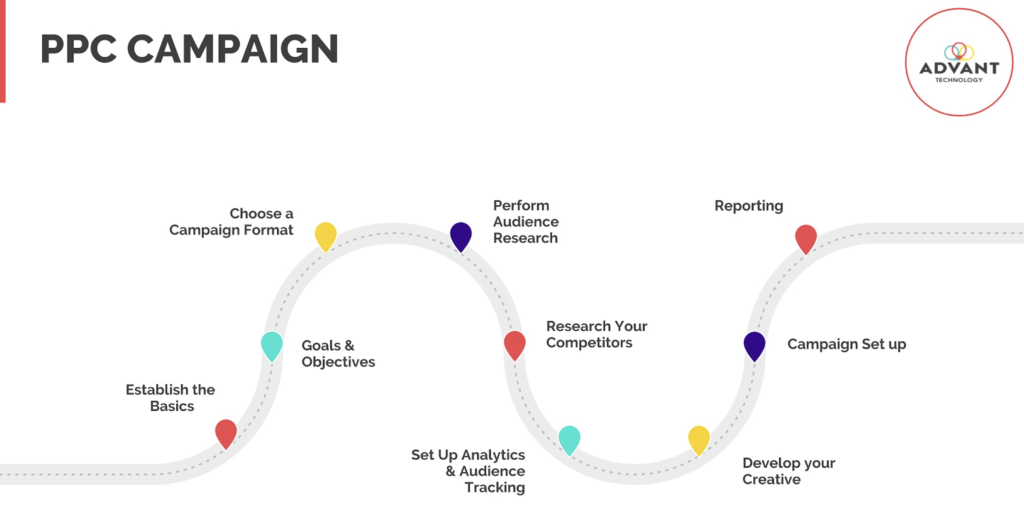
Data, Machine Learning & Algorithms

Setting up for PPC success

Hang on in there; we’re not done yet. There’s still lots to learn; let’s take a look at how to set up a PPC campaign. How you end up building a campaign will ultimately depend on the final platform you choose; what platform you choose will depend on some of the basics.

1- Establish the Basics

With any marketing campaign, you want to establish your goals and the objectives for reaching those goals. You want to establish first and foremost:

  • Who do you want to target?
  • How do you sell your products?
  • How do people buy what you’re selling?
  • How will you measure success?
  • How can you track offline activity?
  • What type of campaign do you want to run?

2- Goals & Objectives

An example of a goal might be: To increase revenue by 20%

An example of an objective might be: Increase the number of new customers acquired through PPC campaigns by 40%.

Let’s look at some of the different types of campaigns you can run to reach your goals.

Brand Awareness

This type of campaign is aimed at getting your brand known among your target audience. Brand awareness campaigns can also aim to increase your KPIs, which might be ad recall or top-of-mind awareness. Whilst awareness is good, just because someone is aware of your product does not mean they are willing to buy it; therefore, as part of a branding campaign, you may also want to increase consideration and purchase intent, which is slightly further down the buyer journey funnel. Purchase intent is harder to achieve than funnel awareness. Video storytelling can be a good medium for purchase intent, but you won’t be able to buy video ads on a PPC basis; more common is pay-per-view.

Lead Generation

Lead gen campaigns are typical where you’re offering a service; industries include insurance, finances, insurance, accounting and law. These types of brands typically require contact information so they can send out more detailed content via emails such as whitepapers or additional offers.

Lead generation campaigns are all about collecting data from your target audience and building up profiles on those people so you’re ready to market to them again. This is a very common practice if you are a B2B marketer.

Direct Sales/Performance Campaigns

The goal is a direct sale, we’re getting into the weeds here, and you’re thinking, hold on, isn’t this always the goal? Well, yes, pretty much every campaign leads back to sales, but that isn’t always the objective. Direct sales campaigns are normally where the only metric that matters is ROI. £10 in ad spend £20 out in revenue. For example, you’re not bothered about your brand or leads, just sales! Performance campaigns are going to be most popular for E-commerce brands.

3- Choose a Campaign Format

Digital advertising encompasses many formats. Let’s take a look at them.

Display ads

Display Ads are banner ads in the form of html5 of images, they can be bought by some ad networks on a PPC basis, but mostly they are bought on a CPM via programmatic real-time bidding.

Search ads

Paid ads that show up when a user performs a search great for keyword targeting. Search ads can be run on Apple search, Bing, Google Ads and also Pinterest, among others.

Social media ads

Ads that appear on any social media platform, such as Facebook, Twitter and LinkedIn. Social media ads are typically image-based as opposed to just text which is more popular with search ads.

Google shopping ads

Google shopping ads are product listing ads that appear at the top of search results on Google with an image and description. This format is typically used for eCommerce brands and can be bought on a CPC basis.

Remarketing ads

As we’ve established, some platforms are better than others at remarketing and specialise in just this one thing, but they do it well.

4- Perform Audience Research

You need to know your audience in-depth, and part of that is understanding what they are looking for or what they are searching for. So much of our behaviour nowadays is linked back to our search habits. From our search habits, marketers can infer so much data. Try the Google Keyword planner for free or upgrade to paid tools like SEM rush can give you keyword ideas based on an initial seed word.

Alternatively, turn to a specialist partner who can help properly asses the path to purchase / user journey and map out the different keywords that are relevant at the different stages of the buyer journey. Let us know if you’d like us to refer you.

5- Research Your Competitors

It’s crucial that you know who your competitors are before launching a campaign- just knowing the keywords they are bidding on and seeing what ads they’re running can give you a great head start.

If you already know your competitors it’s a good idea to set up alerts for any new or changed ads they are

Tools from SEM Rush can help you see what keywords they are bidding on and the estimated CPC for each, as well as their ad copy.

Look out for:

  • Keywords they are bidding on
  • Headlines, the more competitive keywords will probably have stronger ad copy that you can learn from
  • Ads they are running

6- Set Up Analytics & Audience Tracking

Installing Google Analytics is an easy job, and there are loads of plugins, especially if you are using web tools from the likes of WordPress, Squarespace or even an E-commerce solution like Shopify or Bigcommerce.

7- Develop your Creative

If you did your job well in the audience research phase, you’ll know the motivations behind why someone would want to use or buy your product and, even before that, what kind of content is going to engage audiences.

Creative is so important. You can deliver an ad to the right person based on the target keywords you’ve to know the user is searching, but if the ad copy does not resonate with the user, they may not consider it to be relevant, and they’ll just scroll straight past your ad and result in wasted ad spend.

Having good ad copy will benefit your whole campaign and increase the quality score of your campaign. Quality score is crucial to keeping costs down and driving return on investment.

A well-written ad will use the right keywords, make it stand out visually and will even use the persona data that you’ve collected to be sure it’s relevant.

A few tips for excellent ad creative:

  1. Use powerful headlines. Above all, remember you are selling something, so don’t be afraid to be direct about it. Remember, you are selling something, so don’t be afraid to be direct about it when it comes to performance campaigns. For brand awareness campaigns you can be a bit softer and more emotive.
  2. Be concise – Remember your audience is human, too, so think like a consumer rather than just an advertiser. If you are selling a product that you would use or buy, then your audience will be more likely to also.
  3. Be relevant -Understand your audience and target market, be mindful of your audience and use language that is going to resonate with them.
  4. Be creative – Use a mix of images & video where possible.

ABT Always Be Testing

Chances are you won’t nail it the first time. A/B testing ads is the only way to find out what works for your target audience. Look at your reports and see which creatives are delivering the best ROI or which ads are hitting other metrics such as quality score, CTR etc. You can then use this information to inform your creative approach going forwards.

And remember – just because you have a new winner, it doesn’t mean you should stop testing. PPC is a constant work in progress. Always be testing!

8- Campaign Set up

Once you have all the ingredients, you want to set up your campaigns. Be sure to keep the structure of the campaign well organised. If you are selling many products or you have a complex audience where you need many different messages, you need a taxonomy/ short code structure so you can easily see what each ad group is doing.

Here are some good tips you should follow when setting up campaigns:

Structure campaigns tailored to specific audiences allowing us to understand which audiences are best performing and where we see the biggest engagement

Audience groups Clear definition of audience targeting groups with a deep understanding of who you are addressing

Dynamic budgets Allow for flexibility

Use smart bidding and use AI where possible to gain a competitive advantage. 

Automation Automate simple tasks that will lower costs and increase KPIs

Clear insights having your campaigns clearly labelled and broken out allows you to see insights and better understand what’s driving sales and what should potentially be paused.

9- Reporting

Good reporting is the backbone of success in digital marketing, particularly when it comes to PPC advertising. Reports can help you track your campaign’s performance and make informed decisions on how to adapt in the future.

There are a variety of different reports available depending on which platform is used but no matter what platform you use pay close attention to Google Analytics to see which traffic source is driving traffic and sales.

PPC marketing takes time to learn, and whilst this guide is a good starter, it cannot replace years of knowledge in developing a digital advertising strategy. For that, you should be a knowledgable team or turn to an agency that is experienced. Sometimes the trade-off in fees paid to a paid media agency is worth it because, ultimately, their goal is to return a higher ROI than if you advertiser were to manage the campaign yourself.

Good luck with your next campaign and if you need help, we’d love to use our knowledge and experience in driving sales for your brand!

Free Paid Media Review

We are a world-class programmatic marketing agency that can generate more sales and leads for you. Leave your email address, we will contact you for your free paid media review.

READY TO TAKE ADVANTAGE?

Ready for advertising that really works? Take advantage of our FREE programmatic or paid social review.