Categories
Blog

Conversion Rate Optimisation for B2B Landing Pages

Conversion Rate Optimisation for B2B Landing Pages

Improving conversion rates for B2B landing pages can be challenging, but with the right strategy and approach, it is possible to achieve significant results.

As a programmatic agency that has spent millions of dollars on paid media, we have deep knowledge of what works. Whilst we are not a CRO agency, we do help advise our clients on what works. By producing landing pages that are highly optimized, you will have a better chance of converting users. B2B audiences are especially time-poor. They want information quickly and have high standards in finding quality information that will help them in their journey to buying products and services.

Here are some tips to help you improve conversion rates for B2B landing pages.

Target Audience

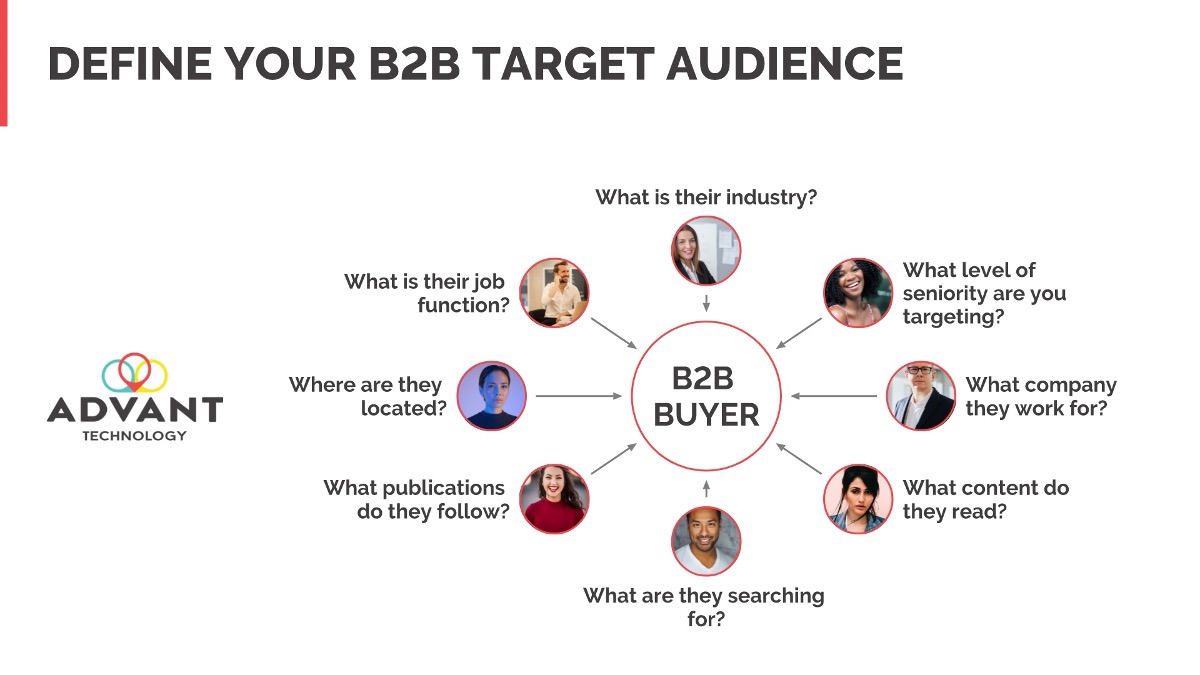
Before diving deep into the details of on-page CRO, ensure you understand your audience. In-depth audience research will help you identify what your b2b audience is looking for. You should conduct stakeholder interviews, this will help you position your product/service area to drive more leads and conversions from your site.

Put yourself in potential customers’ shoes- it’s key to realizing conversion rate goals! Craft content for the user first. Think about your USPs and make sure they shine through.

Use Clear, Compelling Headlines

You only have a few seconds to capture your user’s attention – make them count! Crafting an eye-catching yet informative headline is key in drawing users to your landing page. Be sure it clearly conveys the benefit of what you’re offering and leaves viewers wanting more.

Persuasive copy

Persuasive copy will guide the user in the right direction. It sounds simple but make sure spelling is spot on and there are no grammatical errors. For some people, this is unforgivable and looks unprofessional.

Conversion Rate Optimisation for B2B Landing Pages

Ensure Lead Gen Forms are Simple

There is a balancing act between asking for too much information and putting off users with too many fields. Keep it easy and straightforward. Clear labels, relevant sample text, and an easily located submit button will help visitors quickly make their way through, increasing your conversion rates.

Social Proof

Just like in B2C marketing, B2B buyers want to see social proof. Positive endorsements from customers, so make sure you’re showcasing those glowing customer testimonies for maximum impact. The difference between B2B and B2C is that you’ll want more detailed case studies proving you have already succeeded with others. This is your opportunity to incorporate all your USPs through a real-world situation.

Leverage Lead Magnets

Lead magnets are an excellent way for you to get something back by giving something away. Making your lead magnet more specific to the audience you’re targeting can be one of the best ways to increase conversion rates. By taking a precise and tailored approach, it’s possible for businesses to dramatically improve their results when reaching out for leads. Example lead magnets can be tools, calculators, whitepapers, videos and even ebooks.

The basics

In addition to the above, you’ll also want to ensure the look and feel of your site is clean and uncluttered. Make sure your site speed is fast; no one likes to wait for pages to load for a lifetime.
Sounds simple, but once a customer has filled out a form, ensure your sales team is following those leads appropriately. Just because someone fills out a form does not mean they are ready to buy, you need to nurture the lead, moving them through a sales funnel from MQL (marketing qualified lead) to SQL (sales qualified lead).

Tracking

Use Google Analytics and other analytics tools like Omniture, which will help you identify where users are entering the site, where they leave and what they do.
Hotjar is also an excellent tool which provides heat maps, so you can see where users are clicking, use this data to inform the design, look and feel of your landing pages to drive more efficient leads.

Start With High Traffic Pages

Focus on the pages with the most traffic first and work your way down; getting high-traffic pages optimized for conversions will ensure your work is more effective.

Targets

Conversion rates will vary depending on your industry, how complex the solution you are selling and how long the sales cycle is. Generally, you want to aim for around 1-3% for the B2B industry. Set targets and monitor this over time, taking note of the changes you have made and how they affect conversion rates over time.

Optimize for Mobile

With the increasing popularity of mobile devices, optimizing your landing pages for mobile is essential. This includes using a responsive design, ensuring that the text is easy to read, and using images and videos that are optimized for mobile.

A/B Testing

Use A/B testing to optimize your landing pages: A/B testing is a powerful tool for conversion rate optimization. You can determine which changes are most effective for improving conversions by testing different versions of your landing page.

Optimize for the Funnel

Use landing pages tailored to specific sales funnel stages: By creating landing pages tailored to particular stages of the sales funnel, you can increase the likelihood of conversions. For example, a landing page tailored to the sales funnel‘s awareness stage should provide a general overview of your product or service. In contrast, a landing page tailored to the decision stage of the sales funnel should give detailed information about your product or service.

Use Images & Video

Images and videos can be powerful tools for conversion rate optimization. They can be used to showcase your product or service, providing a visual representation of what you’re offering. They also help break up the page allowing users to absorb more information and improve time spent, all helping to drive a lower cost per lead/sale.

Improving conversion rates for B2B landing pages

Conclusion

In conclusion, improving conversion rates for B2B landing pages requires a strategic approach, but it will undoubtedly make your paid media efforts across Linkedin, Google Ads and Programmatic advertising more effective. Simple math, doubling your conversion rate will make your paid media twice as efficient.

If you want an honest opinion on your landing pages speak to our programmatic experts, we’d love to help your business drive more sales!

Free Paid Media Review

We are a world-class programmatic marketing agency that can generate more sales and leads for you. Leave your email address, we will contact you for your free paid media review.

Categories
Blog

How to use PPC to inform your Link Building Strategy

How to use PPC to inform your Link Building Strategy

PPC (pay-per-click) advertising, such as Google ads, can be a valuable tool for informing your link-building strategy.

By analyzing the performance of your PPC campaigns, you can gain valuable insights into which keywords and pages are driving the most traffic and conversions.

Tapping into valuable insights from your paid media efforts is a great way to improve your SEO.

Guest Posting

PPC data can help you identify websites that are relevant to your industry and have a large audience. By guest posting on these websites, you can build links back to your website, which can help to improve your search engine rankings and improve your overall domain authority, which is a valuable metric that Google uses to define whether or not your site is worthy of appearing on the first page of the SERPs. Also, guest posting can help you build relationships with other website owners and influencers in your industry.

Digital PR

To maximize the bang for your marketing buck, make sure that PPC and PR work together in harmony. Analyzing data from your campaigns helps you identify which pages of your website are driving conversions – use this intelligence to craft outreach plans targeting media influencers such as journalists who will promote your content through digital channels!

How to use PPC to inform your Link Building Strategy

The power of PPC keywords and phrases

Leveraging the power of PPC and link-building together can help you get a clear view on which keywords are driving the highest traffic levels and conversions. Analyzing your existing PPC data provides valuable insights in terms of what words have proved to be effective: use those same key phrases when building links for an even stronger SEO performance!

Identify your strongest pages

Unlock the power of PPC data to supercharge your link-building efforts! Identify which landing pages are delivering you the most conversions, and use that knowledge as a starting point for building links. Increase rankings on key pages to drive further traffic – and ultimately more conversion success – back to your website.

Low performing pages

Ok, what about the other way around now?

With PPC data, it’s possible to identify pages with underperforming metrics that still contain substantial promise. Whether the page requires more attention or further optimization, these insights can be invaluable in taking your site’s performance to new heights!

Ride the buzz wave

Leverage your pay per click data to uncover potential content ideas and capitalize on trending topics. Dive into campaigns that are performing above average and explore the associated keywords further—this could inspire timely, relevant pieces of content tailored towards capturing audience attention.

Our London-based PPC agency is here to help you take your link-building strategy to the next level. Whether it’s an existing campaign in need of a boost or preparations for something brand new – our team of local experts is just one call away! Let us guide the way and ensure your projects meet their full potential.

Free Paid Media Review

We are a world-class programmatic marketing agency that can generate more sales and leads for you. Leave your email address, we will contact you for your free paid media review.

Categories
Blog

Growth Marketing Agency: Expert Consultants for Digital Growth

Growth Marketing Agency: Expert Consultants for Digital Growth

If you’re looking for help with digital marketing growth, engaging, and acquiring customers at scale, you’ve come to the right place.

Our agency of growth marketers has a team of experts who can assist you in all areas of paid marketing growth across big-hitting channels such as:

Facebook Ads, Google Ads / Paid Search, YouTube advertising, TikTok, Quora, Pinterest, and of course, programmatic display, native & video.

We power these platforms fueled with buyer research and a data-driven approach for improved performance marketing.

We help companies in a range of different industry verticals and varying sizes.

Our team of growth marketers will work with you to create a business growth plan that fits your unique needs and help accelerate growth, serving as the foundation to helping you scale with a strategic vision and a clear road map.

Expert Consultants for Digital Growth

Growth Marketing Platform built by Growth Marketers

We’ll work with proven marketing strategies, starting from the ground up and moving quickly towards success.

From building your foundation to launching your first campaign! We achieve tangible growth goals step-by-step with a relentless focus on testing, optimising, and retesting our process to find what works for you.

At Advant Technology, growth marketing is all about growing our clients’ businesses through customer acquisition, improved customer lifetime value and maximising customer retention.

Let’s talk about Growth Marketing

Fact, traditional marketing techniques don’t work as well anymore.

The same old tactics are just too limited. Sure, you might get some results with some paid search, a bit of SEO, and even some Facebook ads.

Returns are diminishing, though, and you’re probably not going to scale as much as you could.

Growth marketing, by contrast, is evidence-based. It focuses on being customer-centric, not company-centric. It’s about being strategic, first, not just tactical campaign driven. It’s more than just acquisition.

It’s also about looking at retention and up-selling, it’s a compound shift from opinion to evidence-based, and instead of having fixed annual plans, it’s about having an agile marketing operation. 

So what does this mean for your business, and how can we help you become a growth marketing-driven business?

Growth hackers are constantly testing new strategies to find the best ways of reaching their customers.

The growth marketing field is a constantly changing and evolving space. Our agency stays abreast of these changes to focus on your business.

As technology advances, so too does the sophistication of campaigns for brands looking to grow their customer base through experimentation with different content formats, platforms and content.

Using the most sophisticated marketing technology available, our growth marketers can track what content is seen by different user segments and when.

This allows them to create highly optimised strategies for each identified group of users, going down as far as an individual level with personalised messages tailored just right!

Marketers can craft highly personalised campaigns that reach users across multiple channels with deep personalisation. This enables them to follow the user’s own behavioral cues for optimal growth strategies that will be optimised based on what each person does individually instead of being one size fits all like traditional media.

The future of marketing is personalised, data-driven campaigns that engage your customers and build trust.

When marketing is done with an individualised approach, the cost of customer acquisition can be massively reduced. 

These success stories show how personalised campaigns lead to greater ROI for brands.

Hopefully, you are beginning to understand how growth marketing strategies can work for your business.

We are all about growth marketing!

It’s not just a catchy description; it’s what our company does every day to help companies achieve their goals and grow through the power of digital marketing tools.

The old model of agency-client relationships is broken.

We build close, long-term partnerships with each client so we can support your business objectives and adapt quickly to changes in the market. 

We fully immerse ourselves in success-driven tasks. 

We have found that by working with a small number of clients at once, we can invest all our energy into doing excellent work for each client. 

Our agency growth marketing team only handle a few accounts at a time. 

Our team becomes invested in the company’s business goals and their role within your marketing team; this helps create an internal dynamic that mimics an internal hire. 

We pride ourselves on making sure every engagement goes smoothly – from start to finish – and we’re always transparent with our clients.

We take great care in finding out which growth strategies work best for each client.

What makes our growth marketer team so successful is a deep understanding of your customers. 

We go beyond demographic data and focus on understanding the entire customer journey. We do that by looking at the buyer user journey and extracting as much customer data as possible. This then feeds into content marketing and paid media programs.

This is at the heart of growth hacking/growth marketing, and it’s what sets our agency apart from others in the space to accelerate growth.

How do we help you with your growth marketing strategy?

We know that to be successful, your company needs a strategy and the right tactics. That’s why we’ve created this blueprint for marketing performance services at scale!

  • Buyer Journey Research – Customer life cycle
  • Marketing Performance Strategy
  • Growth Media Planning and Performance Marketing
  • Customer & Internal stakeholder interviews
  • Digital channel strategy
  • Mar-tech advertising audit
  • Tool analysis
  • Consumer Data Management and Analytics
  • Mar-Tech & Advertising Operations
  • Digital Innovation

We hope this blueprint gives you a good idea of what’s possible and how our team can help you achieve your desired outcomes.

Benefits of our Growth Marketing Agency

What are the benefits of our Growth Marketing Agency?

  • Maximising relevance to your customers will improve customer engagement
  • Increase sales growth and maximise profitability
  • Lower business costs whilst streamlining business processes and lowering the reliability of resources
  • Improve customer experience
  • Increase trust among your target audience
  • Personalised messaging across the entire customer life cycle
  • Improve reputation among your target audience
  • Better content management and processes for content development that lead to more organic growth
  • Eliminate the silos between your channels so you can give customers a more consistent and connected experience
  • Target the best customers with your messages and offers for a great ROI
  • Utilise a holistic approach to optimisation that takes into account all of your digital properties.

If you are looking for a growth marketing agency that can provide the same level of service as a large, international agency but with the personal touch and attentiveness of a smaller company, please reach out to us! We would be happy to discuss your specific needs. Schedule a call today.

Free Paid Media Review

We are a world-class programmatic marketing agency that can generate more sales and leads for you. Leave your email address, we will contact you for your free paid media review.

Categories
Blog Facebook Ads

Paid Social Agencies

Paid Social Agencies

Paid Social Agencies

A paid social media agency is responsible for executing paid advertising across social media platforms.

There are loads of digital marketing agencies on offer coming in all shapes and sizes, but which service offering is right for you? Which agency is going to fit in with your team?

Which social media marketing agency is going to return you the biggest impact and the most sales?

Social Media Platforms

Different social media platforms cater to different audiences, and each platform has unique data and unique algorithms that can be leveraged in your paid campaigns. A good paid social team agency worth it is salt will help you plan and buy on the right platform to maximize your brand awareness and generate sales. Let’s take a quick look at a few of the key social media advertising platforms that can be used in digital marketing campaigns.

Facebook Ads: With over two billion active users, Facebook is a powerhouse for paid social media advertising. The platform offers ad targeting options that go well beyond interests and demographics to include behaviours, life events, and even purchase intent! Facebook ad formats include traditional News Feed ads, carousel ads (which allow you to showcase several products or services in a single ad), video ads, and dynamic product ads. The Facebook analytics ad platform is also incredibly powerful, providing insights into not only how your ads are performing but also who is clicking on them, what they do when they get to your website or landing page, and more.

Instagram Ads: Instagram has over one billion active users, and with its recent addition of Stories Ads and Shopping Tags, it’s quickly becoming a powerhouse for e-commerce businesses. The platform offers unique data targeting options that go well beyond interests and demographics to include behaviours, life events, and even purchase intent! To access Instagram advertising, you must use the Facebook Ads platform.

LinkedIn Ads: With over 500 million users, LinkedIn is a great platform for B2B businesses looking to reach out to their target market. The social media ad options available on LinkedIn offer some of the most granular targeting capabilities, including job titles, company size, and even specific fields of study! LinkedIn ad formats include Sponsored Content (which appears in the main feed), Sponsored InMail (which is a direct message sent to a user’s inbox), and Text Ads (which are short, text-based ads that appear on the right side of the LinkedIn feed).

Twitter Ads: Twitter has 330 million active users and is a great platform for promoting brand awareness. The Twitter Ads platform works can also deliver sales but, generally speaking, is not as effective as Facebook. You can reach your target audience based on past tweets.

TikTok Ads:  TikTok, the short-form video app with over one billion active users, is a great platform for brands looking to reach a younger demographic. The ad options available on TikTok are limited but do include promoted videos and branded lenses.

Reddit Advertising: Reddit ads are often forgotten about, and many social media marketing strategies would therefore miss out on this highly effective in getting your brand in front of a relevant user base. With its highly engaged audience, Reddit ads are especially beneficial for eCommerce businesses looking to drive awareness and sales online. Reddit ad formats include sponsored links and promoted posts.

Pinterest Ads: Pinterest is an excellent platform for B2C brands looking to reach out to their target market with Pin-specific ad targeting options in which you can leverage keyword targeting, interest targeting, and more.

YouTube Ads: YouTube is the second largest search engine in the world and has over two billion active monthly users. YouTube advertising is one of the most effective ways to reach your target market with video content. YouTube has two main ad formats, Trueview (skippable) – viewers can watch your videos uninterrupted, but they have the option to skip after five seconds. This format is often used with longer-form content or YouTube preroll ads (basically TV commercials) that can be 6 or 30 seconds long.

There we have a short summary of the channels that a paid social media agency is responsible for managing.

Raid Digital Media Agency

Six roles of a paid digital media agency

There are many roles that a paid social media agency will have to fulfil in order to get the best results for its client. Let’s take an overview of some of these roles below:

  • Social Media Optimization Specialist: A specialist who works on optimizing content before it goes live on the chosen channels. They also work closely with developers and designers to ensure that the content is effective and engaging.
  • Targeting Specialist: A specialist who works on finding the right target audience for the client’s product or service. They use a variety of methods to find these people, including social media listening, customer profiling, and more.
  • Data Analyst: A specialist who looks at all of the data that is collected from the various social media channels. They use this data to create reports and insights that help the paid social media agency understand what is working and what isn’t.
  • Creative Director: A specialist who oversees all of the creative elements of the campaign. This includes everything from the initial concept to the execution of the final ad.
  • Account Manager: A specialist who manages the relationship between the paid social media agency and the client. They make sure that all of the objectives are being met and that the client is happy with the results.
  • Media Buyer: A specialist who is responsible for buying advertising space on behalf of the client. They work with a variety of different publishers to get the best rates for the client.

Paid social agency

What is paid social agency?

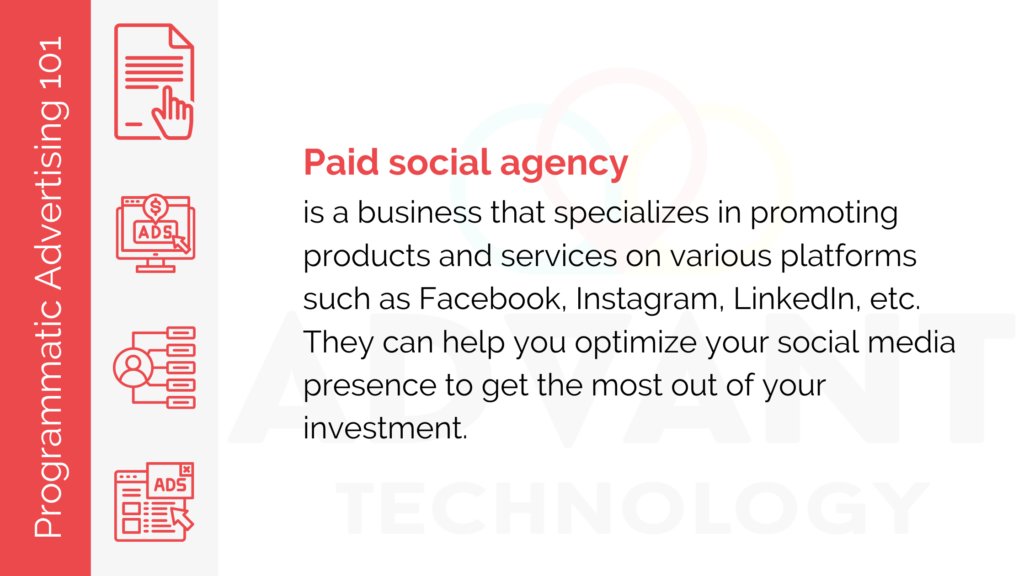
A paid social agency is a business that specializes in promoting products and services on various platforms such as Facebook, Instagram, LinkedIn, etc. Social media agencies can help improve your company’s presence online by utilizing all the benefits of each platform to increase brand awareness and drive traffic to your website or landing page. By using a paid social agency, you don’t need to hire six different roles for your company.

If you are looking for a paid social agency, you can contact us here.

Free Paid Media Review

We are a world-class programmatic marketing agency that can generate more sales and leads for you. Leave your email address, we will contact you for your free paid media review.

Categories
Display banners Programmatic

Data-Driven Programmatic Display Advertising Agency for Brands

Data-Driven Programmatic Display Advertising Agency for Brands

We are a data-driven programmatic display advertising agency that can help you reach your target audience with accuracy.

With a deep understanding of your market, audience and competition from in-depth research into the latest technology (like Pinterest Programmatic) trends as well as our own expertise across industries, we help you reach more potential customers with display ads.

We’ll build out your campaign from the ground up across all display channels. We’re experts in finding creative ways to reach potential customers.

Display Platforms

Display Platforms

  • Google DV360 & Xandr
  • Google Ads – Google Display Network
  • Facebook Ads
  • Apple Search Ads
  • Taboola
  • Pinterest
  • Quora
  • LinkedIn

Display Advertising Case Studies

We have worked with many different clients to increase the number of impressions using Display Advertising. Here are two examples from Chelsea FC and Aegean Airlines. You can click on them to learn more about the campaigns. 

Chelsea FC Aegean AirlinesRead more on the page: programmatic agency

Benefits of Display Advertising

Advant’s technology-driven growth marketing solutions are designed to deliver measurable results with an unprecedented return on investment. Our innovative strategies underpinned by data, as well as creative and informed media buying, will ensure your display ads reach the right audience at just the perfect time!

We’re not just a display advertising agency.

We create engaging campaigns that get results for some of the best-known brands in the world across digital channels, and we’ve been doing that since 2014.

What Is Display Advertising?

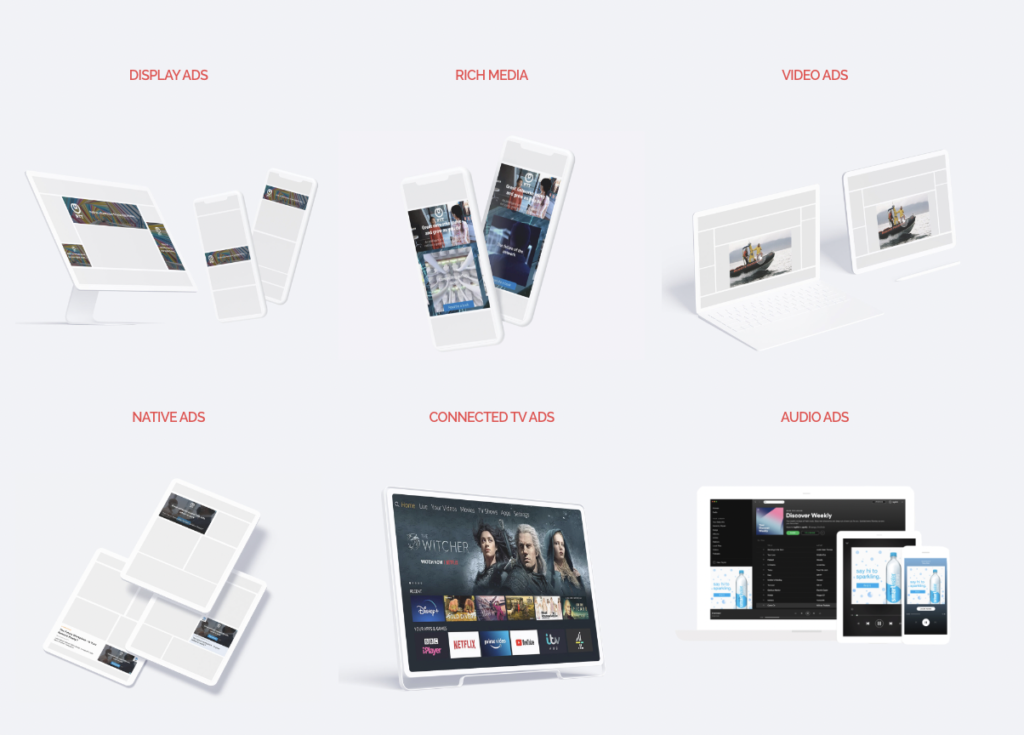
Display advertising is a type of online advertising that comes in several ad formats, including display banner ads, video ads, native ads, Connected TV and programmatic audio Ads.

Programmatic Advertising Agency

Display advertisements can be bought through programmatic advertising technology called a Demand Side Platform (DSP). Ads are normally bought in real time and paid for on a CPM basis.


Why Use Display Advertising?

There are many benefits of display advertising when used as part of an integrated marketing campaign.

Some of the key benefits include:

  • Reaching a large audience with your message
  • A cost-effective way to reach potential customers
  • Increase brand awareness and recall
  • Drive traffic to your website or landing page
  • Generate leads and sales

Build Brand Awareness

The journey to purchasing begins when you have first exposed the brand, and because display advertising has a high reach and excellent targeting, it is a useful tool for building that initial awareness.

The power of display ads can’t be overlooked. These innovative and creative formats help you reach new customers and build positive brand perceptions among consumers who see your advertisement on any device they use throughout the day – even if it’s not their computer!

The more visibility created, the better the recall rates for brands.

Reach Your Target Audience

With display advertising, brands can reach the right audience at scale with a range of ad formats that are relevant for every stage of your customer’s journey. The targeting capabilities of the display through programmatic are endless and go way beyond the Google Display Network (GDN), which is what most agencies use when running display campaigns.

Story Telling: Display advertising is a great way to tell your brand’s story and engage with customers in new and creative ways. Because there are so many different ad formats, you can really get creative with your display campaigns.

Rather than blending in with the other content on your site, display advertisements are designed to stand out and attract attention.

Adding animation allows you to tell a more complex story, which is great for B2B brands.

Display Retargeting Campaigns

Retargeting is one of the most effective uses of display advertising, and with our data-driven solutions, we can help you set up responsive display ads so that not only are you targeting the right audiences, you’re doing it with the right ads. Retargeting is great for moving users down the purchase funnel.

Display Formats our Agency Offers

Display Formats our Agency Offers

The most common type of digital advertising that can be used to drive awareness and consideration with the highest reach across internet users. They have lower CPMs and are, therefore, great for use across the marketing funnel.

Video Ads

A fantastic way to create awareness, they are predominately used in the mid to upper funnel. Video is very powerful and can be used to tell a story (in 30 seconds or less) that engages viewers in an interactive way. We are experts in buying both instream and outstream and even offer video ads on a cost-per-completed view (CPCV).

Dynamic Display Ads

A great way to drive conversions as they are personalised for each user. They can be used as a retargeting tool or to increase brand awareness and consideration.

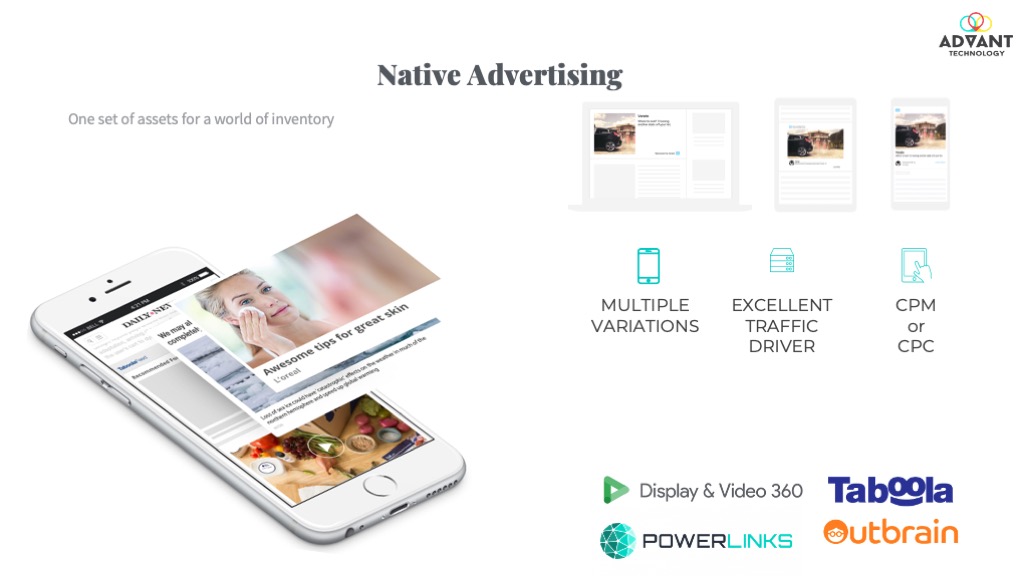
Native Ads

As the name suggests, these ads look very similar to the content that surrounds them on the publisher’s website, which can help to create a less intrusive experience.

Interactive Ads

Using specialist ad-serving technology to create ads that are highly engaging where users can fill out forms, play games and more, all inside the walls of a banner ad.

Audio Ads

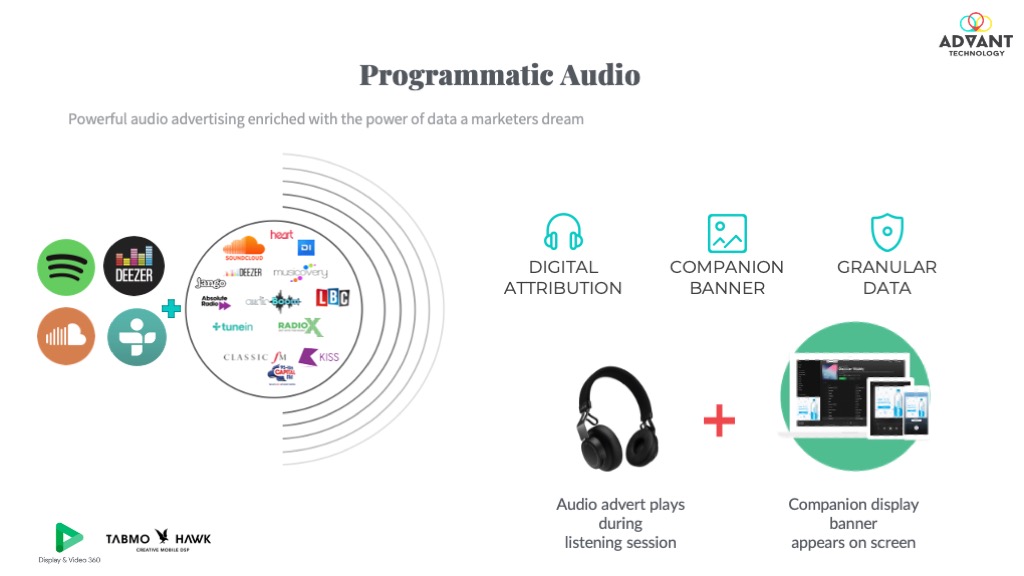
A new, emerging ad format that enables brands to reach consumers through audio channels. Programmatic audio ads are generally non-clickable and are, thus, mostly a branding tool. They run across mobile apps such as Spotify, Deezer and Acast.

Connected TV Ads

The future of TV is here with the use of connected TV devices such as AppleTV, Amazon Firestick and Roku. CTV ads can be served across connected TV ads. 

Free Paid Media Review

We are a world-class programmatic marketing agency that can generate more sales and leads for you. Leave your email address, we will contact you for your free paid media review.

Categories
PPC

The Ultimate Guide to PPC Marketing – Increase Your ROI

The Ultimate Guide to PPC Marketing - Increase Your ROI

Pay Per Click (PPC) marketing is a great way to generate leads and increase your ROI. In our Ultimate Guide to PPC Marketing, we will discuss how PPC works, the different types of campaigns you can use, and what tools you need for success. We will also show you some tips on where to find quality keywords for your campaign!

You will get introduced to the main terms, definitions, platforms, technologies, and even techniques relating to PPC advertising. Basically everything you need to know about PPC.
Marketing PPC

PPC Terminology

Let’s start with the definitions of a few acronyms relating to PPC ad campaigns and SEM marketing. You can see there are many definitions to take in – but don’t worry, you will learn them as we go along!

We know there is a ton of content out there on the web, but most of it focuses on B2C marketing, so where possible, we’ve skewed the content to also be useful for B2B marketers/advertisers or even other agencies.

Search Engine Marketing (SEM)

The term PPC is often used interchangeably with SEM. SEM is a broad term which can be split into two unique areas; paid advertising (PPC) and organic listings on search engines Google. It’s probably how you found this article today.

The better optimised your content, the higher your website will rank on search engine results pages. This digital marketing strategy falls within the practice of SEO (Search Engine Optimisation).

SEM includes both types of promotions, as well as all related marketing efforts. This means you will find SEM at every stage in the customer journey – from initial research to final purchase.

Search Engine Marketing is defined as a form of internet marketing that involves the promotion and sale of products or services on search engines.

Cost-Per-Click (CPC)

This term is used in SEM and PPC marketing as a metric to indicate the amount of money spent on an ad and the number of times that ad is clicked.

Cost Per Mille (CPM)

CPM – Cost Per Mille or cost per thousand impressions. This stat simply tells you how much it will cost for your ad to be displayed a thousand times. This is probably the most common stat used in PPC marketing as it enables you to compare the relative costs of running ad campaigns across different platforms.

Return On Investment (ROI)

ROI is a financial metric used to evaluate the efficiency and profitability of an investment. This term is also used in PPC marketing as a way for marketers to define the success or failure of their campaign and to understand if their investment is worthwhile.

Ad Rank

Ad Rank is defined as the rank of the ad to other ads on search engines. This is determined by a combination of factors, including Quality Score and Bid amount.

Quality Score

‘Quality Score’ is the ranking system used by Google Ads and Microsoft Advertising (formerly Bing Ads) to determine which ads are more relevant than others when running a search campaign. This score is made up of several factors, including the relevance of your keywords, click-through rate and ad extensions that are relevant and working.

Ad Extensions

Ad extensions are tools provided by both Google Ads and Microsoft Advertising that enable you to add more information to your ads. This can include images, phone numbers and location information to help advertisers focus on what is most important about their business or product.

Ad extensions are optional enhancements for your ads. Most take up more space on the search results pages and make your ads more visible instantly.

Keyword Research

Keyword research is a vital part of PPC campaigns, and there are many tools on the market that will help you find the most appropriate keywords for your campaign.

Google Keyword Planner

The Google Adwords keyword planner is a very useful tool that will enable you to find keywords related directly to your product or service; you can even use your website as a starting point!

If you use Google Trends, this is a great way to look for relevant new and emerging keywords over time.

Bing Ads Intelligence

Another useful tool which again enables you to find keywords related directly to your product or service. This is a tool provided by Bing; it’s a similar set of tools to that Google’s intelligence tools.

Maximum Bid

The maximum is the highest amount you are willing to pay for an ad click. This is an important factor when running a PPC campaign, and it will affect your overall Ad Rank.

Ad Group

An Ad Group in a PPC campaign is a collection of ads within your campaign. The ads within your ad group should be well-organised and related to each other. These ads work together to achieve maximum results.

Campaign

A campaign in PPC advertising is defined as a collection of ad groups, and this allows you to track the performance of different ad groups.

Campaigns are usually organised around a certain theme, have distinct ad group names and set their own daily budget amounts.

Keywords

Keywords are an integral part of any PPC campaign, and these are words or phrases that advertisers bid on within their ad groups. There are many tools on the market that will help you find relevant keywords to include in an ad campaign, but some have high costs, so your agency can help spread those costs.

When it comes to keyword advertising, above all, you need to ensure your keywords are relevant to the product or service you are selling. A good agency will ensure sufficient keyword research is done to use the right keywords before going live in order to achieve success with your campaign. This is all part of a PPC management service.

Landing Page

In PPC advertising, the landing page is defined as the page to which users are directed when they click on an ad.

Ad Text

The ad text in a PPC ad is the text that appears on your ads, usually under a headline. This will be seen by those searching for keywords related to your product or service.

Conversion Rate

Conversion rate is defined as the percentage of visitors to your site who complete a pre-defined action. A high conversion rate is vital for any PPC campaign, and there are a number of ways to improve the conversion rate of your landing pages.

Return on Ad Spend (ROAS)

ROAS is a calculation that takes into account the amount of money spent on your PPC campaign and divides it by how much revenue is generated from these campaigns to show you how much profit you have made from your PPC marketing campaign.

Cost Per Acquisition (CPA)

It is a calculation that takes into account the amount of money spent on your PPC campaign and divides it by how many customers you have acquired from these campaigns.

Average Position Rankings

The Average Position Ranking can be found in your campaign reports. It is the average position that your ads have appeared on the search results pages. As you can see in the result below, there are several positions. Magidcx appears top, and a similar web appears bottom, so the average position ranking is a calculation of these positions.

Impression share

In PPC campaigns, impression share is defined as the percentage of times your ads appeared compared to the number of times they could have been shown. The higher your impression share, the more opportunity you’re given to appear in front of potential customers. It’s an important KPI in paid search ads. It can be found easily in your Google Ads reports. Impression share is influenced largely by budget and keyword relevance.

Click-Through-Rate (CTR)

CTR is defined as the number of times your ad has been clicked on, divided by how many impressions it has received. The higher your CTR, the more interested users are in what you have to offer, and this will lead to greater success for your paid search marketing.

Bid Strategy & Targeting

In PPC advertising, bid strategy refers to how you set up your bids. For example, you may want to bid higher at a particular time of day or on a certain device. This will align with your overall PPC strategy based on what you want to achieve (awareness, leads, sales etc.)

Campaign Budget

In PPC advertising, a campaign budget is the amount of money you want to spend on your ad campaigns within a specific time frame. In Google Ads, for example, you apply a daily campaign budget which is quite different to programmatic advertising through platforms such as Google DV360, where you apply a total budget.

Negative keywords

Negative keywords are simply words or phrases that you don’t want to be associated with your ad. These can be used to improve ad relevance and, therefore, the effectiveness of an ad campaign.

Google Analytics

A reporting platform that allows you to track the performance of your ad campaigns. This is free for all marketers, which makes it extremely popular.

There are other platforms that are finally making an impact in being the favoured choice for analytics, such as Oribi, which is great if you are an E-Commerce brand. For larger enterprise advertisers, take a look at Google Analytics 360 or Adobe Analytics, but these platforms are going to cost upwards of $150,000 a year.

Great, so we have a better idea of the key terms and acronyms that get thrown about by marketers and agencies. Now, let’s take a look at some of the most popular platforms.

Top PPC Platforms

You can’t talk about PPC marketing and not include Google Ads, formerly known as Adwords. This is the biggest paid search platform on the market, and it’s likely you’ll be using it to run your PPC ad campaign. There’s no doubt it has a place in your PPC marketing strategy, but the question you should be asking is, how do I make Google Ads work for me? There is so much competition, so you need to set up your Google Ads account with an effective advertising strategy that is well targeted.

Google Ads is a mega beast of a platform. Sure, it’s easy to get going, but doing it well isn’t actually that easy, and it takes years of experience in digital marketing knowledge to do well. We’re not saying that you couldn’t achieve success / ROI on your very first campaign, but if you operate in a competitive niche, there is a good chance your competitors will have a well-oiled set-up to make your life that bit harder.

With this being the biggest PPC platform in the world, we’re going to take a bit more of a deep dive.

How does Google Ads Work?

Google Ads is a pay-per-click advertising platform that allows businesses to create text, image and video ads which are shown on Google search and third-party websites. PPC Google Ads are usually text ads placed above organic search results after performing a search.

What’s great about search ads is that they are relevant to the user based on their intention at that moment. Intent-based marketing is important because not only is your ad placement to the right target audience but it’s also displayed at the right time.

When a user clicks on a search ad, the advertiser pays Google for the click. It’s that simple! Google Ads does also encompass other advertising types such as the Google Display Network and YouTube, but, as neither of these is PPC advertising, we won’t explore these any further in this guide.

Google Shopping Ads

Google shopping ads are a type of product listing that appear as paid listings on Google’s search results page and website pages where shopping comparison information is shown.

Product listing ads are a form of advertising in which businesses can promote their products or services to consumers by displaying them directly within the search engine results page (SERP) – next to organic search results – and Google’s advertising network where relevant.

Google Ads also offers Remarketing Ads, which is an excellent tool that allows advertisers to target users who have already visited their website or used their app. Users are then served ads across the web when they are browsing via the Google Display Network. Again this is not a form of PPC ad, so we won’t dwell on them right now. We will, however, look at other vendors who offer remarketing PPC ads.

Microsoft Advertising (Formerly Bing Ads)

Microsoft Advertising is normally a little bit cheaper than its Google counterpart in terms of CPC, but that’s counteracted by lower traffic levels. This is only a top-level comparison of Google and Microsoft Ads, and it’s still an effective PPC tool, but if we could only choose one platform to master, it would be Google Ads!

Facebook Ads

The Facebook marketing platform is also an absolute beast in the world of technology that is actually very hard to master and takes years of experience, which is why many businesses will use a paid social media marketing agency. Facebook Ads also includes ads served on Instagram and even across millions of sites globally through what it calls the ‘Meta (formerly Facebook) Audience Network’.

The Meta Audience Network is an ad network that lets you show ads on websites outside of Facebook through its pixel.

This advertising tech platform has the ability to reach specific audiences based on their demographics, interests and behaviours. This may include some kind of intent depending on the mighty, almost stalker-like, Facebook algorithm.

Facebook ads are very effective at targeting customers who have already shown an interest in your business which makes it a great tool if used correctly!

The platform offers many types of pricing, including CPV (cost per view) and CPC, which is why it has made it into our PPC Guide.

If you’re a B2B marketer, you may not instantly think of Facebook and Instagram, but at the end of the day, you’re advertising to people, and if your target audience is using Facebook and Instagram, then it has the potential to convert. Facebook Ads are not typically thought of as part of a B2B marketing or B2B lead gen strategy but don’t discount it. We’ve seen it perform really well, even for ABM (Account Based Marketing) campaigns! With the right targeted data, you can reach your target account list (TAL) even in the Metaverse!

Adroll

Adroll focuses on retargeting ads – getting ads in front of people who have already visited your website. Adroll retargeting is also a great tool for remarketing across the web, so it’s definitely worth checking out if you’re interested in display advertising.

AdRoll isn’t just about displaying adverts on other websites. It can help B2B marketers generate leads with its advanced targeting capabilities, which allow them to reach their target audience more accurately than other platforms. The benefits are that they offer both cost per click (CPC) and cost per impression (CPM) campaigns, as well as reporting tools that will let you track the performance of all your paid social media ads by channel, like Facebook or Instagram etc.

Criteo

Criteo is a competitor of Adroll and also focuses on display advertising and remarketing ads.

Criteo works with thousands of publishers to bring ads across the web and is a great platform for remarketing. Criteo charges only when ads are clicked, and the price you pay depends on many factors that are part of the Criteo proprietary advertising algorithm.

Criteo is also an effective pay-per-click service that uses its predictive technology to find the most likely customers for your business.

They have a self-serve platform, so you can get started without needing any assistance!

OutBrain

OutBrain is a native advertising network. They work with publishers like The New York Times, Rolling Stone and Men’s Health to place ads across different websites that are relevant to your target customers’ interests.

Outbrain is a great platform for reaching the top and mid-funnel potential customers, but they also offer retargeting ads, which may need further nurturing before they’re ready to buy! Outbrain offers a wide range of targeting capabilities, including content, audience and interests.

Unlike programmatic advertising through technologies like ShareThrough, you only pay on a CPC basis.

Taboola

Taboola is a similar PPC platform to OutBrain. Taboola arguably appears on less premium inventory – more tabloid than high brow. Their advertising policies are less restrictive than OutBrain, and they allow landing pages to be eCommerce pages, whereas OutBriain’s advertising only allows you to advertise landing pages which are not eCommerce pages, so if you are an eCommerce brand wanting to use OutBrain, they’d only be good for advertising your blog page, for example.

Like OutBrain, Taboola offers a self-serve platform so you can get started without needing any assistance. For larger campaigns, they offer managed services, or you can use a native advertising media agency.

LinkedIn Ads

Linkedin Ads is a B2B social media ad platform that allows CPC bidding strategies.

It’s a great platform for B2B marketing because it allows you to target users by job title, company size and industry sector. This means that if your customers are all professional services-related businesses, then LinkedIn could be the way forward!

The LinkedIn Ads platform is quite easy to navigate, making it a great option for beginners who are just finding their feet with paid B2B advertising.

LinkedIn Ads offers a number of different campaign types and allows you to experiment with them. One of the campaign types is lead generation, where you can capture data from potential leads before nurturing them further down your sales funnel.

The platform is quite flexible, allowing for both automatic bidding as well as manual bids – which gives businesses complete control over their ads.

Pinterest Ads

Pinterest Ads offers you the ability to run PPC bidding.

Pinterest is a great platform for eCommerce brands wanting to drive traffic back to their sites.

What we particularly like about Pinterest is that it offers keyword targeting. Just like Google search ads, your ads will appear to audiences who have searched the keywords you enter at a campaign level.

Benefits of PPC Advertising

Benefits of PPC Advertising

Advertising has many different pricing models. We’ve discussed some already, CPM, CPA and CPC. PPC is similar to CPC, but PPC refers to the style and overall realm of advertising vs the actual cost per click you end up paying.

The important thing to note is you only pay when someone clicks on PPC advertising. CPM advertising, on the other hand, is where you pay per impression regardless of whether someone clicks your ad or not.

Therefore CPM has potentially greater risks because you could spend a lot of money, and no one ever clicks your ads. CPC is one step closer to your goal of driving a sale.

Let’s take a look at some other key benefits of PPC ads. Note these benefits are not mutually exclusive to PPC ads. They may also apply to other programmatic ads.

PPC ads are highly targeted

You have a choice of various targeting mechanisms, from audience traits such as interests to keyword targeting, ensuring your ads are as relevant as possible.

PPC ads are highly measurable

With the correct implementation of pixels on your site or app, you can track users right the way through from click to sale. Google Analytics integrates directly with Google Ads, making this process much easier. Just one of the ways Google makes its platforms easy to use and incredibly sticky. Facebook Analytics has caught up, though.

For further measurability, if you’re an app-based marketer, you’ll need proper app attribution from companies like Kochava and Appsflyer.

PPC can help your SEO

If you are running PPC campaigns on Google then this is great for your SEO because it means that the ads will be more visible to people searching.

PPC ads get found higher in search results than other channels, which means they’re getting greater visibility. If you can achieve a combo where you appear on top of the paid ads and on top of the organic SERPs, you’ll have the SEM equivalent of jab, jab, hook KO! Being top of both shows your audience that you are hyper-relevant and thus improves your overall CTR and reduces marketing spending.

Instant Results

You don’t have to wait for your website to be found via organic ranking, which can be a long and slow burn. PPC ads allow you to get going straight away, driving traffic to your site from targeted audiences in just a few hours if you want to.

Cost Effective PPC

If PPC is done well, it can yield excellent results. Some PPC platforms, such as Google Ads, are a must on any digital media plan, correction, or any media plan! The results are just so good that you have used Google Ads. It’s that power of ROI that keeps Google at the absolute top of the tree when it comes to PPC advertising.

It’s important to remember that PPC management does take work. It is by no means set and forget. You have to stay on top of it. Strong reporting tools and detailed real-time dashboards will help you visualise what’s happening. Google’s interface, for example, can be quite daunting at first, so we recommend getting an agency to help you visualise the data more easily so you can better see how your ads are performing against your KPIs. Tools such as Google Data Studio are great, but for larger advertisers, you may want to consider Tableau or similar.

Data, Machine Learning & Algorithms

Yes, Data, Machine Learning & Algorithms will help your ads perform better, so immerse yourself in all that data. Consider developing your own algorithms if you’re serious about PPC. These algorithms can then be imported on top of your campaign data and automate your bidding to make it more effective.
Data, Machine Learning & Algorithms

Setting up for PPC success

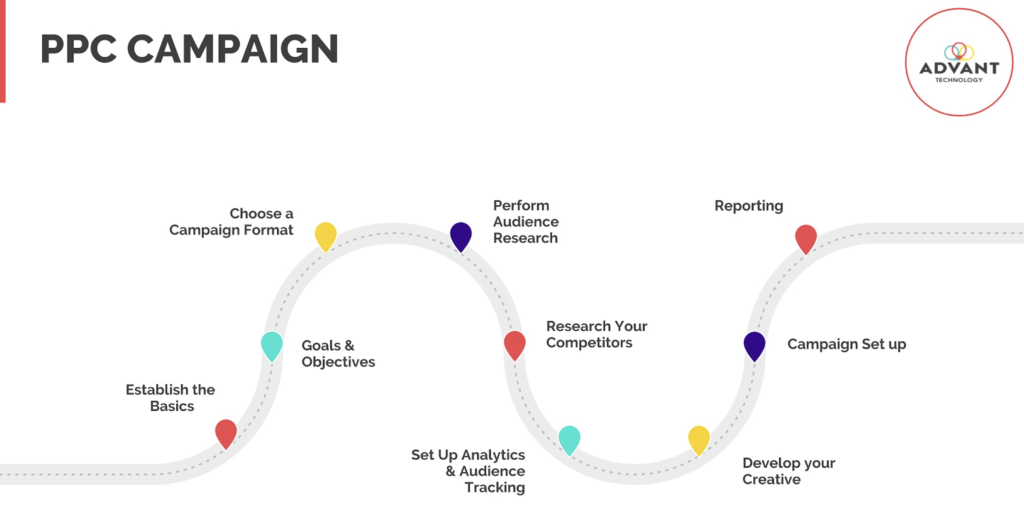
Hang on in there; we’re not done yet. There’s still lots to learn; let’s take a look at how to set up a PPC campaign. How you end up building a campaign will ultimately depend on the final platform you choose; what platform you choose will depend on some of the basics.

1- Establish the Basics

With any marketing campaign, you want to establish your goals and the objectives for reaching those goals. You want to establish first and foremost:

  • Who do you want to target?
  • How do you sell your products?
  • How do people buy what you’re selling?
  • How will you measure success?
  • How can you track offline activity?
  • What type of campaign do you want to run?

2- Goals & Objectives

An example of a goal might be: To increase revenue by 20%

An example of an objective might be: Increase the number of new customers acquired through PPC campaigns by 40%.

Let’s look at some of the different types of campaigns you can run to reach your goals.

Brand Awareness

This type of campaign is aimed at getting your brand known among your target audience. Brand awareness campaigns can also aim to increase your KPIs, which might be ad recall or top-of-mind awareness. Whilst awareness is good, just because someone is aware of your product does not mean they are willing to buy it; therefore, as part of a branding campaign, you may also want to increase consideration and purchase intent, which is slightly further down the buyer journey funnel. Purchase intent is harder to achieve than funnel awareness. Video storytelling can be a good medium for purchase intent, but you won’t be able to buy video ads on a PPC basis; more common is pay-per-view.

Lead Generation

Lead gen campaigns are typical where you’re offering a service; industries include insurance, finances, insurance, accounting and law. These types of brands typically require contact information so they can send out more detailed content via emails such as whitepapers or additional offers.

Lead generation campaigns are all about collecting data from your target audience and building up profiles on those people so you’re ready to market to them again. This is a very common practice if you are a B2B marketer.

Direct Sales/Performance Campaigns

The goal is a direct sale, we’re getting into the weeds here, and you’re thinking, hold on, isn’t this always the goal? Well, yes, pretty much every campaign leads back to sales, but that isn’t always the objective. Direct sales campaigns are normally where the only metric that matters is ROI. £10 in ad spend £20 out in revenue. For example, you’re not bothered about your brand or leads, just sales! Performance campaigns are going to be most popular for E-commerce brands.

3- Choose a Campaign Format

Digital advertising encompasses many formats. Let’s take a look at them.

Display ads

Display Ads are banner ads in the form of html5 of images, they can be bought by some ad networks on a PPC basis, but mostly they are bought on a CPM via programmatic real-time bidding.

Search ads

Paid ads that show up when a user performs a search great for keyword targeting. Search ads can be run on Apple search, Bing, Google Ads and also Pinterest, among others.

Social media ads

Ads that appear on any social media platform, such as Facebook, Twitter and LinkedIn. Social media ads are typically image-based as opposed to just text which is more popular with search ads.

Google shopping ads

Google shopping ads are product listing ads that appear at the top of search results on Google with an image and description. This format is typically used for eCommerce brands and can be bought on a CPC basis.

Remarketing ads

As we’ve established, some platforms are better than others at remarketing and specialise in just this one thing, but they do it well.

4- Perform Audience Research

You need to know your audience in-depth, and part of that is understanding what they are looking for or what they are searching for. So much of our behaviour nowadays is linked back to our search habits. From our search habits, marketers can infer so much data. Try the Google Keyword planner for free or upgrade to paid tools like SEM rush can give you keyword ideas based on an initial seed word.

Alternatively, turn to a specialist partner who can help properly asses the path to purchase / user journey and map out the different keywords that are relevant at the different stages of the buyer journey. Let us know if you’d like us to refer you.

5- Research Your Competitors

It’s crucial that you know who your competitors are before launching a campaign- just knowing the keywords they are bidding on and seeing what ads they’re running can give you a great head start.

If you already know your competitors it’s a good idea to set up alerts for any new or changed ads they are

Tools from SEM Rush can help you see what keywords they are bidding on and the estimated CPC for each, as well as their ad copy.

Look out for:

  • Keywords they are bidding on
  • Headlines, the more competitive keywords will probably have stronger ad copy that you can learn from
  • Ads they are running

6- Set Up Analytics & Audience Tracking

Installing Google Analytics is an easy job, and there are loads of plugins, especially if you are using web tools from the likes of WordPress, Squarespace or even an E-commerce solution like Shopify or Bigcommerce.

7- Develop your Creative

If you did your job well in the audience research phase, you’ll know the motivations behind why someone would want to use or buy your product and, even before that, what kind of content is going to engage audiences.

Creative is so important. You can deliver an ad to the right person based on the target keywords you’ve to know the user is searching, but if the ad copy does not resonate with the user, they may not consider it to be relevant, and they’ll just scroll straight past your ad and result in wasted ad spend.

Having good ad copy will benefit your whole campaign and increase the quality score of your campaign. Quality score is crucial to keeping costs down and driving return on investment.

A well-written ad will use the right keywords, make it stand out visually and will even use the persona data that you’ve collected to be sure it’s relevant.

A few tips for excellent ad creative:

  1. Use powerful headlines. Above all, remember you are selling something, so don’t be afraid to be direct about it. Remember, you are selling something, so don’t be afraid to be direct about it when it comes to performance campaigns. For brand awareness campaigns you can be a bit softer and more emotive.
  2. Be concise – Remember your audience is human, too, so think like a consumer rather than just an advertiser. If you are selling a product that you would use or buy, then your audience will be more likely to also.
  3. Be relevant -Understand your audience and target market, be mindful of your audience and use language that is going to resonate with them.
  4. Be creative – Use a mix of images & video where possible.

ABT Always Be Testing

Chances are you won’t nail it the first time. A/B testing ads is the only way to find out what works for your target audience. Look at your reports and see which creatives are delivering the best ROI or which ads are hitting other metrics such as quality score, CTR etc. You can then use this information to inform your creative approach going forwards.

And remember – just because you have a new winner, it doesn’t mean you should stop testing. PPC is a constant work in progress. Always be testing!

8- Campaign Set up

Once you have all the ingredients, you want to set up your campaigns. Be sure to keep the structure of the campaign well organised. If you are selling many products or you have a complex audience where you need many different messages, you need a taxonomy/ short code structure so you can easily see what each ad group is doing.

Here are some good tips you should follow when setting up campaigns:

Structure campaigns tailored to specific audiences allowing us to understand which audiences are best performing and where we see the biggest engagement

Audience groups Clear definition of audience targeting groups with a deep understanding of who you are addressing

Dynamic budgets Allow for flexibility

Use smart bidding and use AI where possible to gain a competitive advantage. 

Automation Automate simple tasks that will lower costs and increase KPIs

Clear insights having your campaigns clearly labelled and broken out allows you to see insights and better understand what’s driving sales and what should potentially be paused.

9- Reporting

Good reporting is the backbone of success in digital marketing, particularly when it comes to PPC advertising. Reports can help you track your campaign’s performance and make informed decisions on how to adapt in the future.

There are a variety of different reports available depending on which platform is used but no matter what platform you use pay close attention to Google Analytics to see which traffic source is driving traffic and sales.

PPC marketing takes time to learn, and whilst this guide is a good starter, it cannot replace years of knowledge in developing a digital advertising strategy. For that, you should be a knowledgable team or turn to an agency that is experienced. Sometimes the trade-off in fees paid to a paid media agency is worth it because, ultimately, their goal is to return a higher ROI than if you advertiser were to manage the campaign yourself.

Good luck with your next campaign and if you need help, we’d love to use our knowledge and experience in driving sales for your brand!

Free Paid Media Review

We are a world-class programmatic marketing agency that can generate more sales and leads for you. Leave your email address, we will contact you for your free paid media review.

Categories
Blog

Data Insights Agency Helps Brands Generate Growth through Paid Media

Data Insights Agency Helps Brands Generate Growth through Paid Media

At our data insights agency, we understand that performance marketing is the key to growth for any brand.

That’s why we focus exclusively on paid media performance campaigns. We use the latest data tools and techniques to help our clients achieve their desired results.

Whether you’re looking to increase website traffic, boost sales, or better understand your customers, we can help. Contact us today to learn more about how we can help you grow your organization!

Let’s start with the basics…

Data insight agency

We believe that data should be the driving force behind all decisions. As an agency, our job is to help you find ways of unlocking its power and making it work for your benefit both now and in future endeavours.

We use proprietary technology and a process-driven system that relies on big data to gain a deep understanding of your target audience.

Understanding the customer journey is key to success in an online world.

Data is essential to understand where your traffic, leads and sales come from and what the different journeys are for each platform customers use. All of this allows us to optimize to take actionable insights on how we spend marketing budgets with media partners/platforms so that you get the best possible ROI. 

Actionable Insights

Reams of data can be hard to understand and even harder to put into meaningful insights.

For larger organizations, it’s tough figuring out which arm is impacting the company. Our agency‘s involvement can help add clarity by helping you make sense of the data that will have an impact on your business growth. We help you avoid data overload so you can focus on your day-to-day tasks.

This skill and knowledge in handling data are what separates us as a growth marketing agency from other agencies. 

Analytics

One way our agency team helps you to better understand the impact of performance campaigns is through our market-leading real-time reporting dashboards. 

Through hundreds of advertising campaigns over more than seven years, Advant Technology has first-hand data on what clients need in their campaign reports.

We’ve learnt that by being able to visualize relevant information in a clear, cohesive way, brands can use the data properly for value creation in a quick, efficient manner. 

This helps marketers spend less time reporting so they can focus on their product/service. It’s just one way we create value as a growth marketing agency.

Access Integrated Platform Data

GA4 implementation

Google Tag manager

Facebook Ads reporting

Google Data Studio Data Visualisation

Supermetrics

Google DV360

Demand Side platform reporting – Display, video, native

Pinterest Ads reporting

Twitter Analytics

Quora Ads reporting

TikTok Ads reporting

Google Ads reporting

Campaign manager

Floodlight reporting

Search console reporting

Data Insight Intelligence

Buyer Persona research

User journey behaviour analysis

Measure ad effectiveness

Creative concept testing

Develop attribution modelling

Develop customer segmentation

Multivariate testing

Data-Driven Solutions Agency

Paid Media performance campaigns

Media Buying

Programmatic ad serving

Ad tech consultancy

Tracking & data integration

Bid management automation

Audience development

Marketing strategy development

Analyze site conversion rate optimization

If your brand needs an agency to help you grow rapidly and scale your digital marketing with fact-based decision-making, drop us a line only. Our services can help brands prepare to invest in a data-driven approach.

Free Paid Media Review

We are a world-class programmatic marketing agency that can generate more sales and leads for you. Leave your email address, we will contact you for your free paid media review.

Categories
Blog

International Digital Marketing Agency Services

International Digital Marketing Agency Services

Looking for a digital marketing agency that can help you with PPC, social media and programmatic advertising?

Look no further! At our agency Advant Technology, we specialise in helping clients achieve their paid media goals.

We understand the importance of building awareness and driving sales, and we are dedicated to helping our clients achieve these objectives.

What Makes Us Different From Other Digital Marketing Agencies?

A successful digital marketing agency needs to have a strong understanding of its client’s business, and this is why we develop a deep understanding before spending any digital budget.

Our digital marketing agency processes start with the

  • Goals and objectives are the starts of everything we do, and our advertising services are tailored to meet those.
  • Once we have the goals and objectives, we look at audience insights, a time when we can research and educate ourselves about your business.
  • Next comes the overarching strategy, which is a high-level plan that will help us allocate the correct resources to each activity.
  • This sets a framework for developing an efficient channel strategy where we look at which advertising platform will be best.
  • In some cases, we may need to look at a partner strategy, perhaps specific publishers whom we need to partner with in order to get special access to inventory or data.
  • Next comes the content production and media plan, which will outline all the content we will produce and where it will be placed.
  • Each platform is different, so we need to adapt creativity to the channel.
  • Next, we launch, and the program optimisation begins.
  • Continuous reporting is a big focus for our clients and us, giving them transparency about how their digital agency is spending its budget.
  • Finally, the program is reviewed, and further opportunities are identified for additional effective marketing solutions.

We’re committed not just to providing services but also to going above and beyond by offering dedicated support throughout all stages.

Our Digital Marketing Services

International Pay-Per-Click advertising (PPC)

The power of pay-per-click advertising lies in the fact that behind every search, there is some form or intent resulting in a channel which can deliver high conversion rates.

With our digital agency partner network, we can run PPC in virtually any language in any country more than translation we do transcreation. 

Advant Technology is able to improve your campaigns by carefully selecting keywords and target markets that will generate the most relevant high-converting traffic. 

We have a team of highly experienced professionals who specialise in setting up and managing international PPC campaigns. As a data-led team, we look at key performance indicators which we set at the start of the marketing strategy. Our expert team then report back with any changes needed to the digital strategy in order to deliver more effective marketing results.

For PPC marketing efforts, we use a combination of Google Ads and Bing.

Social media performance marketing

Social media is an integral part of any digital marketing strategy.

The goal of social media marketing is to build relationships with customers and followers across social media platforms such as Facebook, Instagram, Snapchat, LinkedIn, Pinterest and the ever-growing TikTok platform.

Paid social, on the other hand, needs to connect with customers on an emotional level, build brand awareness and ultimately drive more sales. A strong marketing agency worth their salt will choose the right social platform based on your goals, your industry, your market and your target audience.

The right social media agency is one that helps you understand your audience and their needs, not merely what they’re interested in. We know that each social media user interacts with the platform differently. That’s why we develop comprehensive buyer personas to inform our testing and optimisations, ultimately helping you grow your business.

So, what makes us one of the best social and digital marketing agencies? It’s our data-led approach.

Data lies at the heart of every industry-leading social media marketing strategy, and we have the team with the skill set to analyse data, find insights and use it to make decisions about developing a media plan that drives efficiency beyond other digital agencies.

Social Media Digital Strategists

Our team of digital strategists is always testing new ways to grow clients’ businesses. We have systems set up where we can run hundreds of tests and analyse results through visual dashboards to make the necessary optimisations and get the most out of our client’s online advertising budgets.

To get better results, our marketing agency tests audiences obsessively and experiments extensively with ad-creative. We utilise data-based campaign optimisations that are built out across multiple channels for growth.

Maintaining growth requires strategic planning, which our experts do every week on behalf of our clients, and we do this across many international markets.

To most, when you say social advertising, they think of Facebook, but there is more to social media advertising than just Facebook Ads.

You might think that once you start seeing results on your paid social campaigns, you should only focus only Facebook, but we like getting creative with the way in which we think about digital platforms to reach customers. We work together towards increasing touch-points across all major networks to increase scale & efficiency.

Programmatic advertising agency services

Beyond the major digital marketing solutions such as Google Ads and Facebook Ads lies programmatic advertising.

Most of the digital marketing campaigns we run for clients include some form of programmatic advertising, and it’s what separates us as a leading international digital marketing agency used by some of the world’s biggest brands as well as start-up/challengers.

Even some of the top digital marketing, creative and PR agencies outsource their programmatic but not Advant Technology. Our own account management and ad operations team run programmatic in-house. In fact, programmatic advertising is part of our DNA.

The truth is programmatic advertising is complex, and that’s why we are a white-label solution for some of the best award-winning agencies across the globe.

If you’re looking for a digital marketing company, make sure they offer programmatic advertising because programmatic advertising has many benefits, and it’s not just for big businesses. We’ve proven programmatic can also work for start-ups and smaller businesses too.

Programmatic works for B2B advertising as well as B2C.

Our programmatic advertising services include:

– Programmatic buying

– Programmatic media planning

– Programmatic creative

– Programmatic campaign execution

Some of the benefits of working with us for programmatic advertising include:

– Reach: Our programmatic advertising campaigns help you target specific audiences more efficiently and at a lower cost than traditional media buying.

– Transparency: We show you exactly how much you’re spending, where your ads are running, and who’s seeing them.

– Efficiency: Our automated buying means less wasted ad spending. AI and machine learning are used to improve efficiency further.

– Accountability: Because you can track your results, you can see what’s working and adjust your campaigns accordingly.

  • Retargeting: One of the unique benefits of programmatic advertising is that you can target previous website visitors with ads as they browse other websites.

Our approach in programmatic is the same as our other digital services, centred around our clients’ needs and always data-led.

Flexible, collaborative relationships

Marketing is constantly evolving, and so are the needs of both clients and agencies.

Clients need a partner who will keep them up-to-date with what’s happening in their industry while also providing guidance on how best to navigate it; our agency acts as this counsel.

The goal should always be identifying opportunities where you can expand your reach – whether through new strategies or reevaluating old ones.

Marketing campaigns are living, breathing organisms. They need constant supervision and attention if you want them to succeed!

One responsibility our agency takes on when working with clients is providing proactive, engaging account management throughout all stages, including planning/strategy development, execution and optimisation. It’s what we do for our clients. We think of ourselves very much as an extension of your team, and this is something our clients say to us.

Digital marketing services for any industry

Some of the industries we’ve worked in are Travel, Finance, Automotive, E-commerce, Technology etc.

Sector experience helps but at the heart of any effective marketing strategy lies a deep understanding of people, data and technology, and this is something Advant Technology excels in. We’ve probably got a bunch of case studies in your industry. Drop us a line if you’d like to learn more.

Global Digital Marketing Agency

Advant Technology is a global company. We originally were based in London but have now grown to include the United States and Andorra. What truly makes us global, though, is our remote team, who works across several continents and has the capacity to reach audiences across the globe with just a few clicks.

Free Paid Media Review

We are a world-class programmatic marketing agency that can generate more sales and leads for you. Leave your email address, we will contact you for your free paid media review.

Categories
Display banners

Advant Technology: Display, Google and Facebook Retargeting Services

Advant Technology: Display, Google and Facebook Retargeting Services

Retargeting Services - Advant Technology
Retargeting Services – Advant Technology

Retargeting is a powerful tool that can be used to deliver ads to people who have visited your website but haven’t converted as such, it is one of the most efficient targeting methods to help increase conversion rates.

Most people do not convert the first time they visit your site; therefore, bringing those users back to your site is crucial.

Discover the buyer’s journey

The buyer or Consumer Journey is a process that defines the steps customers take to purchase products and services. It considers different phases of decision making, from information gathering through evaluation and final purchase.

Remarketing campaigns aren’t just about throwing ads in front of website visitors who have already been to your site. It’s about understanding the consumers’ journey and providing relevant messaging at each stage, retargeting ads are a powerful tool for pushing customers down the funnel, but they must be used correctly if you want to maximise your advertising spend.

A well-thought-out retargeting strategy delivers ads with the right frequency, and with the right message, for example, a product that the user viewed on your site the previous day. This is done with dynamic campaign optimisation, also known as dynamic retargeting.

Retargeting Agency Platforms

We specialise in retargeting services across programmatic display, Google Ads, Google Display Network and social media, including Facebook, Instagram, LinkedIn, Twitter, Pinterest, as well as Quora and Reddit Ads.

Yes, each of these platforms helps to reach past visitors, but which is best for your marketing strategy?

That’s where our team of planning and buying expert marketers will help choose the right retargeting platform that fits your ad spend budget.

Facebook Retargeting Campaigns

Facebook has a huge reach through its apps which include Instagram. With Facebook retargeting, you can target people who have visited your website or specific pages on your website. One of the benefits of Facebook retargeting is that it’s very easy to create custom audiences based on their interactions with you as a brand. For e-commerce brands, Facebook retargeting is a diamond that can shine bright for you! 

Via Google Ads, you can build a Google Display Network remarketing campaign, which means you can retarget people who have visited your website or specific pages on it with a display ad format. The Google Display Network is extensive but not as extensive in reach as programmatic display retargeting. One advantage is that you can quickly share audiences from your PPC search ads, thus allowing you to make your PPC campaigns more effective.

Programmatic Display Retargeting

Programmatic advertising is one of the most sophisticated forms of digital advertising. With programmatic, you can retarget with many formats, including video ads, display ads, native ads and even audio ads. For even more sophisticated awareness-driven campaigns, you can even do cross-device Connected TV retargeting. As programmatic has such extensive reach, you can combine the retargeting ads with other forms of targeting such as site lists and audience lists to really narrow in on your target audience.

LinkedIn Retargeting

LinkedIn retargeting allows you to target your current and potential customers on the world’s largest professional network. You can retarget with text, image or video ads. LinkedIn is great for B2B brands.

Pinterest Retargeting

Pinterest retargeting ads are a little different to other social media platforms as it allows you to retarget people who have engaged with your pins as well as your site. Pinterest is unique because it’s a visual search engine, which can be great for retargeting as people are already interested in what you do via keywords.

Retargeting Services - Advant Technology
Retargeting Services – Advant Technology

Retargeting Campaigns Explained

B2B Retargeting

The B2B buyer journey is a much longer and much more complex sales cycle; therefore, to affect their decision-making, you will need multiple touchpoints with your audience. Retargeting ads work by helping to create a journey, keeping you top of mind, re-engaging users and bringing them back to content that will influence and build trust.

Cart Abandoners

When a potential customer leaves products in their cart without making a purchase, retargeting can be used as an effective way to bring them back to your website and complete the sale. Thus increasing sales and increasing conversion rates.

Dynamic Retargeting

Works by creating a retargeting campaign that’s tailored to each visitor based on the products they’ve viewed on your website. This is done by tracking user behaviour and then serving them ads related to the items they were looking at on your site. Dynamic remarketing is the most effective way to retarget website visitors as it provides a personalised experience that’s relevant to them.

Audience Segmentation Retargeting

Allows you to track users who have visited different parts of your site and then deliver a retargeted ad based on that audience behaviour. A  finance client of ours uses this method to tailor the retargeted based on the type of finance product they offer. The more tailored the message, the greater the chance they will click your ad.

List Based Retargeting

This retargeting method uses email, name and telephone lists to target those who have given consent to be included in a remarketing campaign. Typically you can build these lists based on past purchasers.

Retargeting Effective Ad Strategies

There are many ways of approaching retargeting ads. It can be difficult to determine which one is best for your company or brand. That’s where we come in. With our years of experience in retargeting, we can help you choose the right platform and create a retargeting strategy that will help increase sales and conversions.

Retargeting reporting

Advant Technology offers live real-time dashboards so you can track all the data in one place. We also offer in-depth post-campaign analysis to help you understand which retargeting methods are the most effective for your business. We include all the metrics you need to make informed decisions about the effectiveness of your ad spend.

Remarketing Clients

Advant Technology has run hundreds of retargeting campaigns. Our retargeting clients come from a wide range of industries, including finance, travel, technology and more.

Frequently Asked Questions About Retargeting Strategies

What is retargeting?

Retargeting is a form of digital advertising that helps to reengage users who have previously visited your website. We do this by serving them ads related to the content they were looking at on your site.

How do we collect audiences for retargeting?

There are a few ways you can collect retargeting audiences. The most common way is by using tracking pixels. These are tiny pieces of code that you add to your website, which allow retargeting platforms to track users who have visited your site. We can also use app-based events and customer data lists as an alternative to pixel-based retargeting.

What is the difference between retargeting and remarketing?

Retargeting and remarketing are used interchangeably. They are the same thing.

How much does a retargeting campaign cost?

Retargeting budgets are often dependent on the size of the audience you want to retarget. The greater the audience size, the more money you will be able to spend on retargeting them, which is a good thing since you should see excellent returns on any effective retargeting campaigns.

Conversely, if your audience/site visitor count is small, so will the budget you can spend on retargeting that audience. So to answer this question, you’ll have to look at your audience size. On top of the media spending budget, there will also be agency fees for the management of the campaign.

Depending on the goals and objectives, your industry, size of audience etc., you should expect to pay somewhere in the region of around $0.50 to $2.50 per click on GDN, and you can expect to pay a similar amount for a Facebook retargeting campaign.

For serious marketers, generally speaking, you should look to spend around 10-30% of your overall digital budget on retargeting campaigns.

When should you use retargeting campaigns?

Retargeting should be used whenever you have a website visitor that you would like to reengage. For most businesses, this will be after they have left your website, but retargeting can also be used to target users who have engaged with you on other channels such as social media or email.

Benefits of Retargeting Ads

Improves customer engagement – When you retarget your customers with personalised ads across the web, they become more interested in what is being advertised. This prompts them to reengage, and this leads back towards improved customer engagement!

Boosts brand awareness – Retargeting helps build brand awareness by showing your ads to potential customers who have already been exposed to other parts of the site they visit. This creates more brand awareness for you by keeping your brand top of mind and showcasing more of what you have to offer. If brand awareness is the goal, use video retargeting.

Increases conversions – Retargeting ads have been proven to drive conversions for your brand. When a customer reengages with the ad, they will show more affinity and are much more likely to make a purchase. So, the conversion rate will increase due to this.

Enhances Customer Lifetime Value – Retargeting ads enhance customer lifetime value because once a person makes an initial purchase, you can retarget them with similar products that might interest them even more.

How to choose your next remarketing agency?

When choosing your next retargeting/remarketing agency, it is important to consider their experience and expertise in the field.

Also, be sure to ask about their retargeting methodology and what platforms they will use for your campaign.

Additionally, make sure that you have a good understanding of the budget you are willing to spend on retargeting and ask the agency what kind of results you can expect within that budget.

Discuss how they will report, how often and in what format.

Understand that retargeting is only one part of the overall purchase funnel. Having an expert in retargeting that is no good at prospecting won’t work, so make sure you also evaluate their full agency offering. You want to ensure the agency that is doing the mid to lower funnel is also doing the bottom of the funnel.

Can you run marketing and remarketing campaigns at the same time?

Yes, retargeting can be done in conjunction with other marketing campaigns. In fact, it’s often recommended to run retargeting campaigns simultaneously with other branding or lead generation initiatives.

What are some common retargeting myths?

When it comes to retarget, there are a lot of misconceptions out there. So, before we get into the details of how retargeting works and why you should be using it, let’s first dispel some of these myths.

Myth #01: Retargeting is only for big brands

Myth #02: Retargeting is only for e-commerce businesses

Myth #03: Retargeting is too expensive

Myth #04: retargeting doesn’t work

How should you optimise a retargeting campaign?

There are many factors/levers we can push and pull when it comes to optimising retargeting, which include.

  • Better or more micro-segmentation of audiences
  • Messaging
  • Creative new / different /fresher
  • Format – video, display, native, audio
  • Landing pages
  • Dynamic product optimisation
  • Split test audience exclusions
  • Creative size
  • Combine audience retargeting with other targeting methods, including geo, time of day, recency, bidding optimisation
  • Platform change
  • Bidding model from CPM to CPC or CPC to CPM

These are just a few optimisations that our team will look at, but there are many more strategies we can employ to get the most out of targeted ads. We know how to create retargeting ads that convert.

Advant Technology is a retargeting specialist. We offer retargeting services across programmatic display, Google Ads PPC and social media, including Facebook, Instagram & Pinterest. Our retargeting methodology is based on data-driven insights, which helps us to achieve optimal results for our clients. Contact us today to discuss your retargeting.

Free Paid Media Review

We are a world-class programmatic marketing agency that can generate more sales and leads for you. Leave your email address, we will contact you for your free paid media review.

Categories
Programmatic

Programmatic Agency London: Meet the Experts

Programmatic Agency London: Meet the Experts

Advant Technology is a programmatic advertising agency founded in 2014 and has quickly grown to be one of the most successful agencies in London, working with some of the world’s most sophisticated marketing teams globally.

Display Advertising Agency

We specialise in digital display, video, audio and native advertising, which means we buy ad space to help brands engage with their potential audience through paid ads that are served to consumers based on their browsing habits and other user behaviour.

We use the most effective technology tools to reach potential customers, such as Google Ads, DV360 and Xandr, allowing us to run on the Google Display Network across mobile devices and desktop devices.

As a global player in display marketing, our account management team will help you define your audience and develop a tailored display advertising strategy. 

Display Advertising 

The online advertising ecosystem started with the classic display ad, a banner ad in a simple JPEG image format. Today the digital space encompasses much more. 

Our programmatic display agency has access to many formats that help our clients generate brand awareness which include web banners, rich media such as skins and wallpaper, video including pre-roll and out-stream, native, connected TV, social, search and programmatic audio. 

London-Based Digital Marketing Agency

London is the leading digital marketing hub globally. It has a unique position where US companies wanting to enter Europe do so through London, and leading European companies take their first step through London. The result is the epicentre of digital marketing with access to the best ad-tech service providers. That talent and drive unique to London has laid the foundation for excellence in programmatic display advertising.

Target Audience

Your target audience is the foundation for launching a successful digital display advertising campaign. Advant Technology will help you determine who they are using a proprietary approach; this data is then translated into a custom strategy, ensuring we get the right message to your potential customers and advising you on how best to convert your website visitors.

Remarketing Display Advertising Services London 

We provide remarketing services to our clients; this means that even if someone has visited your website but hasn’t completed their purchase, you can target them again with the right message at just the right time. This will help increase conversions and improve ROI on display ad campaigns. 

Benefits of Display Advertising

There are many benefits to using display advertising as part of your marketing mix.

Some of these benefits include building brand awareness, increasing website traffic, generating leads and driving conversions.

What’s more, display advertising can be targeted at specific demographics (location, age, gender) or interests (travel, technology) so you can ensure your message is being sent to the right people.

Benchmarks That Matter

Online display advertising is complex, and it can be easy to get lost in the data. We simplify this by giving you access to market-leading dashboards. They are customised on a per-client basis. You can expect to see impressions, clicks, cost-per-click, conversions, CTR, viewability, time in view, completion rate, win rates and many other benchmarks. 

Display Advertising Campaigns

Frequently Asked Questions

What is a programmatic agency?

A programmatic agency is an advertising agency that specialises in programmatic display advertising. Programmatic display advertising is a form of digital advertising that uses software to buy ad space on websites and apps in real-time.

How much does programmatic cost?

Clients typically have a budget in mind; typically, we work with clients who are spending at least $5000/. £4000 a month on paid media. If you are already running paid search / PPC campaigns, programmatic advertising could help you extend your potential audience reach.

What are display advertising platforms?

Display advertising platforms are typically referred to as demand-side platforms or DSPs. They enable agencies to buy programmatic display campaigns through a complex infrastructure that connects advertising space from ad-funded publishers in genres such as news, entertainment and gaming mobile apps etc. to advertising buyers who buy the space through an auction that takes place in an ad exchange. 

Is Display Advertising Paid?

Yes, display advertising is paid, unlike organic marketing channels such as SEO. 

Do You Run Ads on the Google Display Network

Yes. Advant Technology has access to multiple DSPs, which allows us to run display advertising on a wide range of websites, including through the Google Display Network across all regions. We are also experts in other enterprise-level platforms such as Google DV360 and HAWK by Tabmo and Zeta. 

Benefits of a Display Advertising Agency

A programmatic agency’s main focus is planning and buying digital media. 

Agency Account Managers: Our agency account managers work closely with you to create a marketing plan that best suits your needs and budget and manage the campaign during its duration.

Digital Marketing: As a client-side marketing team, you have a lot on your plate. Our programmatic agency has a team of digital marketing experts who are able to run and analyse effective online ad campaigns for you, allowing you to focus on other areas of your business.

Data Targeting: We use data-driven targeting methods to target specific demographics, interests, and even locations with laser precision. We have access to partnerships and tried and tested methods to avoid unnecessary experimentation and wasted budget.

Campaign Management: Managing a digital marketing campaign can be a difficult task. For our programmatic agency, this is daily life. We monitor the performance of each ad for it to reach its full potential.

Data-Driven: Data-driven marketing techniques allow our advertisers to see what’s working and what isn’t, which means that they spend less, get more, and ultimately get a better ROI.

Reporting & Measurement Analytics: We offer detailed reports on all aspects of digital marketing campaigns so that our advertisers can track progress and see what needs to be improved upon.

ROI Tracking: We offer ROI tracking software to track site visitors and, importantly, how much money is made from online ad campaigns.

Multiple Channels: Our programmatic agency-managed service allows clients to advertise across various digital advertising channels, whether it’s Google ads search, display or social media advertising.

Creative Strategy: As a rich media agency, we have access to a wide range of creative agencies who will create the perfect ad campaign for your business or for simple banners; we can build the creative in-house.

Free Paid Media Review

We are a world-class programmatic marketing agency that can generate more sales and leads for you. Leave your email address, we will contact you for your free paid media review.

Categories
Guide Programmatic

The Complete Guide to Understanding Programmatic Digital Advertising​

The Complete Guide to Understanding Programmatic Digital Advertising

The world of online advertising is changing rapidly. There are new technologies that are emerging every day to give marketers more ways to target their potential customers through the buying of ad space.

One of the most well-known techniques is programmatic advertising. If you’re not familiar with this type of advertising yet, this guide will help you understand what it is and how it can benefit your business.

Digital marketing experts need to understand so many audience touch points. Buying advertising space is not as simple as it once was. The automated buying process of programmatic advertising is a response to this complexity.

Programmatic advertising explained

The first step in understanding programmatic marketing is learning about its definition – what exactly does “programmatic” mean?

To put it simply, programmatic advertising relies on automated software and algorithms to make decisions quickly and efficiently. In digital advertising, programmatic means using technology to deliver ads automatically based on a number of different factors, including but not limited to location, time, and browsing history.

It means you can reach out to individuals who are already interested in your product or service without having to pay for broad advertisements that may not necessarily be relevant to your target audience, aka in-market audiences. 

Programmatic advertising is a complex sub-section of digital advertising, which is why most programmatic ad spend is transacted by programmatic agencies.

What is a programmatic agency?

Since most programmatic is traded by agencies, let’s define what a programmatic agency is. 

They are normally responsible for the entire programmatic process on behalf of the advertiser. From planning programmatic advertising campaigns to strategy to trafficking and buying ad space, a good programmatic agency will take care of everything for you.

They should have a deep understanding of the different programmatic advertising technology platforms in the programmatic ecosystem so that they can offer you the best advice when it comes to your campaign goals.

Benefits of data-driven advertising for businesses

Targeting potential customers using programmatic advertising is extremely efficient because it uses data to target the right individuals.

When executed correctly, programmatic media buying can lead to higher click-through rates (CTRs) and conversion rates, as well as increased brand awareness.

Programmatic ad buying benefits also include improved efficiency and automation, better creative optimization for performance based on data collection and analysis as well as enhanced transparency through detailed analytics reporting.

Who should use programmatic marketing? 

This type of media buying is ideal for advertisers who want to run targeted campaigns and reach their target audience quickly and efficiently.

However, it’s important to note that programmatic marketing is not a one-size-fits-all solution – it requires significant technical know-how in order to be executed properly.

If you’re not familiar with programmatic advertising or don’t have the resources to execute a programmatic campaign yourself, it’s best to leave it to the ad-buying experts. A good programmatic agency will be able to help you take advantage of all the benefits that programmatic advertising has to offer.

What are the main components of programmatic?

The next step in understanding how programmatic advertising works is learning about the main parts that make up this type of digital marketing:

  • A supply-side platform, or (SSP), is a technology platform that allows publishers to sell ad inventory directly to advertisers and agencies.
  • A demand-side platform (DSP) is a form of internet advertising technology that provides bid management systems for marketers to buy advertising inventory programmatically.
  • Ad exchanges are a platform for advertisers and publishers to interact with each other using real-time bidding. An ad exchange is responsible for the mediation of matching bids and requests as well as reporting on delivery statistics.
  • Real-time bidding (RTB) is a real-time auction system. In RTB, the highest bid wins and inventory is sold on an impression-by-impression basis as opposed to being sold in advance or through some other prearranged means of purchase.
  • Data management platforms (DMPs) are used by marketers to collect, organize and activate customer audience data. They allow for the activation of first party data (data that is collected directly from customers), as well as the buying and selling of third-party data.
  • Private exchanges are ad marketplaces made up of advertisers and publishers that operate independently from the open ad market. Using private exchanges, brands can select audiences they wish to reach using their own data.
  • Ad Servers are technology solutions that help to serve ads to web pages, mobile apps, and other digital media. They provide a way for ad agencies and advertisers to manage their advertising campaigns, as well as measure their effectiveness.
  • Programmatic direct enables marketers to buy media from publishers directly using technology.
  • Ad Tags are snippets of code that are placed on web pages that allow marketers to track the number of times an ad is viewed or clicked, as well as other interactions, they are served through an ad server.
  • Header bidding is a process that allows publishers to offer inventory to multiple ad exchanges simultaneously before making a call to their ad server. This improves the chances of getting the highest bid for the inventory.

What is an example of programmatic marketing?

Check out some of our work for many case studies and examples of programmatic ads.

Is Google Ads programmatic?

Programmatic is not just one system. It’s an umbrella term that describes many different types of systems, including but not limited to RTB (real time bidding). Google Ads is not an example of RTB, but it is a programmatic system. The Google Ad exchange is an example of an ad exchange its main competitor is Xandr.

Should I buy from a programmatic ad network?

Ad networks are still a big component of programmatic advertising, they group publisher inventory and instead of selling to media agencies directly, they offer their inventory into supply side platforms, which then sell that inventory into the programmatic advertising ecosystem.

What is the difference between programmatic and traditional advertising?

The main difference between programmatic and traditional digital marketing is the use of technology in programmatic to automate human tasks.

How are machine learning and artificial intelligence used in programmatic advertising?

Machine learning and AI are used in programmatic advertising to optimize campaigns, target audiences, and personalize ads. They help to automate the decision-making process by making predictions about future events.

For example, they can predict whether or not a user is likely to click on an ad. Machine learning gathers data and “learns” from it, while artificial intelligence applies human-like cognitive functions to that data.

Key programmatic technology platforms include:

  • Google DV360 – A DSP that is a part of the Google Marketing Platform.
  • Adobe Media Optimizer – A programmatic DSP that is a part of Adobe Advertising Cloud
  • Xandr – An ad tech company and marketplace that sells and buys ads programmatically on behalf of advertisers and publishers. 
  • Viant- A digital marketing platform that provides tools to create audiences, build targeted campaigns, use data management platforms (DMPs) to activate first party data.

Each programmatic technology has its advantages and disadvantages. When choosing a programmatic platform, make sure to review all of your options and consider your specific needs. A programmatic agency can help you choose the right technology partner.

What are the main formats of automated advertising?

Digital Display Advertising – targeted ads that are delivered across many devices in the form of a banner or rich media ad. It is the prevalent form of programmatic advertising.

The benefits of display advertising are that it has a huge scale, and you can communicate a lot of information in a small space through multiple frames of your ad. Generally, you have up to 15s but make sure your ad is catchy so people notice it.

Video Advertising – ads that are delivered as pre-roll, mid-roll, or post-roll videos. The benefits of video advertising are that this creative format allows you to tell stories and create immersive experiences; it’s great for branding or awareness campaigns.

Native Advertising – a format of digital advertising that matches the form and function of the environment in which it is delivered. Also huge scale, it feels more natural to the user and makes it less likely to get into issues with ad blockers and banner blindness.

Connected TV Advertising – TV ads that are delivered across over-the-top (OTT) platforms, including Roku players and smart TVs. Connected TV has grown in popularity because it has a high reach because people spend so much time watching TV.

Digital Audio Advertising – a type of programmatic advertising that delivers audio ads to users through their phones, computers, or other devices. The ads can be delivered as pre-roll, mid-roll, or post-roll audio ads, or as banner ads that play audio. They are served in apps such as Spotify. Learn about all the benefits of Programmatic Audio Advertising.

Programmatic Digital Out of Home Advertising – a type of programmatic advertising that delivers digital ads to users through physical displays, such as billboards and transit shelters. It is a growing sector because it offers location-based targeting capabilities.

How do you succeed with programmatic advertising?

Programmatic advertising is not a “set it and forget it” solution. In order to succeed with programmatic, you need to continuously optimize your campaigns.

This means regularly testing different targeting options, creatives, and bid strategies to find what works best for your business. You also need to ensure that your data is up-to-date and accurate.

Regularly cleaned and aligned customer data will help you achieve better results with programmatic advertising.

Expert knowledge in the digital advertising space will give you a head start, but even the savviest of digital advertising professionals will need to regularly test new strategies and tactics in order to keep up with changing algorithms, regulation changes, and market trends.

To make programmatic advertising work, you should keep a close on campaign analytics to measure their effectiveness and make changes when needed. Set up real-time dashboards, which will help you take action immediately when needed.

Keep an eye on programmatic ad fraud, which is bad for your business and the industry as a whole. You can protect your business from digital ad fraud by working with an ad fraud vendor who will be able to report fraudulent impressions and prevent you from bidding on potentially high-risk impressions.

Lastly, to keep up with the pace of programmatic advertising, you should have a dedicated team in place who can constantly review campaign performance and make changes quickly according to results or use an agency, like Quora Advertising Agency.

What is programmatic advertising in simple words?

Programmatic advertising is the use of technology to automatically deliver advertisements based on a number of different factors, including location, time, and browsing history.

What is direct programmatic advertising?

This is a type of programmatic advertising that allows buyers to purchase ads directly from publishers. It offers more transparency and control over the buying process, but it can also be more expensive than other types of programmatic advertising.

What is an ad exchange?

An ad exchange is a place where buyers and sellers can come together to find each other. It’s a marketplace for advertisers, publishers, and technology companies that work in the programmatic advertising space.

How much does programmatic advertising cost?

Programmatic buying costs will vary depending on the advertiser’s budget. So you can invest as little or as much as you want in a programmatic advertising platform.

What’s next for programmatic advertising?

Programmatic advertising is constantly evolving. The next steps for programmatic include more transparency and better controls for buyers, as well as the development of new technologies that will make the buying process even more efficient.

New formats will emerge, such as out-stream video developed just a few years ago, which will provide new opportunities for advertisers and publishers.

The industry will continue to face challenges from ad fraudsters who are always looking for new ways to exploit the system.

Consumer data and privacy is probably the biggest challenge that the industry will face in the years ahead.

Advertisers and publishers will need to find ways to use data responsibly while also protecting their customers’ privacy. All of these challenges make it an exciting time to be involved in programmatic advertising!

What is programmatic creative?

Programmatic creative is a term that refers to the use of technology to automatically create and serve ads. It can be used for everything from creating simple text-based ads to generating animated videos.

Programmatic creative makes it possible for advertisers to quickly and easily create and test multiple versions of an ad, which helps them find the most effective version faster.

So what exactly is the difference between RTB and programmatic?

Real-time bidding is a type of programmatic advertising that allows buyers to purchase ads through an auction system.

Programmatic is the term used for all types of automated buying, not just RTB.

So programmatic includes both RTB and non-RTB methods like programmatic direct, PMPs or programmatic guaranteed.

Want to learn more about programmatic media buying?

Check out our blog. We have tons of content to help you learn more about programmatic ads.

Free Paid Media Review

We are a world-class programmatic marketing agency that can generate more sales and leads for you. Leave your email address, we will contact you for your free paid media review.

Categories
Guide Native Programmatic

Getting Started With Programmatic Native Ads on DV360

Getting Started With Programmatic Native Ads on DV360

Programmatic strategies are constantly changing due to emerging formats, product features, and advancements in measurement and KPIs.

Many clients are seeking guidance on both short-term and long-term strategies for programmatic native ads on DV360.

Today, we are sharing with you the top five strategies our very own programmatic managed service buyers are implementing right now.

What is Google DV360?

It is a demand-side platform (DSP) and is part of the Google marketing platform (GMP). It’s an enterprise-level software different from Google ads.

Google Display & Video 360 (DV360), formerly DoubleClick, is a key component of Google’s marketing platform (GMP). Through a single dashboard, it enables campaign management & media buying across several multimedia channels, such as native, audio, video, display, and CTV.

Google’s machine learning technology powers DV360 and lets marketers work together more easily across teams while maintaining control of their marketing investments, creating faster and smarter marketing.

This article will use DV360 as a reference when learning about an effective way of buying programmatic native ads on the internet across web publishers and apps. However, the principles also apply to other demand-side platforms such as MediaMath, Xandr and The Tradedesk. 

How do you run Google’s Native Ads on DV360?

There are several steps marketers need to follow before they can start running native ads via Google’s platform:

  1. The first step for marketers is to create ads that meet the advertising specifications.
  2. Create the first campaign via the dashboard.
  3. Next, select the “Native” placement type for your ads.
  4. Once that is done, set up your bids by adding daily or lifetime budgets or using automated, rule-based bidding to optimize ads delivery across different placements.
  5. Define the campaign duration by setting a start and end date.
  6. Ensure you select all the right targeting options so your native ads are displayed to a relevant audience that is likely to purchase your product or service.
  7. Select an appropriate bidding optimization. There are several types of bidding optimizations available that we list below.
  8.  The last step marketers need to take is to sit back and watch as Google’s platform takes over, serving your ads across the internet. The best part of running native ads on DV360.

Bidding optimizations:

  • CPM Bid Strategy: A bidding optimization that uses a cost-per-thousand impressions (CPM) bid.
  • Flat Bid Strategy: A flat bid strategy sets the maximum price per ad impression based on the total budget for all ads in an ad group or campaign.
  • Target CPA Bidding Strategy: bidding optimization uses a target cost-per-acquisition (CPA) bid.
  • Custom bid strategy is an automated bidding method in DV360 that optimizes the bids by considering various factors like campaign priority, time of day, device type etc. This custom bid strategy can enhance the overall performance of the campaigns. It can provide an edge over other competitors participating in the same auction. This is a data-led approach for advanced advertisers only.
  •  The last step marketers need to take is to sit back and watch as Google’s platform takes over, serving your ads across the internet. The best part of running native ads on DV360.

Main Modules

There are five main modules on DV360. They include campaigns, audiences, creatives, inventory, and insights. Each of these modules plays a unique role and has its own management tools.

Campaign

The campaign module is where advertisers create and also execute cross-channel media campaigns. You can create, monitor, optimize, and plan campaigns.

Audiences

The audience module is where marketers can create and manage their audiences and maintain optimizations based on the reporting module across their campaigns. An experienced programmatic agency, advertiser or individual expert can set up audiences with Google’s tools in the audience module.

Creative

Start creating native ads by uploading an image for your ad. Click on the “Create Native” button and upload an appropriate file or enter text manually using the editor provided below. You can create native ads by customizing both the title and description of your ad.

The format gallery also allows advertisers to browse and find innovative formats and templates to test custom solutions. You can use the campaign manager to host native creative.

Inventory

An inventory module is where experts can discover and manage inventory from top publishers and broadcasters. This section offers the possibility to negotiate deals and explore opportunities in the marketplace.

Google’s DV360 native ads are exceptionally scalable. They are a mixture of remnant inventory and premium, which can be bought through PMPs, programmatic direct and programmatic guaranteed. 

Insights

The insights module allows users to access all the information and metrics needed for their campaigns. Customizable features inside the insight panel allow experts to analyze performance and act on those results.

These are available in easy-to-visualize reports and interactive dashboards. With the new 360s query workspace, you’re able to instantly access all of the data and insights that you need to create superior ad campaigns and first-class user experiences.

We recommend using Google Data Studio, which has a direct connection with Google DV360, allowing you to visualize data quickly and faster, encouraging stakeholders to refer to the data and making informed decisions about campaign optimizations.


FAQs

Can I run native ads via DV360 on Programmatic Direct?

Yes.

Can I run native ads via DV360 on programmatic guaranteed?

Yes.

Can I run native ads via Real-Time-Bidding (RTB)?

Yes.

What are some of the  programmatic native ad exchanges?

  1. Google Exchange
  2. Open Exchange (Adhese)
  3. PubMatic
  4. MdotM (Mobfox)
  5. Sovrn (Sovrn Holdings Inc.)
  6. Smaato
  7. Mopub
  8. Nexage
  9. Adyoulike
  10. Teads
  11. Sharethough
  12. Triplelift
  13. Taboola
  14. MGID
  15. OutBrain

What are the advertising specifications for Native ads on Google DV360?

Agencies and media buyers should refer to the following link.

What types of native campaigns can I run on the DSP DV360?

App install

App install ads are a great way to increase your app’s installs.

Traffic campaigns

Traffic ad campaigns are a great way to drive traffic to your website and increase conversions.

Native video

Ads are a great way to tell stories through the power of video.

Can Advant Technology help to run native ads for me?

Yes, this is our bread and butter. We have run hundreds of native ad campaigns and can run native ads on Google DV360 and potentially other native ad tech platforms depending on the objectives of your campaign and the KPI metrics you have set. 

If you don’t know the objectives and KPIs to look at, reach out to our team, and we can develop them in collaboration with you based on your business goals. If you want to run with a different DSP for whatever reason, we can facilitate this for you.

I’m interested in native ads. Does Advant Technology work with advertisers and agencies?

Yes, we work with advertisers directly or via many types of agencies, including

  1. SEO
  2. Creative
  3. Traditional Media Buying agencies / Offline Media Agencies
  4. PPC agencies
  5. Social media agencies
  6. PR agencies
  7. Full-service agencies
  8. Branding
  9. Influencer
  10. We even partner with other programmatic agencies

Conclusion

The possibilities for digital marketing are endless. What is your business goal? Do you want to generate more leads, convert more visitors into customers, or increase the average lifetime value of customers?

Getting started with programmatic native ads on DV360 isn’t so tasking once you know what it’s all about. However, delivering profitable advertising and returning a positive ROI with programmatic isn’t easy to do well. 

We hope this article was useful but if at the end of reading this you need help, consider hiring a marketing agency that allows you to obtain all of the value offered by DV360. You will be one step closer to delivering faster and smarter marketing campaigns.

Let our team of international media buying and planning experts help you deliver.

Free Paid Media Review

We are a world-class programmatic marketing agency that can generate more sales and leads for you. Leave your email address, we will contact you for your free paid media review.

Categories
Blog

How Are Online Ads Priced? Top 4 Advertising Models 

How Are Online Ads Priced? Top 4 Advertising Models

The world of advertising is changing. And in some ways, it’s becoming more complicated for advertisers and marketers to navigate.

So how are online ads priced? Read on, and we’ll explain the top 4 advertising models. You’ll learn that you don’t always need to buy on a CPC or CPM. 

By understanding the advertising pricing models better, you are able to negotiate with agencies and publishers to drive better advertising outcomes or apply new bidding strategies if you choose a self-serve ad tech platform such as Google Ads or Facebook Ads. 

Today, there are many online platforms, and with that come many digital advertising pricing models in buying advertising. 

Online advertising pricing models that you choose will depend on many factors, including your goals and objectives, the advertising platform, campaign objectives and your advertising budget.

Let’s begin with a quick introduction to various online advertising technologies. We start with formats and types of ads because different cost methods apply to different platforms/technologies. 

An introduction to the various types of online advertising:

As you’ll see later on, each model has its own benefits and drawbacks depending on the purpose for buying ads – be it traffic generation or branding. Here are a few channels you might need in your marketing mix.

Search Engine Marketing (SEM)

What is SEM? 

SEM refers to ads bought through search engine ad networks such as Google Adwords, Bing Ads, Yandex etc. These PPC (Pay Per Click) ads appear when users do specific keyword searches related to your business or products/services. 

For instance, if your company sells running shoes, you could bid on keywords like “running shoes” on Google.

When someone does a Google search for these keywords, your ad will appear along with other results. SEM ads are managed through the advertiser’s Google Adwords account.

Display Advertising

Display Ads are placed on dynamically-created web pages based via data-driven machine learning algorithms, mostly on publishers’ websites through programmatic ad exchanges, which are purchased via a DSP. The main difference between search engine marketing (SEM) and display advertising is that display advertisements are purchased on a CPM pricing model basis – cost per thousand views of your ad.

Programmatic display advertising is bought through real-time bidding across the open exchange and negotiated deals which are called private market places and programmatic guaranteed.

On the other hand, SEM campaigns are typically purchased on a CPC pricing model or PPC basis. There are several types of programmatic campaigns that fall within display ads, including banner ads, rich media ads, video pre-rolls, sliders etc. 

Most advertisers implement both SEM & Display strategies to achieve different goals like branding vs direct response goals.

Native Advertising

What is Native Advertising? 

Native advertising refers to a type of paid media where the ad experience follows the natural form and function of the user’s environment. 

In other words, native ads are designed and placed in a way that they blend in with their surroundings – much like how you’d expect regular content to appear on any given website or social media newsfeed.

You’ve probably seen examples of this in the form of promoted content on social media platforms like Facebook, Instagram or Twitter. Native ads are often paid for using a CPM pricing model in the programmatic world, but across social media and Google Ads, they are typically purchased on a CPC, Cost Per Click bidding model. 

Affiliate marketing

What is affiliate marketing? 

Affiliate marketing refers to an arrangement where one company (the publisher) promotes a product/service of another company (the advertiser) and receives a commission based on referrals or sales made by your audience. For example, you own a blog about gadgets selling cameras.

You could join the Amazon Associates affiliate network and promote Canon cameras on your site with links that track user behaviour through cookies. If someone buys something after clicking the link, you get paid for sending them to Amazon’s customer checkout page – like a percentage of their total purchase or a specific amount per item.

Mobile app campaigns

What is an app campaign? 

Similar to other forms of online advertising, app ads can be purchased through either search or display ad networks. One way to do this is through the Google Adwords and Apple Search Ads platforms (formerly known as iAD).

App campaigns are set up much like PPC (pay per click) ads, where you bid on keywords your target audience might use during a search query – such as “ios games”.

Advertising pricing models – Quick Look

Now that we understand a few formats and types of advertising campaigns, let’s take a look at the various advertising pricing models, which will really vary depending on the channel you are using. Given there are so many platforms, we’re focusing on the main social platforms and their respective bidding models.

  1. Google Adwords – pay per click (PPC) common in search ads
  2. Facebook Ads – CPM (cost per thousand or cost per mille), CPV Cost Per View model & CPC model
  3. YouTube Ads – CPM model & CPV
  4. LinkedIn Ads – CPM & CPC
  5. Twitter Ads – CPM, CPC
  6. Programmatic Display/video and native advertising – CPM
  7. Google’s Display Network – CPM
  8. TikTok – CPM & CPC
  9. Snapchat – CPM & CPC

Deep Dive – Online Ads Pricing

The main models can be broken down into

  1. Flat fee
  2. Cost per Click (CPC)
  3. Cost per Mille (CPM)
  4. Cost Per Action (CPA)
  5. Cost Per Acquisition (CPA)
  6. Cost Per Lead (CPL)
  7. Cost Per Download (CPI)
  8. Cost Per Install (CPI)

Flat Fee (FF)

The flat fee is a time-based model and one of the most basic. Relating solely to the time the ad is active, whether that’s a day, week, or month, the advertiser is charged a flat rate for this period.

Deeper info on the user, such as statistics, impressions, or general user actions, is not included. This makes it one of the cheaper options but also less thorough. 

The benefit is that if you’re concerned about budget, all the costs are known upfront, so you don’t risk running over. 

You would only ever use a flat-fee pricing model based on time if you are working directly with a very small publisher, this type of business model was prevalent in the early days of advertising, and we have moved to different pricing models today.

 Cost-Per-Click (CPC)

Cost-per-click (CPC) is a quantity-based model that is common with sponsored social media and display ads on web pages and Google ads. It’s regarded as one of the most popular and cost-effective forms of advertising. 

With this format, the advertiser is only charged per click, which saves money being wasted on showing ads to an uninterested audience. Also, clicks can be a useful measure of ad yield as they can reveal the number of potentially interested users. 

The drawbacks for advertisers are that keywords are becoming more expensive, and clicks do not guarantee action. A click might have been accidental, or the user might have left the ad in seconds and not interacted how you wanted them to.

Unlike FF ads, the costs can fluctuate depending on the number of clicks generated, so the upfront price won’t be as predictable. And depending on the average cost, ads will only be shown to users that are expected to click.

The average CPC will vary based on many factors, such as target audience location and industry. But one of the main factors is the quality score that Google Adwords and Facebook give to all advertisers, and it affects how much you’ll be charged for your clicks.  

Cost-Per-Thousand/Mile (CPM)

Cost-per-thousand (CPM) is most common for video and display advertising, especially in programmatic advertising. A flat rate is set for every 1000 views, which is often effective for direct sales, as well as brand and product awareness campaigns. 

Like with the FF model, the cost is known upfront and can be set within a budget relative to the cost per 1000 views.

The bad thing for advertisers is that it’s not based on clicks, so there’s no guarantee any action was taken from the ad as this user behaviour is not measured. This means you’re paying for impressions over clicks, which might not be for everyone. 

How do you calculate the cost of CPM ads?

CPM = 1000 * cost / impressions or try this handy calculator.

Cost-Per-Action (CPA)

Cost-per-action (CPA) is a performance-based model that is the safest for the advertiser, with the cost only coming when an action is taken, meaning no bad leads. These are more specific than CPL and can be reliant on things like a purchase or service sign-up. 

CPA is great for those looking for quick purchases, in particular, helping industries such as financial services, insurance, and professional services that have a high purchase barrier. 

Like the other models, which look at user behaviour, the price is not set beforehand, so a more open budget would be needed. 

CPA can be broken down into further categories, which we’ll jump into now. The top 3 include:

Cost-Per-Lead (CPL)

The price is based on the user filling out online forms, usually with personal data. The cost of this can increase depending on the complexity of the form. This is a very common approach in B2B advertising.

Cost-Per-Sale (CPS)

This type often has the highest prices as it’s used by large online retailers and requires the purchase of a product or service. This is common in affiliate advertising.

Cost-per-Download (CPD)

The cost is based on a user downloading specific material or downloading an app.

Cost-per-Install (CPI)

The cost is based on a user downloading an app and installing it, and then opening it.

Hybrid pricing models:

Hybrid models offer an even more tailored model. With so many models to choose from, the above models are not set in stone, and you have the choice to blend them if you can. 

Great stuff! 

You’re starting to learn a little more about the process by which ads are priced.

Marketing / Advertising Agency

 If you are reading this article, it’s likely because you are still learning about digital advertising. 

If that’s the case, you perhaps should consider working with an agency.

If you decide to work with a digital marketing/programmatic agency, you should expect that they will guide you as to the best way of buying online advertising and which pricing model you should use to lower advertising costs and increase your return on investment (ROI). 

A programmatic agency will take on the full management of this process, so you, the advertiser, can focus on other aspects of their business while the agency does its job to ensure that adverts are shown to potential customers at the right time and you don’t get bogged down in a million different ad formats furthermore trying to figure out which pricing model is best for you. 

So, what’s the best model of online advertising for me and my campaign?

Depending on which site, audience, and style of campaign you’re looking for, each model has its pros and cons.

If you’re still not sure which one is for you, Advant Technology can help.

We’ve run hundreds of video and display campaigns on various pricing models to get our clients more bang for their buck. So. if you want to run a campaign with any of the common pricing models discussed in this blog post, reach out!

Free Paid Media Review

We are a world-class programmatic marketing agency that can generate more sales and leads for you. Leave your email address, we will contact you for your free paid media review.

Categories
Tourism

What is a Destination Marketing Organisation?

What is a Destination Marketing Organisation?

Advant Technology has worked with many DMO advertising campaigns over the years, helping to create awareness and drive profitable footfall to specific locations within destinations. 

As Advant Technology works extensively in the tourism marketing and advertising sector, we felt it pertinent to define precisely what a Destination Marketing Organisation (DMO) is.

Understanding DMOs

The destination stakeholders represent the connection between individual suppliers and consumers of tourism services. This group comprises private, public, and non-governmental organisations that play an active role within the ecosystem, either as suppliers or consumers.

A destination marketing organisation (DMO) is responsible for promoting its location to potential visitors, including marketing the location’s goods and services. They are tasked with providing comprehensive promotion of their location to facilitate profitable tourism.

A DMO may be a non-governmental organisation (NGO), governmental organisation, company, or association interested in promoting its location. It can include anything from small towns to entire countries.

Depending on jurisdiction and legal requirements, they may focus solely on marketing within one country or internationally, therefore marketing to the whole world.

Services offered by DMOs

Destination Marketing Organizations offer services such as:

  • Destination management
  • Promotion
  • Visitor information and more

Types of DMOs

There are many different types of DMOs, including:

  • National DMOs
  • Regional DMOs
  • Destination Marketing Associations (DMA)
  • International associations and more

Advantages of Effective Destination Management Organisations

Achieving Consistency: An effective DMO has ownership and responsibility to coordinate among public and private stakeholders at international, regional, national and local levels to ensure consistency.

Sustainability: Destination activities and initiatives that are not well-managed may lead to irreversible loss of resources and customer loyalty, damage the destination’s image and reputation, and create obstacles for future development. An effective DMO works towards sustainably managing these issues.

Tourism Marketing & Promotion: The Tourism Marketing & Promotion Division is responsible for implementing all provincial tourism marketing and promotional activities to facilitate profitable tourism. It supports destination DMOs in developing, managing, promoting and evaluating their respective tourism products.

Building Tourism Culture: Tourism marketing and promotion helps build awareness of the destination’s attractions, services and experiences in key markets—locally, nationally and internationally. The destination marketing organisation acts as a point of contact for international tourism organisations.

Establishing Effective Partnerships: The effective implementation of tourism activities can only be achieved through collaboration between all stakeholders in the destination.

Limiting Overtourism Impact: Tourism marketing and promotion can help lead visitors away from overcrowded sites, reduce traffic congestion and provide more options for visitors.

Building Strong Brand Identity: A destination’s brand can attract and retain visitors by providing a clear and consistent message about the destination. A strong brand identity helps build loyalty among visitors while increasing their overall satisfaction with the experience.

Destination Branding: Destination branding involves creating an image or style that identifies a place in the minds of target markets (visitors, potential visitors and opinion leaders) and differentiates it from the competition. Destination branding is essential in destinations with similar product offerings to their neighbours.

Conclusion

The benefits that a destination marketing organisation can bring to a destination are numerous and include limiting the impacts of overtourism, building a solid brand identity and establishing effective partnerships. Destination marketing organisations work diligently to facilitate profitable tourism for their respective destinations.

If you are a DMO and want to learn about promoting your brand through engaging content delivered to tailored audiences, reach out to our team, and we can help you plan an effective and measurable campaign.


MORE TO EXPLORE

Digital Marketing Tourism Agency

Free Paid Media Review

We are a world-class programmatic marketing agency that can generate more sales and leads for you. Leave your email address, we will contact you for your free paid media review.

Categories
News

Advant Technoloy at Cannes Lions 2022, Nice

Advant Technoloy at Cannes Lions 2022

Cannes Lions Festival is one of the biggest events in the advertising and media industry. Every year, professionals from all over the world come to Cannes to network, learn, and be inspired.

The festival is a great opportunity to see the latest work from the world’s best ad agencies and meet with industry leaders.

Advant Technology at Cannes Lions 2022: Highlights from Nice

If you’re in the advertising or media industry, Cannes Lions is definitely an event you don’t want to miss!

This year Advant Technology is looking to establish new relationships with independent agencies in the following sectors

  • PR
  • Digital Marketing
  • Branding
  • Media
  • Influencer

We’re also interested in meeting with companies that provide innovative marketing solutions. So if you think your company has what it takes to partner with Advant Technology, we’d love to hear from you!


New to Advant Technology?

est. 2014, Advant Technology has been using programmatic technology to manage paid media ad
campaigns across display, video and native advertising to generate awareness, sales or leads and a
positive ROI for our clients and agency partners.

Having spent millions of dollars in programmatic since 2014 across hundreds of campaigns and multiple verticals we’ve become masters at programmatic execution. Trusted by agencies across the globe.

You can see some of the brands we have worked with and our services here.

Categories
PPC

PPC Advertising Agency Services: Increase Your ROI with Our Strategies

PPC Advertising Agency Services

Do you feel like your PPC (pay per click) advertising campaigns are not performing as well as they should be?

Have you been considering hiring a PPC agency to help increase your PPC campaign ROI?

PPC agencies are popping up everywhere, offering their clients Google Ads strategies, but here at Advant Technology, we’ve been helping challenger and global brands with their PPC campaign management since 2014.

We offer some of the best PPC ad agency services for search advertising in the industry due to our unique proprietary approach to keyword analysis which is at the centre of our digital paid search strategy.

Digital Marketing Agency

Being a United Kingdom, London based agency, we are a group of thoroughbred experts who have come together to form a team that understands how all programmatic online advertising channels can work together in harmony to create maximum impact. We don’t do SEO, we don’t do web development, but what we do, we do well and that includes paid search and a variety of paid media marketing including social media marketing, and display, native & video advertising, executed via real time bidding.

Award Winning

Our clients range from start-ups to award winning, billion dollar enterprises. Whether you’re looking for brand growth or performance, Google Shopping Ads or conversion rate optimisation, our digital agency experts can help develop a paid advertising strategy that’s right for you.

Paid Search Marketing Challenges

Paid search marketing is one of the best performing digital channels because search marketing has intent behind every search, however, being one of the best channels means it also faces many challenges that include:

  • High competition
  • A rise in ad blockers
  • Industry regulation around privacy concerns
  • Post pandemic customer demands that are always evolving
  • Click fraud

With all these challenges you might be asking is yourself, is paid search right for my brand? Perhaps I should be spending my money in social advertising or other digital marketing channels such as SEO or display advertising.

We get these types of questions all the time.

At Advant Technology, we are not exclusively a PPC company, we believe that paid search is still a viable option for most businesses, but the truth is that normally a combination of different digital marketing platforms will result in the right blend to maximise your ROI and achieve your business goals.

Let’s take a quick look at each:

SEO:

SEO is a long-term digital strategy that takes time to see results, however, when done correctly, it can be one of the most effective digital marketing channels you can invest in. SEO focuses on improving your website’s organic search engine results rankings in Google and other global search engines. SEO includes, but is not limited to, content marketing, web design and on-page optimisation. SEO is incredibly complex because Google’s algorithm is changing all the time, however, if you are looking for a more stable marketing channel, then SEO could be the one for you.

Social Media Advertising:

A great way to reach new and existing customers is via paid social ads on the various social media platforms. Popular social platforms that return a strong ROI include the obvious choices such as Facebook and Instagram but you may find that you get a better ROI on TikTok, Pinterest or even Reddit, Snapchat or Twitter. It all depends on your product/service and demographic.

Unlike paid search and SEO, social allows you to prospect new audiences who are not actively searching for your product or service, instead you can reach audiences based on their interests.

Search Advertising:

A form of paid online advertising where businesses pay to have their ads displayed in the sponsored sections of search engines such as Google and Bing and because they are PPC ads, you will only ever pay per click! Search advertising is one of the most effective digital marketing channels because it allows businesses to target their ads at people who are already interested in, and are actively searching for, what they have to offer.

Display Advertising:

Display advertising is a form of online advertising, usually with image or video ads, where businesses pay to have their ads displayed on publisher websites. Display advertising is one the most effective digital marketing channels for increasing your brand visibility because it delivers your message where people are already spending their time, online!

Paid Search Marketing Services

What does a PPC Agency Do?

Advant Technology is a data driven agency with our clients’ business strategy at the heart of everything we do. As such, our PPC specialists follow a carefully curated full funnel PPC strategy to ensure all of our campaigns are delivered to their full potential. We have outlined this process below:

PPC Management Agency Process

  • Project Initiation
  • Strategic planning & marketing strategy
  • Client onboarding
  • Channel creation including logins
  • Creative consultation
  • Invoicing & spend tracking
  • Tracking strategy & pixel implementation
  • Campaigns structure setup, all strategies and corresponded assets upload, push live

Top PPC Agency Management

  • Search marketing strategy 
  • Detailed keywords research
  • Targeting breakdown
  • Plan campaigns & ad sets to reflect various targeting (geo, location, etc), keywords, etc.
  • Set up many variations for ad groups & ads for A/B testing 
  • Budget and bid management
  • Pixel Implementation via Google Tag Manager
  • Linking with Google Ads with Google Analytics
  • Tracking setup & test (web development outsourced)
  • Conversion tracking test
  • UTM structure created and applied for each creative/ad set depending on the structure required
  • Bid management and analysis
  • Bid optimisation
  • Keywords optimisation 
  • Ads review/pause/refresh/new to test
  • Ads rotation
  • Budget optimisation between strategies
  • Excluding least performing keywords
  • Excluding least performing ad groups
  • Monitoring & refreshing keywords if required

PPC Reporting

  • Ad spend
  • Goal & KPIs defined 
  • Mapping available metrics & dimensions to goals & KPIs
  • Google Data Studio Dashboard design, setup & maintenance/update
  • Additional pages/filters created if needed
  • Ad hoc reports
  • EOC Reporting (pptx, screenshots, future recommendations)

Client Onboarding

Before entering into a PPC management contract, we typically meet several times to get a better understanding of your goals, the industry you are in and where we can improve. That means auditing you existing PPC campaign if you have one. The audit will be carried out by out our PPC team, so we’ll need access to your Google Ads.

Microsoft & Google Ads Management

Bing is not as popular as Google globally, however it still gets strong reach so it can be worth including depending on your budget. Running paid ads on Bing is a great way to reach new audiences. Advant Technology will manage your Google Ads and Microsoft Ads account as one, this means we’ll be able to monitor how much you’re spending across both channels and the results that each channel is delivering. This allows us to be fluid with our budgets and meet aggressive growth targets.

AdWords Remarketing & Retargeting

We use remarketing for those who have visited your website recently, as well as retargeting user who have interacted with your brand in other ways, on other channels. We usually use display advertising to remarket to past website visitors.


Keyword Research & Analysis

We use a proprietary user journey analysis approach to identify all the relevant keywords at all stages of the buyer journey funnel. This ensures that we capture as much of your business’ target market as possible.

Ad Copywriting

We write ad copy that is creative, compelling and speaks to the needs of your customers. Ad copy must be relevant to your target audience, keyword rich and action orientated. As a PPC agency, we ensure these requirements are met every time.

Ad Extensions & Dynamic Ads

We always optimize ad formatting to ensure you get the most out of your PPC ads, this includes testing different formats and layouts, multiple headline/description options, and using the Google/Microsoft ad tools to their full extent.

Competitor Analysis/Benchmarking

Our PPC services include identifying your competitors’ PPC campaigns (and non-PPC if relevant) and analysing what they’re doing well, or not so well. We can then use this information to improve your paid search campaigns going forward.

We will recommend which keywords you should be targeting and excluding in your PPC campaign in order to get a higher return on investment. We’ll suggest any additional keyword ideas that we feel will work well for the business based on our research or experience with similar businesses/industries. This is done at the beginning of each campaign and throughout the PPC management process.

Campaign Structure & Management

Our team will create a structured and manageable campaign, this will allow for efficient management and optimisation for the length of your PPC campaign. We’ll create several campaigns and normally many ad groups, each ad group will have many relevant keywords which we’ve identified as being most likely to drive conversions.

PPC Bid Management

We vary bid management depending on your business goals, for example, we may manage bids at a high level, such as by device type and time of day, or we may be more granular about managing by location or keyword quality score (as this can vary significantly).

Ad Testing & Optimisation

We’ll test new adverts on an ongoing basis to ensure you’re getting the best possible results from your paid search campaigns. We’ll regularly monitor results and make any changes that are needed to ensure your search advertising is always performing at its best.

Landing Pages

Whilst we are not web developers we do have the knowledge and skills to advise you on how you should structure your landing pages to improve lead and conversion rate.

E-commerce Platform

No matter what platform your site is built on, we can integrate. We’re experienced with all the different shopping cart platforms and can ensure your ads are pointing to product pages that convert.

A/B Split Testing

Your paid search ads are A/B tested to determine the most effective ads. This is an ongoing process throughout all campaigns and strategies, so you can achieve commercial success as quickly possible.

Conversion Rate Optimisation

We look at how different ad groups are performing. It’s not just about getting the clicks but also about getting the conversions. We work to improve your conversion rate so you’re not wasting any of your advertising budget.

Choosing the right PPC Advertising Agency Word Cloud

PPC FAQs

What is Pay Per Click and How Does it Work?

In a nutshell, PPC (or Pay Per Click) is an advertising model where businesses pay for each click their ads receive. This means that you only pay when someone clicks on your ad, which helps to control your advertising budget and makes it easier to measure the effectiveness of your campaigns.

What is a PPC Agency?

A PPC agency is a marketing company that specialises in the area of paid search advertising. This includes platforms such as, Google AdWords and Microsoft Ads, although they may offer other paid media channels and Facebook ads.

Why PPC Marketing Works & What The Benefits Are

Pay per click advertising has many significant advantages over other online marketing channels including: instant results, detailed reporting & analysis of performance, highly targeted results and measurable ROI.

How to choose the right PPC agency

How Do I choose the right PPC agency?

There are a number of factors to consider when picking the right PPC agency to run your paid media. It’s important to choose an expert and experienced team, who understand your business goals. Moving agencies can be stressful but your professional Advant Technology project manager will help streamline the process. It also helps to think about what you want in an agency. Asking questions such as:

What culture are you after?

What pricing model do I want?

What is the role of the PPC team going to be?

Does the agency use data?

How often will they report?

What do their reports look like?

Will they help write effective copy?

Can their team grow as my company grows?

What is Our Paid Search Process in a Nutshell?

Once we have a good understanding of your business, we’ll start by conducting keyword research. This will help us to identify the best keywords to target in your paid media campaigns. We then create a structure and set up your campaigns, including ad groups and ads. We manage bids at different levels depending on the goals of the campaign, as well as continuously testing new ads to find the most effective ones. Finally, we work to improve conversion rates so you’re not wasting any of your advertising budget. And that’s just the beginning – our team will be with you every step of the way to ensure you’re getting the most out of your PPC campaigns.

What does data driven paid search mean?

Data-driven paid search is the process of making decisions about your campaigns based on data analysis. This includes reviewing your advertising campaign data to determine what’s working and what’s not, as well as adjusting your campaigns accordingly. In order to understand that we use data available in our reporting. Data driven attribution is the practice of using data to attribute value to different marketing channels for conversion purposes.

What is attribution modelling?

Attribution modelling uses historical analysis of your advertising spend and web traffic to allocate a percentage credit as conversions occur from one source (e.g Google Adwords) towards another (e.g Facebook Ads). This helps marketers understand the impact each channel has on generating revenue, allowing them to optimise their digital media budget allocation across all channels.

We have a number of pricing models depending the scope of work. Normally a percentage of spend + project management fees. Please get in touch with us to discuss your requirements. We look forward to hearing from you!

If your business could benefit from some of the information you have read above, please feel free to get in touch with us to find out how Advant Technology can help increase your marketing ROI with paid search!

Free Paid Media Review

We are a world-class programmatic marketing agency that can generate more sales and leads for you. Leave your email address, we will contact you for your free paid media review.

Categories
Media Buying & Planning

The Ultimate Guide to Buying Media

The Ultimate Guide to Buying Media

So you want to learn about the paid advertising media industry – brands, agencies, publishers and, importantly, buying media? Then you’ve come to the right place.

This post focused on digital media buying, the prevalent form of advertising today. We also cover some offline media buying aspects.

So, how do you buy media to generate sales and increase brand awareness?

You might be thinking that it can’t be that complicated. The truth is there are many aspects of buying media, whether you are a brand managing an internal media buyer or a media buying agency purchasing advertising space. Over the past few years, the media landscape has shifted significantly, and the buying process has evolved dramatically.

Word Cloud Generating Leads Large Advant Technology

What is media buying? 

It is the process of purchasing ad space in order to reach a targeted audience, with the aim of promoting a brand organsation or business. This applies to both offline or digital media. The person responsible is known as a media buyer.

What is a media buyer?

Media buyers are professionals who look after the buying of advertising. Their role will depend on their seniority, from managing budgets and developing strategies to negotiating rates with ad publishers and researching new opportunities for clients.

They are the driving force behind the planning and executing media campaigns, ensuring ads reach their intended audiences.

Why do companies choose to purchase media?

The basic idea is to generate sales and brand awareness; this is done by delivering a targeted advertising message.

The ad message’s goal is to change perception and ultimately persuade potential customers to buy your product or use your service.

What are some of the common objectives of buying media?

There can be various objectives when it comes to purchasing media. The most common ones are:

  • Generating leads or sales
  • Increasing brand awareness
  • Building a database of customers/subscribers
  • Driving website traffic
  • Generating word of mouth or social media buzz
  • Increasing customer engagement
  • Attracting new customers
  • Reinforcing brand positioning
  • Expanding geographically

It’s important to remember that the objectives of a campaign will vary depending on the company and what they are hoping to achieve. However, most companies want a mix of the above objectives.

What are some of the things a buyer should consider when planning a buy?

The process usually begins with developing a creative brief by the client. This document will outline what they want to achieve and provide some basic information about their target customer.

From there, a media buyer will put together a plan which includes selecting the right channels/media, negotiating rates and securing ad space.

The campaign then needs to be executed, and the buyer will need to continuously analyse performance in order to make necessary insight-driven changes based on data analysis.

6 Steps of Media Buying - Advant Technology

6 steps to the media buying process

Planning and strategising

The first step in the process is planning and strategising. This is where the buyer develops a media plan for the client, outlining what they are looking to achieve. The media plan should address the target audience across different media outlets to maxmise return on investment against the marketing objectives.

Bidding and negotiating

The second step is bidding and negotiating. The media buying agency puts together a plan to select channels/media, negotiate rates with publishers or ad networks (or both) and secure ad space.

It might involve applying special discounts for larger ad spend. It can also include looking at the technical specifications of ad space, such as page layout if the ad placement is print or file size if the creative needs to be delivered digitally.

Today most buying of media is done digitally, so the bidding is done in a live auction in real-time against other advertisers, called real-time bidding in programmatic advertising.

Executing the campaign

The third step is to execute the campaign. Where an ad creative is either provided to the publisher or the ad is purchased through technology if it is a digital media buy, which is the case in programmatic advertising.

The buyer needs to ensure that ads are being seen by target customers and that tracking is in place to monitor how effective the campaign is.

Measuring results

The fourth step is measuring results, which is key to any successful campaign. From a digital perspective, the buyer needs to look at things like click-through rates (CTRs), viewability, reach, impressions, conversion rates, leads generated and sales closed due to the advertising. This information can then be used to adjust the campaign for future buys.

Refining the plan

The fifth step is refining the plan, where necessary. If results from a particular media buy are not as good as expected, the buyer needs to go back to the drawing board and tweak the plan accordingly. This might involve changing the target audience, altering the creative or switching to a different media type.

Reporting to the client

The sixth and final step is reporting to the client. This is only relevant if an agency conducts the purchase of the advertising campaign. The buyer needs to provide detailed insights into what worked and what didn’t so that future campaigns can be improved.

Obviously, no client reporting is required for brands that have an in-house team.

Programmatic vs Direct Media Buying - Advant Technology

Direct vs programmatic media buying

In traditional media, buying everything is done directly, meaning a one-to-one relationship between the buyer and seller. In today’s digital programmatic world, new media buying platforms help streamline the process. 

Let’s take a look at the two; direct vs programmatic. Media planners and buyers can buy directly from publishers/ media owners or use programmatic media buying technology.

Direct media buying is when the ad buyer contacts a publisher, negotiates rates and secures space for an advertisement. Direct media buys are still done for many offline media channels such as print, TV and out of home.

Programmatic buying on the other hand involves using real-time bidding (RTB) to purchase advertising inventory through automated systems that connect advertisers with multiple publishers at the same time. 

This is done through a DSP, aka a demand-side platform. DSPs are complex technologies, so it’s often best left to a programmatic specialist agency that employs experienced media buyers and ad operations teams who can use the technology properly. Programmatic media buying has increased in popularity because it allows for more precision in targeting, thanks to the use of data. With greater precision in reaching target audiences, advertisers are able to increase engagement rates and decrease the cost per acquisition.

What is the difference between media planning and buying?

A media planning team is responsible for putting together a media plan which, as we know, is a blueprint for a successful advertising campaign. They focus on the strategy side of things and consider the target audience, message, and creative factors.

Media buying teams are responsible for purchasing media space or time to run an ad across different channels such as TV, print and digital. They are focused on the execution side of things.

How to achieve the best ROI when media buying

Building an effective media buying strategy requires a good media planner, someone who can look at the marketing objectives and campaign goals as a whole. This is the work of an agency.

They’ll have excellent knowledge of the media landscape and understand how different channels can work in harmony. For example, how to use search, social and programmatic and even direct media buys to deliver the best campaign performance. At Advant Technology, we focus on digital media because we know it works and is fully trackable, unlike offline, which is harder to quantify.

Should I use a media agency or build an in house marketing team?

This is a question that can only be answered by taking into account the specific needs of the business in question.

An external media agency will bring expertise that could be hard to achieve internally. However, an in-house team can be more cost-effective and have a better understanding of the company’s culture. 

The best way to decide is to weigh up the pros and cons of both options. Consider the steps in how to choose an agency in order to help you answer this question.

Whether negotiating traditional or buying digital media through programmatic, media buying is complex and to buy the right ad space at the right price, an expert team will always stand you in good stead. Media buyer experts aren’t easy to come by, so working with an advertising media agency will most likely help to achieve better results than an in-house team.

We hope you learnt lots about the advertising and media industry in this post and if you need help with a campaign launch and achieving your marketing goals, reach out to maximize your ad performance.


Free Paid Media Review

We are a world-class programmatic marketing agency that can generate more sales and leads for you. Leave your email address, we will contact you for your free paid media review.

Categories
Programmatic

An Introduction The Best Various Programmatic Ad Formats That Generate Sales

An Introduction To Various Programmatic Ad Formats That Generate Sales

Are you a media buyer working for an agency? Perhaps you’re a client-side digital marketer? This article is for anyone looking to get a deeper understanding of online programmatic ad formats. Don’t forget to check out bonus content at the end of this article.

As a programmatic agency, we have first-hand expert experience using all of the ad formats listed in this article. We wanted to share the love about the numerous ad placements available for purchase across various ad exchanges.

We’ll talk about the differences between native, sponsored content, display, remarketing ads and other major advertising formats that you can use in your programmatic ad campaigns.

Before we get started, remember that you should think about these formats in the context of online media planning and channel strategy and the importance of using a mixture of channels to deliver a performance-driven programmatic advertising campaign. There is no ‘right’ format; you’ll need to use a mixture of formats to deliver the most effective campaign. So think carefully about crafting a media plan that leverages each format for the benefits you require specific to your use case.

Suppose you are looking to run a multi-market (as opposed to national) programmatic campaign. In that case, it’s important to understand the various digital advertising formats available, as you’ll need greater flexibility to reach your audiences through the ad space eco-system, which varies by market.

Programmatic Advertising Formats Guide

At the London-based programmatic agency Advant Technology Ltd, we use a combination of the formats listed here to reach the ideal customer at the right point in the buyer journey and ultimately deliver the best possible ROI.

So let’s begin by looking at some of the differences between the various ad formats to run an effective programmatic campaign, whether that be display, native or video, which can all be bought through multiple platforms, using automated bidding across programmatic DSPs.

Programmatic Advertising Formats include:

  1. Native Ads
  2. Display Ads
  3. Interstitial Ads
  4. Audio Ads
  5. Video Ads
  6. Connected TV Ads
  7. Digital Out of Home Ads

Programmatic advertising examples

Programmatic Native

Defined as “ads that live within a publication but have been formatted to match the look and feel of the site on which they reside.” Programmatic technology has enabled this technology to scale over the past ten years and is now the prevailing format in online advertising.

Generally, for programmatic native ads you need an image, a headline, a logo and a short description

Programmatic Display Advertising

Defined as “any marketing message that is displayed to users whether in an online publication, email, or mobile app. Display ads appear in many forms including images and rich media.” They typically are not sold on a pay-per-click instead they are sold on a cost-per-impression model (CPM) available through demand-side platforms (DSP).

Interstitial Ads

Interstitial ads are defined as “ads that appear on a website page and block the content for a few seconds before allowing it to be read.” Interstitial ads, also known as full-screen takeover advertisements, work within a user’s window of attention by temporarily blocking out all other content displayed on their device. Interstitial ads work well for advertisers who want to maximize the screen real estate available when a user browses the internet, and they can come in many forms such as video or banner.

Interstitial ads are known for having a higher click-through rate (CTR) than other types of advertisements because they take up such a large portion of the screen, although some argue that many of the clicks are accidental.

In the early 2010s, a significant portion of websites implemented interstitial ads on their sites to make revenue.

While interstitial ads are still used to this day, the desktop advertising space has shifted away from this format due to its intrusive nature. Apple and Google have made efforts to phase them out there possible.

Example Interstitial Full Screen Ad
Example Interstitial Full Screen Mobile Ad

Audio Ads

Audio ads are defined as “ads that play before or during audio content.” Audio ads work by playing within the user’s window of attention. It’s a format that is newer in the programmatic ad buying industry, and more and more agencies are adopting it as part of their marketing strategy.

There are many ways for advertisers and agencies to effectively use audio ads to target ideal customers, including podcast sponsorships and pre-roll advertisements. The key difference between audio ads and other types of ads is that because they take up the user’s sense of hearing rather than sight, they are slightly more passive than other types of advertisements.

This is why they are often used in conjunction with other media types. Audio ads are particularly effective when you do not have a landing page or generating traffic is of low priority.

Try to make audio ad creative attention-grabbing to keep users focusing on the ad through our the duration resulting in great success.

Programmatic Audio Advertising
Programmatic Audio Advant Technology

Video Formats

Video formats/video ads are clips that play before, during, or after the user’s desired content. Video formats vary significantly in length and style, but they typically range from ten seconds to two minutes.

The key to effective video advertising is capturing the viewer’s attention within the first few seconds of play.

Video Advertising

Search Ads

Search ads work by allowing advertisers to bid on specific keywords related to their product or service. The ads then appear in various placements depending on which platform. For example, if you use Google Ads, they will appear at the top of SERPs in Googles search engine. They can be highly effective for advertisers who want to drive sales to their website because there is intent behind a users search.

Email Ad Formats

Email ads are defined as “ads that appear within email inboxes.” These ads work by popping up within an inbox, and they are highly effective because marketers can use email data to determine which campaign should be targeted at which person.

So there you have it, a quick guide to various programmatic ad formats.

As a bonus, let’s also take a look at some of the targeting methodologies you can apply across these formats to reach your audience efficiently, reducing advertising costs and increasing your ROI.

Advanced Targeting Methodologies

Programmatic Remarketing

Remarketing ads are defined as “ads that show up when a user browses the web after having visited a brand’s website.”

The key difference between remarketing ads and other types of ads is that remarketing ads are designed specifically to target people who have already visited a site or product before.

This makes remarketing great for eCommerce sites, as they can show follow up ads with personalized offers and discount codes to people who have browsed but not yet completed a purchase.

Remarketing works by analyzing the browser history on a site and then displaying related ads based on the information it finds.

Programmatic experts will generally plan a spend allocation of 10-20% of the total campaign to this targeting strategy.

Contextual Programmatic

Contextual ads are defined as “ads relevant to the context of the website in which they are placed”.

The content on the webpage determines the context of the website. This targeting strategy can be used across display, native, text and video advertising formats.

Contextual advertising has become popular for its efficiency and ability to generate accurate results for advertisers. Contextual advertising is also GDPR compliant because it is a form of online marketing that does not require any personal data to be transferred.

Since the context of the webpage only triggers the ad, no personal data is transmitted to either party, which means that it does not fall under GDPR.

Contextual advertising has become increasingly popular because it provides users with ads relevant to their interests and needs. Contextual advertising is expected to grow in popularity because of its efficiency compared with other online programmatic formats.

IP-Targeting

IP-targeted ads are defined as “ads targeted to a specific location based on IP address.” IP-targeting works by collecting data from the user’s computer or device IP.

IP targeting is widespread in B2B marketing, where you want to target a specific company list. They are an efficient way to reach target account lists (TALs) great for driving cost-efficient lead generation.

Geo-Targeted Ads

Geo-targeting allows advertisers to choose the region of the world in which their ads will be shown.

The advantage of using geo-targeted ads is that advertisers are able to show the ad only to the people in their location. For example, if an advertisement for a restaurant is displayed on google.com/maps to someone based in New York City, it cannot be seen by anyone else in the world.


Programmatic Advertising FAQs

Programmatic ads definition

Let’s begin with a quick definition of programmatic, which is defined as “ads purchased programmatically through software automation it can be purchased via real-time bidding (RTB) or programmatic direct”.

Programmatic ads use technology to decide where, when and even how much they should be shown to the viewer based on the advertiser’s criteria set by the agency that manages the campaign.

Did you know that programmatic advertisements became popular with publishers because they allowed for increased revenue and better optimization of display advertising space?

Benefits and features of programmatic advertising

Programmatic advertising is good for both buyers and sellers because it helps them know what they are doing. Marketers no longer have to use guesses since using data to make decisions is good. Advertisers can also reach people who are on their mobile phones more quickly than advertisers can on computers.

Let’s dive into some quick tips which apply no matter the advertising format.

Set your objective

For example, are you launching a new product or service which you want to raise awareness for? Or do you have an existing product/service that needs to re-engage with its consumers because it is being outsold by the competition?

Set your ad spend budget

When planning where you will spend your advertising dollars, you need to make sure you are spending a sufficient amount per channel so you can test the channel/platform or programmatic ad format properly.

A programmatic agency will help you plan a reasonable budget per platform.

It’s important to balance your budget and make sure that the media/channel you are using can deliver on the ROI required for your campaign – this is where researching before starting an advertising campaign will help.

Programmatic DSPs Demand Side Platforms

There are many DSPs to choose from; some DSPs only offer display, whilst others will provide a full range of formats from programmatic audio ads to good old banner ads. Note, enterprise-level DSPs usually have a monthly fee of about $10,000 USD, which equates to $100,000 in ad spend, although this varies from DSP to DSP.

Know the target audience

Knowing whom you are targeting, what’s important to them and where they are spending their time online is key if you want your advertising campaign to be ROI-driven. Think about what channels are popular with the people who fit your target audience.

Think about the creative

Think about the context of the product you are selling. Do people need to see it visually, or perhaps they only need to hear about it? A programmatic audio ad on the likes of Spotify could be more efficient.

Maybe a combination of the two will create the most significant impact, the highest brand awareness and the most sales.

Programmatic advertising costs

Bigger impact formats like desktop skins and pre-roll video are obviously more expensive than display ads, which are less likely to garner a user’s attention, so think about this trade-off when considering what formats will deliver the biggest bang for your buck!

Unlike search and many social platforms, most programmatic display ads are not sold on a pay-per-click instead, they are sold on a cost-per-impression model (CPM).

You need to consider the effective CPM, the total media cost, any additional DMP fees, and ad tech fees when buying ad space.

Free Paid Media Review

We are a world-class programmatic marketing agency that can generate more sales and leads for you. Leave your email address, we will contact you for your free paid media review.

Categories
B2B

Programmatic Ads – The Secret To B2B Lead Gen in 2024

Programmatic Ads - The Secret To B2B Lead Gen in 2023

If you are a B2B marketer, you probably use email marketing, various lead gen partners and perhaps pepper in some Google Ads PPC, not to mention a few LinkedIn Ads, right?

Have you considered programmatic advertising to generate high-quality B2B leads? Let 2022 be the year to discover the secret weapon that can generate hundreds of quality leads for you.

With the proper targeting techniques and killer B2B lead generation strategies proven by our agency, you can also run highly targeted B2B programmatic lead generation campaigns.

You just need to work with the right data partners and a solid technology stack that can help facilitate such a campaign.

In this handy post, we’re going to share a few targeting methodologies that will help you get more qualified leads.

Let’s start with a few basics:

What is programmatic advertising?

Programmatic advertising uses automated platforms to buy ad inventory, often via real-time bidding. It allows marketers to streamline tasks by automating buying ad space.

You’ll have seen it because programmatic is the technology behind the millions of ads you see online every day, and programmatic is one of the highest-performing digital channels for driving B2B leads.

Its ability to provide highly targeted campaigns at scale appeals to the fundamental nature of today’s marketers. It allows them to save money and time by reducing wasted ad spend on irrelevant traffic while delivering qualified B2B leads at a scale.

How programmatic advertising works
How a Programmatic Ad is Served to Your Audience

What is a lead generation campaign?

Lead Generation is the process of attracting websites visitors to your site with the intent of exchanging contact information. Generally speaking, leads are usually looking to learn more about you or your services and may or may not be ready to make a purchase.

For a prospect to share their contact information, you need to offer a high-quality lead magnet. Examples of a lead magnet include eBooks or whitepapers, webinar signups, online courses or infographics. Once you have collected their information, your sales team can begin nurturing the lead.

So let’s look at some of the targeting methods that will help you deliver an effective display, video or native programmatic campaign that is laser-focused and will return you a ton of leads from your target audience.

Turn up your retargeting

Retargeting has also gained some use by B2B buyers and marketers. We generally allocate 10%-20% or so of every budget to retargeting. Prospects who are less ready to buy are probably more inclined to buy if their brand is constantly visible in their market. This will increase the chances that your audience will choose your company over your competitors and stay top of mind, making all of your lead generation campaigns deliver.

Retargeting user flow
Retargeting_User_Flow
Account-Based Marketing (ABM) Account-Based Marketing (ABM) lets you target specific accounts and carefully tailor your message to them. Usually B2B clients have already identified a list of target accounts. We, the agency, are then supplied with this list, and we can create an audience segment, specifically targeting the TAL target account list. You can use a TAL in different ways:
  • Hot accounts that are near to closing but need a further push across the decision-making group
  • Colder target accounts that sales have not yet nurtured
  • Old clients that you want to win back
  • Existing clients where you are looking to upsell
  • Customers who are coming to renew
You can manually enter the URLs of businesses you wish to advertise to for the technology platform to generate comparable firms as seed data for your target account list. For smaller B2B enterprises that may not have a detailed list of target accounts segmented in their CRM system, you may manually input the addresses of organisations you want to advertise to. After you’ve distributed the custom account segments to your preferred media buying platforms, it’s critical to customise your ad creative based on where your target accounts are in the marketing funnel. A partner such as Bombora would help overlay a target account list.
Defination of B2B Audience in Programmatic Advertising
Define Your B2B Audience

Firmographic Targeting

Firmographic targeting is the process of qualifying potential customers based on their company-level data – like total revenue, employee count, industry, location (region/territory), and more.

Some firms rely on third-party research firms, while others use manual demographic data entry processes to capture this critical business intelligence, but these efforts are expensive in many cases. We just need the parameters and this can then be applied to any international programmatic lead generation campaign.

The primary objective of firmographic data is to assist companies separate relevant B2B prospects into distinct categories, allowing them to close the gap between observation and action. They don’t need to spend time and effort separating this data before making decisions if marketers, salespeople, and C-suites have access to segmented information that classifies potential clients by size, location, revenue, or growth trajectory. Instead, potential purchasing partners are pre-sorted into relevant categories.

Job Title Targeting

A good starting point is using a TAL, but within those TALs, you want to make sure you reach the decision-makers. Job title targeting allows you to reach out to high-value company decision-makers based on their job title, function, and seniority level.

It aids in concentrating ad spending on business experts who can influence or make the ultimate purchase decision. It also helps you save money by limiting your media spending to professionals who match your job targeting criteria.

We use proprietary techniques to ensure we capture all the relevant job titles when you work with us. Let’s say you want to reach an IT engineer, but in reality, IT engineers may have many different job titles and all of these need to be included to maximise the potential leads or else your marketing campaign would be limited.

How does this work in practice?

We’d look to include the likes of VP IT Engineer, Deputy IT Engineer, IT Engineer Director, etc. As you can see, this will give you the widest exposure and more leads! Little details like this may mean the difference between success or failure in your lead generation strategy.

Technographic Data

Relevant to IT and SAS companies, technographic data, or technographics, refers to the technology and software systems companies use to run their organisation. B2B marketers can use technographic data to build a full technological profile of a company that they wish to target through paid media.

When leveraged correctly, B2B marketers can identify companies using, or have previously used, competitive technology as a conquesting tactic.

Third-Party Data Sets

We’ve discussed using various segmentation techniques to reach your audience, and comprehensive industry research is always required, but with the above methods, you may still be leaving quality leads on the table.

Our last method discussed using third party segments from the likes of Ziff Davis, Loatme and others. Using the IT engineer example, here are all the relevant segments we can apply, all available in DV360, over 40 segments.

Here is a snapshot of relevant segments

Contextual B2B Targeting

One of the core benefits of programmatic advertising is the ability to place contextual advertisements. Contextual advertisements are ads that are based on the context of the webpage. Let’s say you are reading a post on cyber security. By researching, then selecting and applying keywords related to cyber security, you are able to deliver contextually targeted ads that are relevant to the audience.

This will help increase your CTR from relevant audiences, which should help generate leads more effectively. One of the most critical aspects of Programmatic B2B lead generation is selecting the right keywords.

Wrapping It Up: Programmatic B2B Lead Generation Tactics

In short, there are multiple ways to generate leads through Programmatic Advertising tactics. In addition to contextual targeting and data segmentation, real-time bidding is a must for any B2B lead generation strategy or campaign. Let’s take a look at some FAQs.

What creatives do I need for such a lead generation strategy?

Native or display ads will work best. Native ads which consist of an image, headline and text are easy and cost-effective to produce. Display ads such as image and html5 will require a bit more thought but aren’t always more effective at generating leads.

Why should I use programmatic lead generation when I already use LinkedIn?

There is no doubt LinkedIn is a great tool to generate quality leads; after all, LinkedIn has access to fantastic ad formats and unique data, even with their lead generation pre-populated forms, it can still be expensive, so it’s worth testing different lead gen tactics to see which is best. Programmatic data partners such as Bombora also offer completely unique data to LinkedIn, enabling advertisers to benefit from increased reach, so you end up with more valuable leads.

Will programmatic help brand awareness?

Yes. As part of the nurture journey, you must also focus on your brand. Not every campaign you run should be purely focused on lead gen campaigns. Invest in your brand, and every lead generation channel you run across the customer journey will become more effective.

What DSP should I use?

We recommend using Google DV360 since it gives you access to the broadest number of integrations from data partners and supply-side inventory?

How much do I need to invest in programmatic B2B advertising?

There is no correct answer here, but there is a trade-off between the time it takes your team and a B2B programmatic agency such as Advant Technology to set up and manage such a campaign. In general, we recommend budgets of at least $5k per month in media spend.

What’s the difference between Programmatic B2B Lead Generation and traditional lead generation?

The key benefit of programmatic B2B lead generation is that it allows marketers to automate tedious processes. There are various tactics available, but overall a successful campaign will integrate a mixture of all the techniques mentioned above for a targeted campaign with a high potential for success.

How do I know which KPIs to use?

While many metrics are available, overall, marketers should measure conversions and ROI. How much has this campaign made compared to the investment spent? That said, it is good practice to monitor all relevant KPI’s throughout the campaign lifecycle.

What kind of technology is available to support Programmatic B2B Lead Generation?

The marketing industry has become digital-first. This means that any marketing team should have access to all the tools needed. Today, marketers have a wide array of software and APIs available to ensure they can measure, manage and automate their campaigns.

Do I need an ad exchange or a private marketplace?

Once you have identified your segmented targets, gaining access to these users through various exchanges is vital. This ensures that you reach your target audience at scale through programmatic advertising. DV360 supports direct integration with DSPs (digital supply-side platforms) and ad exchanges. If a particular publisher is relevant to your campaign, consider reaching out to them and establishing a private marketplace deal whereby you get preferential access to that publisher. IDG is an example for the tech sector.

How can I prove the success of my campaign?

There are many ways to measure the success of a B2B programmatic advertising campaign. Setting up attribution models is crucial, especially if you have multiple campaigns running or are using various channels. While every company has different objectives and KPIs, it’s good practice to track conversions and measure ROI.

When should I measure results?

Every marketer has a different approach to the KPIs they want to measure. Generally speaking, it is a good idea to track results from day one and continue throughout the life cycle of your campaign. in B2B marketing, you will find that the lifecycle of a buyer is much longer than B2C, so make sure you measure across at least the sales lifecycle.

As a marketer, what do I need in place before starting a programmatic advertising campaign?

Ensure you have access to all required data points when running a B2B programmatic campaign. This includes access to email databases, CRM systems and customer data from various sources.

What publishers do you recommend?

As a programmatic agency company with over eight years of experience in the technology industry, we’ve built up an extensive list of relevant websites that can be leveraged within your programmatic campaign. An excellent place to start is identifying the websites your audience spends their time on. We can help find relevant sites for you as part of our planning and buying service.

What is an excellent programmatic B2B account structure?

Depending on your business requirements and marketing objectives, you can easily segment campaigns by vertical, product or buyer persona. Some of the most common segmentation include:

  • Industry verticals such as finance, healthcare, telecom or retail
  • Products including hardware, software, cloud services etc.
  • Business units within the company

What is programmatic B2B account planning?

Programmatic buying can be highly complex, involving thousands of different advertising channels.

The key to success is to develop a systemised approach where all data points are considered on an ongoing basis.

It’s advisable to set clear goals and determine how you will measure success from the outset.

To succeed with programmatic, marketers need a scalable solution that can meet the demands of an ever-changing digital landscape. Technology should be implemented to automate as much of the campaign as possible, not only on the ad buying side but also for nurturing and remarketing.

What are the best selling points to use when pitching programmatic?

Programmatic advertising is often thought of as just another form of digital marketing, but it is more than that. Programmatic can lead to high-cost savings, simplified campaign management and improved campaign ROI. You just need to ensure you have access to all the relevant technology and tools available.

What are some common programmatic pitfalls?

  • Poor research into audiences
  • Insufficient campaign planning
  • Bad data quality
  • Poor creative execution
  • Incorrect bidding strategy
  • Loose targeting

Conclusion: B2B Lead Gen

Whatever method you use, a structured approach and solid foundation for creating A/B testing are critical to an effective lead generation process.

A well-optimised landing page and strong lead magnets are essential and creative to drive effective CTRs.

Always implement pixels properly to track and attribute which channels are delivering the best ROI. We recommend using Google tag manager to lay down your pixels, so the dev team doesn’t need to be disturbed.

Remember, programmatic advertising gives you the power to target your audience. You can filter based on occupation, seniority, technology stack etc.

Please don’t fall into the trap of thinking that this is an easy option or a silver bullet by applying it without due research and planning.

Programmatic is not only fantastic from a technological standpoint, but it also gives B2B companies new and innovative methods to scale their digital marketing and content distribution efforts beyond LinkedIn, PPC, and email marketing by continuously connecting them with the appropriate prospects at the right time using the proper methods we have discussed.

If you are not sure where to start with any part of the lead generation process, please do not hesitate to contact us for a no-obligation chat. We can ensure you put the right strategies in place and see your lead generation efforts increase dramatically.

Free Paid Media Review

We are a world-class programmatic marketing agency that can generate more sales and leads for you. Leave your email address, we will contact you for your free paid media review.

Categories
Programmatic

11 Benefits of Programmatic Audio Advertising

Benefits of Programmatic Audio Advertising

With programmatic audio advertising, you can reach valuable and highly engaged audiences with advertisements while they are listening to their favourite online audio content. It allows brands to use yet another digital touchpoint throughout the buyers’ journey to deliver highly tailored messaging at scale.

Digital audio is booming in popularity. According to eMarketer, 2020 was the year digital audio surpassed terrestrial audio. This has opened a massive opportunity for SSPs, supply-side platforms and ad exchanges to take advantage of this listenership and monetise audiences at huge scale.

What drives the growth of digital audio ads?

That growth comes from the increase of music streaming services and podcast listeners. Most of the digital audio content is streamed on mobile devices across apps such as those listed here.

  • Apple Podcasts
  • Google Podcasts
  • Audible
  • Stitcher
  • TuneIn Radio
  • Spotify
  • Amazon. Prime Music
  • Deezer
  • YouTube. Music
  • SoundCloud
Programmatic Audio Advertising
Programmatic Audio Advant Technology

11 Reasons Why You Should Do Programmatic Audio Ads

Our programmatic media agency can help develop a marketing strategy that leverages programmatic audio buying at scale globally. Send us a note with your campaign budget, and we’ll be happy to look at a digital radio ad campaign for you so you, too, can reap the benefits of this valuable audience.

If you’re still not convinced programmatic audio ads are the right choice for you, we’ve compiled a list of 11 reasons why you should include it in your next advertising budget.

11 Reasons Why You Should Do Programmatic Audio Ads

1. Reach New Audiences

With all of the available digital channels at businesses’ disposal today, it can be difficult for advertisers to maximize their marketing budgets. A well-rounded media plan should reach audiences at scale and efficiently. Programmatic audio does exactly that.

2. Highly Engaged Listeners

What makes programmatic audio advertising uniquely effective is its ability to connect with listeners.

Listeners are not distracted or interrupted by digital audio the same way they are when watching television programs or online videos; therefore, they are less likely to switch to an alternate activity. Programmatic audio ads provide greater freedom for listeners since the ads are played in the background or while they are engaged in another activity.

3. Low CPM Costs

On the surface, programmatic audio advertising offers low cost-per-thousand (CPM) rates comparable to other digital media channels.

4. Advanced Analytics

Advertisers are able to track the effectiveness of their campaigns in real-time by leveraging advanced analytics capabilities within platform dashboards. These metrics allow brands to measure campaign performance, such as the number of impressions and exposure times, in addition to monitoring ad engagement levels-including the percentage of users who listened through a complete audio ad and those who heard part of an entire audio ad.

5. Improved Sales and ROI

As always, the ultimate goal in any advertising campaign should be to improve sales and ROI. Fortunately, programmatic audio advertising enables brands to target their ads to likely customers by leveraging specific data points, such as geographic location or website interests. This valuable insight can give advertisers a valuable edge in reaching key people who are more likely to purchase.

6. Audio Ad Creative Flexibility

The more customisation and personalisation applied to audio ad content, the more effective it will be in reaching interested listeners. You can now use tools that allow you to deliver dynamic ads based on who the audience is, so you can deliver hundreds of ad variations that are highly targeted.

7. Low Creative Costs

Programmatic audio ads can be created quickly and at a low-cost thanks to standardised formats. As audio requires no visuals, it has the potential of being a lot cheaper. An opportunity for companies to get in front of new audiences without committing a lot of time or money-and with potentially high returns.

8. Greater Brand Awareness

Programmatic audio ads are designed to make brands more familiar with listeners who do not have time to read long-form content or watch longer video ads when they want to hear an informative message about a certain brand, product or service. With shorter forms of media becoming the preferred means of communication, it’s no surprise that brands are increasingly turning to programmatic audio ads as a way to reach millions of listeners.

9. Real-Time Measurement

As with all digital advertising, one of the best advantages is the ability to easily measure campaign performance and ROI. Because marketers can track ad exposure and engagement levels in real-time, they can make adjustments and improvements as needed.

10. Brand Safety and Trustworthiness

Through the use of brand safety and fraud tools you can monitor and any fraudulent impressions and switch off traffic sources that are not meeting standards.

11. Flexibility with Media

Ads can be targeted to music apps or podcast audiences across allowing brands to engage better with their audience depending on the context of their message.

The benefits of digital audio ads are clear, targeting consumers in new ways as they consume content across the web.

Programmatic Audio Advertising Word Cloud

FAQs

Let’s take a look at some common questions about programmatic audio ads.

Which music streaming services are available to target?

Major audio platforms include Spotify, YouTube Music, Apple Music, Tidal, SoundCloud, Pandora, Slacker Radio, iHeartRadio, TuneIn, and others.

What are the specifications for audio ads?

The specifications you need to consider will ultimately depend on which DSP you use but try checking out the following from Google DV360 as a guideline.

What are the typical CPM costs for audio ads?

CPMs generally vary between about $5-$40 CPM depending on the target audience, availability of inventory, competitiveness of other advertisers targeting the same user and the app/environment. Many factors contribute to the final CPM.

What marketing budget do I need?

As a programmatic agency, we recommend not less than around $5,000-$10,000 per campaign,which typically lasts 2-6 weeks. However, the final budget depends on your campaign goals.

Can people click on my audio ad?

Yes, sometimes.

It depends on where the ad has been served, which app you target, and whether they accept companion banners. In our experience, only around 0.25% of audio ads are served with a companion banner. So, if you’re running an audio ad campaign looking to generate traffic, we suggest you look at another channel.

Conclusion

As a programmatic advertising agency, we have found that audio ads are an effective way to built brand awareness and boost engagement.

Digital audio ads are a bit different and whilst you won’t generate huge traffic there, they can be a great way to garner interest and increase brand awareness.

They are a great way to target a specific demographic and can be highly effective when partnered with a strong marketing strategy.

The increased use of technology and consumers appetite for adopting these trends has led to a rise in digital audio consumption, naturally, where users go online, ads will follow.

By broadening the channels you use to include digital audio advertising, you may reach people on a level that fits their listening habits in an environment that does not have huge ad frequency thus combating banner blindness. Perhaps one day, the new norm will be audio ad deafness?

In conclusion, there is no denying that digital audio advertising can be an effective channel for brands looking to target their online audiences in new ways. To discuss the possibilities of your campaign, don’t hesitate to get in touch with us today.

Free Paid Media Review

We are a world-class programmatic marketing agency that can generate more sales and leads for you. Leave your email address, we will contact you for your free paid media review.

Categories
Blog Display banners Native

Your Guide To The Debate: Native Ads vs. Display Ads

Your Guide To The Debate: Native Ads vs. Display Ads

Native and display ads are two of the most popular forms of digital advertising. Both ad formats aim to communicate information about a product or service in the online space.

Although both types of advertising share similarities, they have their respective differences. This article will explain the similarities and differences between native ads and display ads to help you decide which option could work best for your brand.

What is Native Advertising?

Native advertising embeds adverts and promotions within the main content of a web page. Instead of having a different look and feel, native ads tend to match the website’s structure that they appear on. And they are not as intrusive as other kinds of digital advertising.

Native ads appear in the form of listings on search engine result pages (SERP), as news feeds on social media or in the feed of news publishers.

Today, we will focus just on digital native ads that appear in-feed on web publishers vs digital display banner ads.

What is an in-feed native ad?

The difference between an in-feed native ad and other kinds of native advertising is that it’s situated within the feed of free, editorial content rather than presented as a banner above.

Native_Advertising_Example
Native Advertising Example (see blue world map with text, in the centre of the image)

Benefits of Native Advertising

High engagement

Native ads tend to have a higher click-through rate (CTR) than display ads and efficiently drive traffic to your website.

According to a survey, 53% of consumers view native ads more frequently than display ads. Our agency experience found that native ads can deliver a higher brand uplift and consideration than display ads. In a recent campaign we conducted with a leading tourism board, we saw a notable uplift in consideration.

Less affected by ad blockers

Native ads are less likely to be blocked by ad blockers because they are less intrusive.

Bypasses banner blindness

Banner blindness is a phenomenon where users visiting a website quickly scroll past any graphic ad banners without noticing it. This is because humans are often in “Skim Mode” when they visit web pages and have learned to ignore banners, but as native ads feel more like the content on the page, users may be less inclined to ignore native ads.

The human brain takes in visual information very quickly, but this information is processed with different parts of the brain at different speeds. The eyes tend to take in the entire picture on a page first – but it’s not until our minds process what’s actually happening that we notice anything.

Time to market & cost

Native ads are simpler to produce, generally consisting of an image and some text, therefore they are significantly cheaper. This means you can be in-market faster, allowing your team to produce more messages that could also be more tailored, allowing you to do more a/b testing of different themes and potentially see higher engagement rates and ultimately get higher performance, sales and a stronger ROI.

Display Ad Example
Programmatic Display Ad Example from Advant Technology client VISA

What is Display Advertising?

Display ads are a visual-centric form of online advertising that delivers and superimposes a commercial message through images, animations, videos, logos, or other graphics.

Display ads help promote brands and businesses whenever users browse the internet, check their emails, watch videos on YouTube, or use mobile apps.

Initially, display ads were called “banner ads,” They used to be hyperlinked and image-based ads shaped as strips and usually placed at the top of a web page.

Banner ads later evolved into display ads, which now appear in different sizes and shapes, and have different interactive elements such as pop-ups, videos, and more.

Benefits of display ads

Although display ads have lower click-through rates than native ads, they still have some benefits that can’t be overlooked.

If you’re considering running an advert online, but you’re not yet convinced to use display advertising, here are some benefits of using display advertising:

Display Ads are visually pleasing

Humans can be enticed by the things they see, and it’s hard to ignore a well-designed display that is appealing to the eye.

Potential for interactivity

Display advertising can include interactive elements and videos to make the experience more entertaining and eye-catching.

Which ad format to choose

One of the goals of these formats is to increase engagement or to present a more complex message. Advant Technology has run many campaigns on behalf of its advertisers, creating rich, interactive and immersive banners that allow the users to interact with the brand and not simply be a passive consumer in the digital environment.

Smart marketers will leverage the advantages of both native and display advertising to create an effective content strategy.

Free Paid Media Review

We are a world-class programmatic marketing agency that can generate more sales and leads for you. Leave your email address, we will contact you for your free paid media review.

Categories
Blog Programmatic

Increase Your ROI with Programmatic Contextual Targeting

Increase Your ROI with Programmatic Contextual Targeting

If you want to increase your ROI on programmatic advertising, contextual targeting is a great place to start.

In online advertising, contextual targeting allows marketers to deliver highly targeted programmatic ads across a wide range of platforms. This can greatly improve campaign performance because it lets you deliver these highly targeted, relevant ads across a wide range of platforms without creating multiple ad copies.

Programmatic Ad Buying in 2021

Programmatic Background

Programmatic ad buying is growing, with $155 billion spent globally in 2021. So it’s not surprising that more marketers are starting to experiment with programmatic campaigns.

One of the easiest ways to get started with programmatic advertising is through contextual targeting – using keywords that describe your product or service.

Contextual targeting is one of the most powerful and cost-effective ways to engage new customers at scale. Contextual targeting is powerful for display ad campaigns, including video and native ads. It’s long been used in search ads, but it is perhaps underutilised in programmatic advertising until recently.

So let’s dive in on how to use contextual targeting in your programmatic campaigns.

Contextual advertising explained

Contextual ads deliver specific messages to customers when they are most likely to take action. Contextual advertising is powered by keyword targeting.

Programmatic campaigns aim to turn the question “who?” into “when” and “where?”. Contextual keyword targeting does precisely this. It asks which keywords best describe your product or service or your audiences’ interests and then places ads where those keywords appear: on websites, within social media feeds and in a mobile app.

Contextual Advertising Explained Word Cloud

Why use keywords for contextual targeting?

With keywords, you can easily identify specific groups of prospects who have an interest in certain topics related to your brand. For example, when someone searches for “waterproof-breathable rain jackets,” they may be in the market for a new jacket and could make a purchase soon after clicking through an ad about waterproof fabrics.

Why has contextual targeting grown in popularity – 3rd Party Cookies?

Consumers are becoming savvier about their data, and many are opting out. GDPR, the General Data Protection Regulation and other initiatives such as the CCPA (California Consumer Privacy Act).

Initiatives like these have made it more difficult for ad tech platforms to collect data on consumers for use in digital campaigns. As a result, marketers are turning to new forms of advertising that are less reliant on data collection and cookies.

Contextual targeting, AI and relevant advertising

AI technology will help to create more precise advertiser campaigns. Advertisers are now able to focus on contextual targeting, which will enhance their programmatic campaigns. AI will provide advertisers with the personalisation and optimisation necessary to properly target their campaigns and increase revenue. AI technology can take your keyword targeting and broaden this based on many factors, thus widening your reach whilst still keeping campaigns accurate.

Written language can be interpreted in many different ways if it is not properly analysed, so using AI technology will help the advertisers to get a better interpretation of the data which will help them to target their campaigns better.

How to use contextual to increase brand safety

Contextual targeting is an important tool for ensuring brand safety. By excluding ads from appearing on unsafe websites and pages, contextual targeting can help to keep your brand safe from negative associations online.

Technology tools that are more sophisticated than basic keyword matching aid marketers in taking a more nuanced approach. Thus, allowing them to pick and choose the environments they want.

A reliable tool will keep you away from non-brand safe categories such as:

  1. Suggestive
  2. Sensitive social issues
  3. Profanity
  4. Tragedy
  5. Derogatory
  6. Downloads & sharing
  7. Weapons
  8. Violence
  9. Alcohol
  10. Drugs
  11. Tobacco
  12. Religion
  13. Transportation accidents
  14. Sexual
  15. Gambling

An excellent use case of how contextual data can protect your brand.

How can marketers use contextual targeting in their campaigns?

First, determine some keywords for your campaign. These could be subject matter keywords or keywords about your target audience’s interest. Once you have your keywords, create ads relevant to those keywords and place them where they will be seen by people interested in what you have to offer.

You can do this with DSPs like DV360. If you don’t have access to such a platform, work with one of the best programmatic agencies that will be able to develop a digital advertising strategy.

Prominent op contextual ad tech platforms

Grapeshot

Grapeshot is a great technology that Oracle bought. Having used Grapeshot in the past, we can verify that the technology works and the self-service tool are great at helping you build relevant keywords. All you need is a few seed keywords, and then Grapeshot suggests others it thinks are relevant.

Grapeshot works by using machine learning to understand the context of keywords. For example, suppose you were advertising for a new SLR camera. In that case, Grapeshot might find that it has also been advertised for in other contexts like “best travel camera” or “best family holiday camera”. The solution then suggests all these other relevant keywords to your original seed word. This is great news because it’s easy to scale ad performance with contextual targeting!

Peer 39

Another US ad tech firm, Peer39, uses patent-pending machine learning algorithms, which it claims can analyse a publisher site’s entire page content and assign each article with a score for its contextual relevance.
For example, suppose a user is reading about Paris. In that case, the algorithm may determine that “the Eiffel Tower” or “Parisians” are contextually relevant keywords that would make them more likely to show interest in travel.

Using this technology, advertisers can target their audiences with highly-targeted display ads across multiple publishers by specific keywords within the page content. This allows brands to expand their reach and keyword targeting beyond what they could do through typical search engine marketing (SEM) and down to the individual web page level (contextual targeting).

This near-endless combination of potential brand keywords makes contextual targeting the logical platform choice for advertisers looking to maximise their return on investment, especially in the programmatic world.

DSPs That Offer Contextual Targeting

What DSPs offer contextual targeting?

A few DSPs utilise their own contextual targeting technologies. These include:

  • Zeta
  • Google DV360
  • Adform
  • TripleLift

The future of contextual targeting

As technology advances, so does the way we target our audiences. Programmatic advertising is already a very powerful tool, but it is becoming even more effective with the rise of contextual targeting. With privacy concerns and personal data being headline news daily, brands need to find new ways of reaching users. Contextual targeting is one way of ensuring ads are relevant to the user, and it is set to become even more important in the years to come.

Contextual Ads Targeting vs Behavioral Ads Targeting

Difference between behavioral advertising and contextual advertising

Behavioural targeting is a well-known method of targeting online users that tracks their browsing habits and interests. It uses this data to create user profiles that then serve ads to the user based on this data. This includes their age, gender, location, what they have browsed and searched for. This precise targeting is something many internet users are not happy about, and it’s one of the reasons for the death of third-party cookies.

On the other hand, a contextual ad does not use personal data when serving ads.

Conclusion

Though not quite perfect, contextual targeting is one of the most powerful ways to advertise to consumers at scale.

With a few simple steps, marketers can take advantage of this opportunity and improve their overall digital marketing performance.

If you need help planning your next contextually targeted programmatic ad campaign reach out to us. Our team of planners and buyers can help you identify the keywords to target, the right messaging and deliver ads to the right audience.

Free Paid Media Review

We are a world-class programmatic marketing agency that can generate more sales and leads for you. Leave your email address, we will contact you for your free paid media review.

Categories
Blog Programmatic

Comparing Cost-Per-Mille (CPM) vs. Cost-Per-View (CPV): Which is Best?

Comparing Cost-per-Mille (CPM) vs. Cost-per-View (CPV): Which Is Best?

Are you wondering if CPM or CPV is the appropriate pricing model for your video advertising campaign? 

If you’re looking to run a video ad campaign, there are a lot of different factors that come into play.

One of those factors is which pricing model will work best for your needs. We’ll go over what each one means and how they differ from each other so that you can make the most informed decision possible.

There are two main types of pricing models that we cover today. Cost-per-mille (CPM) and cost-per-view (CPV). Understanding the difference between CPV and CPM is essential for evaluating which model aligns with your campaign goals. Each has its benefits, but it’s important to understand how they work before deciding which one is right for your business.

If you plan to run a video campaign and need to run on either pricing model, our team can help.

Whether you go for cost-per-mille (CPM), cost-per-view (CPV), or mix them with the many other models such as CPC cost per click, CPE or cost per engagement or even CPCV cost per completed view, they all have their pros and cons.

Pricing models have changed significantly in the past few years. For example, Facebook ads were traditionally priced on CPM/CPC, but you can now run on a CPV bidding model.

Online advertising is shifting towards cost per engagement (CPE) or cost per action (CPA). So, rather than paying to show your ad 1,000 times, you only pay when your ad is clicked or engaged with, e.g., cost-per-click (CPC) or cost-per-engagement (CPE).

What is CPM advertising?

CPM ads are priced at a dynamic or flat rate for every thousand impressions. An impression refers to every ad shown on a user’s screen, whether above or below the fold, whether seen or not, whether engaged or not.

It is the most widely adopted pricing model in programmatic advertising.

The reason it’s important is that when you understand this pricing model, you understand that the higher the revenue per thousand impressions, the more money the publisher who is displaying the ad will make.

For publishers, they use the acronym revenue per mill or RPM because, for publishers who are sell-side, it’s revenue, whereas on the other side, the buy-side, for advertisers, it’s a cost hence the RPM and CPM, respectively.

The main drawback of this pricing model is the lack of flexibility, no matter the quality of the ad impression the advertiser pays.
The vast majority of programmatic advertising uses CPM bidding and pricing to value impressions, and the real-time bidding ecosystem, which is prevalent in programmatic, uses this pricing model.

For reach and awareness campaign’s on LinkedIn, Facebook Ads Manager and Pinterest, you will be charged a CPM model.
This model draws advertisers due to its simplicity. They know precisely how much their campaign will cost them and for what length of time they need to pay, e.g., if 1,000 people see your ad, you’ll be charged a set amount per thousand impressions, which means no extra money if someone engages with it.

CPM Advertising

How does cost-per-mille work?

Every time you load a web page, ad servers will check if an advertisement is available for that page.

The advertiser with the highest bid wins, and their advertisement is served into this space. A pricing model whereby the advertiser is charged $0.01 more than the second-highest bid for the ad impression.

What is cost-per-view advertising?

Cost-per-view (CPV) is a performance-based advertising pricing model, this time based on every ad that is successfully displayed and watched, meaning you pay for each view instead of a flat rate such as CPM’s cost per thousand.

Firstly, it’s essential to distinguish between cost-per-view (CPV) and cost-per-completed-view (CPCV), as much of the talk around the two now overlaps.

CPV started as being charged for a simple view, perhaps 3 seconds or more, but the CPCV model takes this even further, charging only when a user has viewed a whole video or until an agreed-upon point, typically 15, 30 or 60 seconds in rare circumstances.

Cost per view
online video ad Example
Example of Client Video Campaign

CPM Vs. CPV: Which model is best for my ad campaigns?

There is no right or wrong and one-size-fits-all style as with all online advertising models. Each ad campaign will have different criteria from budget to goals.
It would be best if you tried to think ahead and work out what the average cost of the KPI you are looking for is going to be.

So if your KPI is 15-second views, how many video impressions will you need to deliver that view threshold of 15 seconds? If you used CPM pricing, what is the total cost divided by the number of 15s views? Is this more or less than the CPV model?

Why choose CPM?

Compared with CPV, pricing is predictable if you are paying a flat CPM. If you are buying on a dynamic CPM there is greater risk.

The main advantage is you could acheive more views than CPV pricing but it’s a risk and you will have to optimise

Why choose CPV?

The most significant benefits of CPV over CPM are the guaranteed view lengths and increased audience impact it can offer.

Still not sure?

Ultimately, there are three factors you need to consider when creating your ad campaign, and these will guide your choices:

FAQS

Is CPV going to limit the scale of my ad campaign?

What are your objectives, and does the chosen pricing method help you scale them up? If you’re looking for increased brand awareness, a CPV model alone won’t be the best approach. Usually, a combination of both methods can deliver a good balance.

CPM vs CPV, which is more efficient?

A CPM buy that delivers a cost per view of $0.03 is likely to be more effective than a CPV campaign that delivers a cost per view of $0.06, which is why testing is so important. If you want to learn more about how we plan and test different channels and buying formats, reach out to our team.

What is the average cost per view, CPV?

The average CPV will vary and depend on your target audience and the advertising channel you are using to reach them. A specific audience will normally mean a higher average cost per view.

If you buy Facebook ads, the average CPM tends to be higher than YouTube. TrueView ads, for example, where CPV can be as low as $0.01, making it very efficient.

A good rule of thumb is to estimate the average between $0.03 and $0.20+ per view as a starting point.

Advant Technology offers advertisers CPVs as low as $0.01 across programmatic advertising.

Can you use CPV pricing for display advertising?

NO. CPV does not work for display banners.

What is a good programmatic CPM?

Programmatic CPMs vary by market, audience, website, ad network, ad exchange and publisher.

$1-$15.00 CPM is a good starting point for programmatic CPMs, but you can find them as low as $0.10 per thousand impressions.

You can also find the cost per click (CPC) or cost per action (CPA). To estimate the average CPC, you need to have some idea of your conversion rates and the value of each conversion. The cheapest CPMs usually are on sites with large traffic/scale.

How do you calculate CPM?

CPM = 1000 * cost / impressions or try this handy calculator.

How do you calculate CPV?

CPV = Cost / views or try this calculator.

How do I lower my CPV?

If you are using Facebook, try improving your quality score. You can improve your Facebook ad quality score by having a clear call to action and avoiding ad fatigue by rotating your ads frequently.

What is a good ad spend budget for a CPV campaign?

That depends on the size of the target market you are trying to reach and the frequency you want to achieve.

Final thoughts

The choice between CPV and CPM depends on the type of campaign you want to run and the audience that you’re trying to reach.

If your target is a niche, CPM will likely be more effective as it is more scalable. If, however, you’re looking for mass-appeal advertising campaigns, then CPV could work a treat.

CPM and CPV are just two pricing models, and they can branch off into more specific online advertising pricing models. Further reading is available on our blog, where you can find information on other pricing models.

If you are interested in increasing brand awareness and driving sales reach out now and we can put an action plan in place.

Free Paid Media Review

We are a world-class programmatic marketing agency that can generate more sales and leads for you. Leave your email address, we will contact you for your free paid media review.

Categories
Blog Programmatic

The Ultimate Guide To Choosing The Best Programmatic Agency

The Ultimate Guide To Choosing The Best Programmatic Agency

Are you a digital marketer looking for an expert programmatic advertising partner to develop a marketing strategy tailored to your needs?

Choosing an agency is usually an expensive and time-intensive process, but with the right knowledge, the process can be made easier.

There are many ways you can go about finding your next agency. Typically agencies are chosen through a tender process or previous relationships, however, you decide to find your next programmatic partner make sure you take a read of this blog post by CEO and founder Ben Myers.

As a London-based agency that works with both brands and agencies, we know a thing or two about choosing your next marketing agency.

We have solutions for agencies and brands/clients.

It’s important to find a media agency well suited to your needs. The best programmatic agency isn’t always the biggest, most advanced, most data-led algorithmic all singing, all dancing. It all depends on your requirements as an advertiser and where you are in your journey.

Programmatic background

Programmatic advertising has seen strong growth and in 2021, will be worth 155 billion dollars globally. Some brands have chosen to take programmatic advertising in-house whilst others continue to rely on the expertise of specialist programmatic advertising like Advant Technology. Others take a hybrid approach in-housing the tech and outsourcing the management and ad operations.

Programmatic background
What does a programmatic agency focus on? – Advant Technology

What is a programmatic agency?

Let’s start with the basics. Programmatic agencies focus on making data-driven decisions about digital advertising by using algorithms to conduct personalised A/B testing and leveraging machine learning to increase clients’ ROI.

These companies may also specialise in creating targeted messaging through display ads, video ads and mobile ads.

Using the definitions above, you can determine how these businesses work together to create your marketing budget through different channels.

Why work with a Programmatic Agency?

The best media agency will create a programmatic strategy that works for your business goals, providing you with concepts, creatives and technologies that will keep you at the forefront of changing market conditions.

They’ll find what works well for your brand before implementing the campaign in a DSP, and crucially before spending your budget. This careful media planning phase will help you achieve even greater reach and a better ROI.

Agencies are also adept at leveraging agency partners with publishers, ad exchanges, SSPs, DMPs, Ad servers, ad networks and ad creatives, making the programmatic landscape more accessible to you.

They should provide turnkey solutions, taking care of campaign management. They’ll help make the process seamless by acting as a liaison between your business, ad tech, data and ultimately your audience. They will also advise on the complexities of compliance standards.

Finally, they’ll help with analytics, reporting and measurement based on your goals and objectives. If you choose right, you’ll be selecting a programmatic advertising partner more than just an agency.

Let’s dive into some of the primary considerations when choosing the best programmatic agency.

Make sure the agency is reputable and trustworthy

Always do background research on any agencies you’re thinking about working with and make sure they have a good reputation for timely delivery and great results.

Check to see if they have a good client retention rate and how long their clients have been with them. Your business is spending money, so you need to make sure the agency you choose will be able to deliver on its promises.

Talk about your business goals & media objectives

Before working with an agency, define clear objectives for your programmatic campaigns. Agencies can help you with both short-term (how many clicks do you want?) and long-term (do you plan to generate leads for your sales team or increase brand awareness?) marketing goals.

Understand what the agency offers

Make sure that the agency has a good handle on how programmatic works, from data analysis to targeting users. Ask them how they plan to reach your target audience, what technologies they use and who their publishers are.

Ensure the fit is right

Your agency should have experience working with clients in your industry or vertical or be adept at understanding it. They should create a programmatic campaign that’s customised according to your business goals, not just sell you the same programmatic strategies used for existing clients/past clients they’ve created for other clients.

Make sure you understand your ROI

Understand what is included in your agency’s agreement, e.g., how will their work impact your ad performance? Is there a success fee involved if certain milestones are achieved?

What’s the payment structure and price of future campaigns?

Agree on clear terms with your agency so that both parties have an understanding of how fees will be calculated. For example, some programmatic agencies charge an ad spend retainer or minimum guarantee each month.

Ask them about transparency

Know whether your programmatic partner can provide transparent reporting so that you can measure the effectiveness of campaigns hitting your goals.

As a brand/client, if you opted for a fully transparent pricing model, you should expect to see the granularity of how your programmatic budget is being spent. This information should be available line by line item, impression by impression across all media buys.

If an agency cannot provide this level of transparency, they are likely not operating a fully transparent agency model.

Programmatic media buying technology stack

Is it important that your agency uses all the latest tech? Or is a more streamlined approach with less technology access better for your brand? If you’re not going to be using every piece of the agency’s ad tech stack, does it matter to your brand? In one way or another, you may end up paying for that.

Ask questions about what Demand Side Platforms (DSPs) they use or what DSPs they are experienced in.

Ask them about why they are using the DSP they use. Understand that each DSP is unique, offering different data integrations, algorithms, inventory access, fee structure, reporting and support.

You will also find that some DSPs are better suited to specific industry sectors, for instance, Google DV360 is not very strong in verticals which we classify as grey markets, such as casino gambling, sports betting or CBD product marketing.

Programmatic innovation and programmatic strategy

The best programmatic agencies will be up to date with what’s happening in the programmatic world, and inform clients on new ad formats, new tracking standards, new analytic platforms and even new data platforms. They’ll deliver those insights in way that gives you a clear understanding on how it can benefit your business objectives.

Make sure it’s secure

The agency will ensure that your programmatic advertising is compliant with industry standards by verifying that all data is collected via legal channels.
An agency should also be familiar with ad fraud detection systems like IAS and Doubleverify, useful for preventing ad dollars from being wasted.

Services structure

This one really depends on your business and the type of work you are looking to get done for you.

A lot of agencies offer different types of fee categories. Think about what structure works for you, do you want an agency strictly focused on programmatic media buying or do creative services sit within the account too?

Ensure you have a good working relationship

Working with a programmatic agency should be a positive experience for your marketing team, so both parties must be on the same page regarding communication and expectations. Make sure you choose an agency that makes its people available to answer questions and follows through on promises on time.

Quality of work

As agencies grow larger, it can become challenging for them to maintain high levels of quality, ask some questions about how they keep clients happy?

Are they open to critiques and new ideas, or do they believe their way is the only way? If they have a steady stream of returning clients, they’re doing something right. Look at client retention rates as an indicator.

Long term contracts

Short-term partnerships can allow you to test out agencies while rarely committing to large sums of money, eventually, you want to commit to a long-term contract. This is a commitment and fit from both sides and allows you to ensure that traders and account managers stay on your account.

Culture & service

Finally, don’t underestimate the importance of culture and teamwork when choosing your agency. If there is no chemistry, it can make for an unsuccessful partnership.

You’ll know when you find an agency passionate about programmatic advertising. Finding an agency that cares and that is passionate isn’t hard. You just need to reach out.

Takeaway List of Considerations

There are no right or wrong answers to the questions and considerations in this guide. Careful consideration will help you define what you need in a programmatic partner.

These takeaway questions are designed to get your thinking juices going so you can get to the roots of what you need and what you want.

Takeaway List of Considerations
The Ultimate Guide To Choosing The Best Programmatic Agency Word Cloud

Questions to ask your programmatic agency

  • Have they worked with media budgets similar to yours?
  • How long have they been established? What is the background of the management team?
  • Do their clients rave about them? Check out their reviews.
  • Is there a good level of transparency on what they do and how they do it?
  • Do they value face-to-face interaction with you as a brand?
  • Do they have a deep understanding of your business and target audience?
  • Where do they source their talent from?
  • Can they provide references?
  • How many other brands do they work with?
  • Are the brands in the same industry vertical as the industry vertical you operate within?
  • What is the technology stack they use?
  • How much automation do they have in place? Reporting automation, for example, to give you real-time results might be important for your company stakeholders.
  • Do you need a dedicated account manager? Are you willing to pay for one? How many do you need and what is the cost vs account managers who might work across several clients?
  • What is their team structure like? This can be very important when you consider things like culture and collaboration.
  • Are they familiar with productivity tools like Microsoft Teams, Slack and Basecamp?
  • Are they up to date on the latest industry trends, including any emerging new technologies?
  • What is their attrition rate like?
  • Do they only work with brands, or do they also work with other agencies?
  • What does their reporting look like, and do they provide proactive insights?
  • Do they provide an open door policy to discuss anything with you?
  • What does their contract look like?
  • Do they have a leadership team that is well respected in the industry?
  • What is their payment structure?
  • How do they ensure RFPs are sent to the right vendors? How much control do you have over which agency partners win the business?
  • Do they have trading agreements?
  • Do they have sector experience?
  • Do they have experience in your geographical region/country?
  • Are they a full-service agency where programmatic is outsourced? What effect is that likely to have on ad space?
  • What targeting capabilities/methods do they use?
  • Do they offer paid search services or partner with another agency that does?
  • How do they plan on using first-party data?
  • How do they plan on using second and third party data?
  • Do they offer innovative formats such as digital home and programmatic audio advertising?
  • Do they use just one platform or multiple programmatic platforms to execute?
  • Will they give you a media plan before launching with clear budget distribution?
  • Are they willing to move media spend around based on performance aka, dynamic ad budgeting?
  • Do they offer both desktop and mobile inventory?
  • Can they run connected TV CTV campaigns?
  • How do they charge for their service?
  • Do they put blacklists on their campaigns?
  • Do they offer fraud tracking?
  • Do they offer brand safety features?
  • Do they A/B test?
  • How do they structure the campaigns?
  • What bidding optimisation will they use?
  • Do they have a robust pixel implementation strategy?
  • Have they worked with Google UTMs?
  • Are they experienced in tag management platforms such as GTM – Google Tag Manager
  • Will they help me choose the best ad format?
  • Will they help me with my messaging framework?
  • Will they help me with my landing pages?
  • Will they work with other agencies?
  • Will they work and suggest the best approach in how programmatic fits in with other organic and paid media channels?

FAQs

Should I in-house or outsource Programmatic Advertising?

Advantages of in-housing marketing:

  • Better control: You’ll have more direct and better control over your own marketing and advertising efforts if you do them in-house. This enables you to be more innovative. Your employees can work on their own creative ideas and push the envelope of new technologies, whether it’s increasing audience data insights or developing new ad formats.

Disadvantages of in-housing marketing:

  • In-house talent can be costly: In addition to the financial investment required for hiring and training your employees, you’ll also need to account for the additional overhead costs like office space (and furnishings), IT infrastructure (including bandwidth), etc. High staff turnover can also dampen your efforts.
  • Lack of innovation: A lack of investment across platforms compared to the pooling of budgets from multiple advertisers. Marketing services companies often have access to a broader pool of resources to draw when building out creative strategies and technologies. This also gives them the benefit of leveraging different perspectives for inspiration on new ideas, tools and techniques.
  • Lack of cross-channel marketing expertise: Without an in-house marketing team, you lose the ability to have an in-depth discussion about multi-layered digital programs that are well integrated with other channels, like TV and social media. It is also less likely that these different programs will be integrated with each other.
  • No scale: If your company doesn’t do paid media marketing on a large enough scale, you might find it difficult to justify the need for an in-house team.
  • Limit costs: You can maintain a lean budget, and that’s especially appealing to smaller businesses. Your marketing and advertising efforts will also be more scalable, so you’ll only pay for what you need – when you need it.
  • Lack of control: You don’t have the same level of direct involvement and control over your marketing and advertising efforts when you outsource to a third-party provider.

What business/pricing model should I choose?

Non-Disclosed Margin

In this model, the agency will use its knowledge of the programmatic landscape to run a campaign. The agency will make money by performing what’s known as media arbitrage. The agency will make money by buying media at one price and selling at another. For illustrative purposes let’s say they buy at $0.85 CPM and sell it for $1.00; their gross profit would be $0.15.

Percentage of Spend

A transparent approach where the agency takes a percentage of your media budget to plan, manage, and optimise your programmatic media budget. Your budget is $10,000.00, 15% of which goes to the agency, 85% towards the DSP.

Combination Pricing

Some agencies use a combination approach, a hybrid approach mixing multiple pricing mechanisms.

Results-Based Pricing

Usually, a combination of % of media spend + a kicker based on programmatic outcomes. For example, 15% of media spend + £10 for every sale tracked.

Day Rate or Hourly Rate

Pay for the hours/days required to plan, manage and optimise campaigns.

Conclusion

Programmatic buying is one of the most effective ways to reach desired audiences. However, marketers need to consider their goals and choose an agency that can help them measurably achieve these objectives.

There are many benefits to working with an agency, but make sure they have the necessary experience and expertise to realise your company’s goals.

There are a ton of marketing agencies out there but few programmatic experts. If you need international media buying executed programmatically, Advant Technology could very well be the right fit.

FAQs

Keep in mind the following definitions to help you understand how programmatic technology and processes around it work:

What are demand-side platforms DSPs?

Technology service providers that allow advertisers to purchase digital advertising space via real-time auctions. They then create automated targeting strategies using data collected based on users’ online behaviour and interests based on these user profiles. This allows marketers to focus their ad spend on audiences that are most likely to be interested in their product or service. With programmatic buying, ads are placed throughout many different websites or apps rather than simply being targeted toward a single website through traditional means of advertising.

What is programmatic paid media?

Advertising where marketers pay a demand-side platform for digital ad spots to increase brand awareness and generate sales.

Programmatic paid media might include display ads, video ads, mobile ads or native ads, among other forms of promotion, including social and search-based advertising.

What are advertising algorithms?

Computer systems designed to automatically match advertisements with the interests of website visitors.

These systems are driven by both statistical analysis and machine learning. This allows advertisers to focus their ad budget on locations that will be most successful in creating customer engagement. Marketers can use these analytics to determine which platforms, topics or formats perform best for specific goals they have set out to achieve.

What is a paid media marketing agency?

Companies help businesses manage their digital advertising campaigns across various adtech programmatic platforms. They may also assist in creating messaging strategies that fit the campaign goals of an organisation through paid advertising, paid social or paid search.

Free Paid Media Review

We are a world-class programmatic marketing agency that can generate more sales and leads for you. Leave your email address, we will contact you for your free paid media review.

Categories
Programmatic Blog

How to Find and Target Your Audience Online with a DSP

How to Find and Target Your Audience Online with a DSP

DSP

Are you looking for a new way to target your audience? Or perhaps you’ve recently gotten your hands on a new DSP (Demand Side Platform)? Maybe you’re a programmatic trader with many years of buying programmatic ads?

We know it can be challenging to find the right audience for your campaign. That’s why we created this completely free, super detailed guide, so you can learn everything about programmatic campaign audience targeting using a DSP.

Programmatic ad buying is complex. There are many factors to consider, which is why most advertisers use a programmatic media agency.

Whether or not you use an agency, this is still a valuable guide to understand how you can understand the back end of how audience targeting works in a DSP.

Start-up or market leader, this article applies principles that work across the board.

Our team of experts has put together all of the information that you need in one place, making it easy for you to understand what programmatic targeting is and how it works.

We share media agency planning and buying trade secrets with you to level up your online advertising campaigns. So now, there’s no reason not to start reaching out to more prospective customers using programmatic ads.

Demand Side Platforms - DSP - Programmatic Advertising 101 - Advant Technology -
Demand Side Platforms – DSP – Programmatic Advertising 101 – Advant Technology –

Note: this guide focuses on the options available in Google DV360, but the principles learnt here now apply to most major demand-side platforms:

Demand Side Platforms / Ad Tech DSPs

  • The Trade Desk
  • Mediamath
  • Tabmo by Hawk
  • Adform
  • Xander
  • Emmerse
  • Stackadapt
  • DataXu
  • Adform
  • Adelphic
  • Centro
  • Pocketmath
  • Oath
  • Adelphic by Viant
  • Amazon DSP
  • Adobe Advertising Cloud

Note: This guide to programmatic targeting applies to the main advertising formats that include display, native, instream (pre-roll & mid-roll) video, outstream video, audio advertising and connected TV, although there may be some targeting restrictions for audio and connected TV.

Audience Targeting in Programmatic Increases Efficiency

The world of programmatic advertising is extensive and is predicted to be worth more than $156 billion in 2024.
There are trillions of available ad impressions every month through most major DSPs. Hence, as an advertiser, you need to make sure you’re using the right targeting strategy to narrow in on your target.

With so many ad impressions available, you could easily spend millions of dollars a day and still not hit the most likely audience to purchase your product. The programmatic ad industry is simply too big.

If you don’t target your audience effectively, your ad campaign is unlikely to resonate with your audience.

Now, suppose you’re going to invest in display advertising, native, video, programmatic audio or CTV (connected TV) campaigns.

Well, in that case, you need to understand how to reach your exact audience efficiently to maximize your ad spend, increase brand awareness effectively and drive more sales/conversions.

As you’ll see throughout this guide to targeting options in DSPs, the better your data is, the more targeted the bidding set-up can be, and as a result, the more accurate you can be with your targeting leading to a better ROI.

Audience targeting is not an art form. It’s a data-driven way to increase the chances that your ad will convert by showing it to the right people.

You can do this by looking at their data and seeing which ad would work best for them.

Let’s look at how you can use audience targeting in your own campaign.

Questions to Ask to Define Your Target Audience - Programmatic Advertising 101 - Advant Technology
Questions to Ask to Define Your Target Audience – Programmatic Advertising 101 – Advant Technology

Define your Target Audience

Think of a targeting strategy as a set of levers that you can push and pull to effectively reach the right audience. This audience targeting guide shows you the most important levers to push and pull within a DSP to deliver a well-targeted ad.

It goes without saying that before moving those levers, you need a clear understanding of your audience and their online behaviour.

Understanding your audience needs to go beyond the general demographics of your audience. You should ideally have a deep understanding of your audience’s behaviour. The following questions will help you to build that deep understanding.

  • What is your audience interested in?
  • What content does my audience read?
  • What websites does my audience visit?
  • What apps might have they installed?
  • What products does my audience buy?
  • What brands does my audience follow?
  • What hobbies does my audience enjoy?

Remember, you can have more than one target audience, especially if you have a company that offers multiple products.

Your primary audience will typically demand most of your budget and attention and yield the highest ROI as they are the most likely to convert.

Your secondary target audience is people with similar interests to your primary audience but slightly different characteristics. Your secondary target audiences are where you will be able to expand and test to scale your campaigns beyond the primary target audience. They may not convert as well or yield the same ROI.

Controlled experiments targeting specific secondary audiences should be conducted to see how they convert.

Efficient and effective digital media planning and buying require that you have a well-defined target audience. It will help you use all the targeting levers efficiently, ultimately resulting in better campaign results and a more substantial ROI.

Targeting Tactics

Before looking at the actual targeting options available in Google DV360 (levers), let’s take a moment to explore the basic types of audiences.

When looking at your audience strategy, we think it’s important to understand the context of the audience data you are applying and ask how accurate and reliable it is and how recent it is.
To answer this, you need to look at how the audience data was gathered. This isn’t always easy. Naturally, if the data is inaccurate, there will be little point in applying it in the DSP as part of your advertising campaign.

Let’s look at the three main types of audience data options:

First-Party Data

Data you own and manage from potential customers or your audience. It can come from your website or app, CRM and purchases. As this is your own data, it makes it the most valuable. The challenge with first-party data is reach, often restricted in both scale and breadth.

First Party Data

Second-Party Data

Essentially this is someone else’s first-party data. Second-party data is basically sharing of first-party data.

For example, one of our clients works with another brand to do collaborative b2b campaigns. The other brand could share its data from their Data Management Platform (DMP) to the brands’ DSP.

Another example could be an airline sharing data with a Direct Marketing Organisation/Tourism Board. The DMO then targets that data segment with display ads for people travelling to competitive destinations.

Third-Party Data

Is generally aggregated data. It’s often inferred (implicit) data based on past behaviours.

Through the collection of interests, online browser behaviour, hobbies or preferences, third-party has a vast reach. The flip side is that third party data can often lack quality, reliability and accuracy. Third-party audiences are accessible through data management platforms such as Loatme, Krux and Liveramp.

Your audience strategy needs to take account of the complex factors at play, and you should develop an audience strategy using a mixture of relevant.

One of the reasons we like the Google DV360 platforms is the breadth of high-quality Google audiences. We regularly use Google audiences, and we find they perform very well. They are very accurate.

At Advant Technology, we help advertisers and clients develop a data strategy for targeting. We help them collect first-party data and identify third party data providers from the plethora of aggregators we have existing relationships with.

Relevant Messaging

It’d be remiss of us, an international programmatic agency, to create an article about audience targeting and not talk about relevant messaging, so make sure that your ad uses a message that will resonate! That isn’t covered in this guide but make sure you understand how the two need to work together.

OK, let’s begin with the actual detail.

DSP Targeting Options Explained

Language Targeting

DSP_Language_Targeting
DSP Language Targeting

Language targeting works based on targeting the individual bid requests defined by the publisher.

Language targeting can be useful where you might want to reach ex-pat communities, e.g. Greek people living in the UK.

It can also be helpful when you only have creative in one language but target multiple countries.

For example, you are a b2b company running a campaign in Germany. Your creatives are in English only; therefore, you only want to reach customers in Germany who speak English who will understand your creatives. Setting English language targeting to German IP addresses could be an effective strategy.

Geographic Targeting (Geo-Targeting)

Also known as location-based targeting or geo-targeting
This is one of the most basic principles when it comes to targeting. The vast majority of campaigns at Advant Technology have some sort of geo applied at least at the country level, given that most advertisers have a specific target country when running programmatic ads. We can refine this further than the county by targeting:

Region Targeting

Allows you to target the user based on state, cities, postal codes, airports and universities.

Radius Targeting

Allows you to target the user based on longitude and latitude.

Both region and tadius allow you to bulk upload lat/long codes and allow for an inclusion and exclusion list.

Insider tip:
You might be wondering why you would need to use exclusion lists. Exclusion lists can be a time-saving setting.

Let’s say you want to target all states bar the state of New York, California and Texas. Rather than selecting the 47 remaining states, you would target the US and exclude New York, California and Texas.

Exclusions can also be helpful if you see impressions slipping through from the wrong geo.

Let’s say, for example, you set the campaign to target only Spain, but on a geo impression report, impressions are coming from Sweden. This could be because the Content Distribution Network where your banner is hosted is in Sweden.

Putting an exclusion on Sweden could make sense, but generally speaking, the impressions from the country not on the inclusion list are so few, and their cost is so negligible that it’s not really necessary.

This is generally considered a reporting anomaly and should be ignored.

Available Languages You Can Target

  • Arabic
  • Bengali
  • Bulgarian
  • Catalan
  • Chinese (simplified)
  • Chinese (traditional)
  • Croatian
  • Czech
  • Danish
  • Dutch
  • English
  • Estonian
  • Filipino
  • Finnish
  • French
  • German
  • Greek
  • Gujarati
  • Hebrew
  • Hindi
  • Hungarian
  • Icelandic
  • Indonesian
  • Italian
  • Japanese
  • Kannada
  • Korean
  • Latvian
  • Lithuanian
  • Malay
  • Malayalam
  • Marathi
  • Norwegian
  • Persian
  • Polish
  • Portuguese
  • Punjabi
  • Romanian
  • Russian
  • Serbian
  • Slovak
  • Slovenian
  • Spanish
  • Swedish
  • Tamil
  • Telugu
  • Thai
  • Turkish
  • Ukrainian
  • Urdu
  • Vietnamese

Note that Google uses its own proprietary technology to decipher the language based on the user signals and content-based signals if the publisher didn’t declare the language of the content in the bid request.

Demographic Data Targeting

Along with geo-targeted ads, demographic targeting is considered one of the most important and most basic targeting settings.

  • Age

  • Male

  • Female

  • Or you can set it to unknown

  • Age

  • 18-65+

  • Or you can set it to unknown

  • Parental Status

  • Parent

  • Not a parent

  • Or you can set it to unknown

  • Household income

  • Top 10% – lower 50%

  • Or you can set it to unknown

Insider tip:
The unknown options help expand your audience, which is often good practice if there is no downside. So, if, for example, your audience is both / female and male, then you should tick the unknown box, this allows you to expand your reach with no downside; the same applies to all of the demographic options.

Insider tip:
Assume a scenario: Your target audience profile is 80% female; you may want to consider creating two line items, each with its own budget allocation. Consider the female market to be your core audience and allocate 80% of the budget and 20% to the male audience, or you could consider 100% of the budget if you have budget limitations.

There is no correct answer, but splitting your line item strategies makes sense if the splits are that extreme.

You can also use other levers to target specific content or publisher titles that lean toward females, such as gossip or a title like people.com, which skews heavily to females. There are many ways to skin a cat.

Keyword Targeting / Contextual Targeting or “KCT”

Allows you to input several keywords related to your product or service or potentially your audience. Your ads can then appear against that content in a contextually relevant environment.

Keyword Contextual Targeting KCT works in different ways depending on the DSP. The DSP may use its own technology or that of a third party. In the case of Google DV360, it uses Google Search Technology, unquestionably the most intelligent search technology in the world.

It works if the keyword is relevant to the content on a specific URL of a publisher (or video metadata). Some DSPs work when the keyword appears on the page instead of being relevant to the page.

Insider tip:
It takes a few days for Google and other contextual search ad technologies to reference content across the web and decipher what keywords are on the page or what the content is about. Therefore keyword contextual targeting does not work well with new content or a URL/ publisher page constantly updated.

Insider tip:
Don’t just think of contextual keyword targeting as having to be contextual.
When we ran a global paid media campaign for Diadora, they wanted to target what they defined as “sneaker addicts”, essentially a youth sub-culture.

They provided us with an audience persona that consisted of interests such as hobbies, musicians, brands they follow etc. Using this info, we created a set of keywords that were not related to the product in a traditional sense (sneakers, trainers, footwear), but rather a set of keywords based on their interests (Hypebeast, Avicci, house music etc.).

Category Targeting

The following is a list of broad categories you can target using the Google DV360 platform; under each parent category is a subsection or multiple sub-sections.

  • Arts & Entertainment
  • Autos & Vehicles
  • Beauty & Fitness
  • Books & Literature
  • Business & Industrial
  • Computers & Electronics
  • Finance
  • Food & Drink
  • Games
  • Health
  • Hobbies & Leisure
  • Home & Garden
  • Internet & Telecom
  • Jobs & Education
  • Law & Government
  • News
  • Online Communities
  • People & Society
  • Pets & Animals
  • Real Estate
  • Reference
  • Science
  • Shopping
  • Sports
  • Travel
  • World Localities

Category targeting is broader than contextual targeting. The above list is similar to the IAB category list, available on other ad tech platforms such as Outbrain.

In our experience, category targeting produces some iffy results with ads appearing on domains that have very little to do with the category; therefore, it is advisable to layer the category with other levers unless you have a vast audience.

Category_Targeting_DSP
Category Targeting DV360 DSP

Environment Targeting

Environment targeting refers to whether or not you want to target web browser inventory or inventory served in mobile apps.

Whichever inventory environment you select, make sure your tracking supports this.

If you just want to target mobile web users, not inventory in apps, you’ll need a combination of targeting levers. You’ll need to ensure you have selected both mobile devices and web environments.

Bear in mind that if you do target just mobile web, this could slow down your ability to scale spending as most inventory on a mobile device is actually app inventory from ad exchanges like Mopub.

Insider tip:
There is a myth that browser inventory is better quality than mobile app inventory. This is simply not true and has no foundation.

Environment Targeting Environment
Environment Targeting in DV360 DSP

Position-Based Targeting

Position-based targeting refers to where the ad is likely to be displayed on the devices’ screen.

This is important because logically, an ad in a more prominent position on the page, for example, above the fold and in-article (as opposed to right rail), is likely to have greater consumer attention.
Attention & time are essential! The longer the user looks or has the ad creative in view, the more likely they are to remember or take action, thus improving the ROI of your campaign.

Display & Native Position on Screen

Options include above the screen fold or below the screen fold.

Display & Native Inventory Position in Content

Options include:

  • In-article position, in-feed position, interstitial position, good old in-banner position or unknown position.
  • Display position options
  • Video position on screen
  • Options include above the screen fold or below the screen fold or unknown position.

Video Instream Position

Options include pre-roll position, mid-roll position and post-roll position.

Video Outstream Position

Options include:

  • In-article position
  • In-feed position
  • Interstitial position
  • In-banner position and unknown positions, in which the position is not declared or detected.

Positions explained

  • In-feed ads appear between paragraphs of content or potentially between images as you scroll down the page of a publisher.
  • In-banner ads often appear at the top, sides or potentially bottom of the page.
  • In-article ads should appear in between a paragraph, i.e. split the paragraph in two with the video creating the break

Bear in mind that if you do target just mobile web, this could slow down your ability to scale spending as most inventory on a mobile device is actually app inventory from ad exchanges like Mopub.

Insider tip:
There is a myth that browser inventory is better quality than mobile app inventory. This is simply not true and has no foundation.

Position Based Targeting DSP
Position Based Targeting Demand Side Platform

Viewability Targeting

Options for viewability targeting are pretty straightforward in the Google DV360 DSP. It uses proprietary viewability technology called Active View, the same framework as the MRC viewability standard.

Options include:

  • 90% or greater (most viewable)
  • 80% or greater
  • 70% or greater
  • 60% or greater
  • 50% or greater
  • 40% or greater
  • 30% or greater
  • 20% or greater
  • 10% or greater
  • All impressions

For brand campaigns, we always recommend applying the greatest viewability.

You’ll want to run regular reporting to closely monitor the actual viewability, as Active view is only a predicted.

If you are not getting the reach required due to other campaign settings, you could consider loosening the viewability restrictions day by day until you find the right balance.

If the campaign is a quick burst and you have high spend and reach requirements from day one, it would probably make more sense to start with a low 10% viewability or no viewability requirement. As you gather data, you can slowly increase impressions daily; otherwise, you will risk not hitting reach/spend goals.

Active View (Google viewability Technology)

If you are using a different DSP to Google DV360, you will have other viewability options that could include: a 3rd party integration, typically MOAT or IAS, Integral Ad Science. Note, DV360 does have MOAT and IAS integrated as well.

Audience Lists

We’ve already covered audience lists that come in different flavours, including first, second, and third party, so we won’t cover them again.

You should note that you should use a combination of inclusion and exclusion lists that allow you to narrow in on users as they move down the funnel or have made a purchase to optimize the spend properly.

An example of this might exclude users who have already purchased from you.

Custom Audience segmentation

One area we haven’t touched on yet is custom audiences. You have two options custom affinity and custom intent.

Custom Affinity

You can create custom affinity audiences using interests, URLs and Apps.
Custom affinity audiences work well for branding. For performance-driven campaigns, you should look at custom intent audiences.

Custom Intent

You can create a custom intent audience using keywords and URLs.

Audience List Targeting DSP
How To Select Audience List Targeting in DV360 DSP

Day & Time Part Targeting

If you believe certain times of the week are likely to work better for your campaign, you should apply day and time targeting.

Insider tip:
If you are a b2b marketer, consider only displaying messages during or close to working hours. Your audience may be more interested in interacting with your message during working hours.

Day & Time Targeting DSP
Leverage Day & Time Targeting in a DSP

Browser Targeting

Browser targeting allows you to target different browsers.
Example use cases of using browser targeting
If you promote software for Windows devices, you may create different targeting strategies for Microsoft Internet explorer vs Chrome.

Browser Targeting in a DSP

Device Targeting

Device targeting allows you to target desktop computers (notebooks and laptops), smartphones, tablets, and connected TV devices.

You can select a specific device and the operating system using advanced settings. A quick search for iPhone brings up several versions of the iPhone you can target.

Device Mobile Desktop Taregting
Targeting Mobile, Tablet or Desktop Devices

Connection Speed Targeting

Connection speed targeting allows you to target users based on their internet connection speed. We tend not to use connection speed targeting. If you are a telco company selling ISP services, this could be a handy option, but it is rather niche.

Connection Speed DSP Targeting
Targeting by Connection Speed

Carrier & ISP

Carrier & ISP targeting allows you to target users based on their carrier or ISP.

Also, quite a niche targeting option that is rarely utilized unless you are a carrier and ISP looking to sell ISP. There are hundreds of options available due to the massive number available globally.

Carrier_ISP_Targeting

Conclusion

If you are a marketer, DSPs provide an opportunity for you to leverage new technologies and tools to create more effective campaigns.

By considering the different targeting options available within a programmatic (DSP) such as Google DV360, advertisers can optimize their digital marketing strategies by reaching the right audience at the right time with the right message.

Regardless of how you use the approaches described above, a targeted advertising campaign will almost always outperform an un-targeted one.

If you would like a tailored strategy by an expert programmatic media agency, then contact Advant Technology for more information on how we might be able to help you with your next programmatic buying campaign.

Free Paid Media Review

We are a world-class programmatic marketing agency that can generate more sales and leads for you. Leave your email address, we will contact you for your free paid media review.

Categories
Blog B2B Guide

Ultimate Guide To B2B Programmatic Advertising

Ultimate Guide To B2B Programmatic Advertising

Are you a B2B Marketer wanting to learn more about how programmatic advertising can reach your highly niche target audience?

Perhaps you’re not quite seeing the returns you need with Google Ads and LinkedIn?

You’ve come to the right place to learn about how you can place highly relevant ads for your audience through the world of programmatic advertising.

B2B programmatic advertising is a digital marketing process that uses various technologies to deliver ads to business customers faster, more efficiently and with higher potential for return on investment.

The Challenge

To reach their target audience, B2C marketers have been using programmatic advertising techniques for many years, allowing them to develop highly relevant online advertisements and deliver them at scale and cost-efficiently.
Unfortunately, the same cannot be said in B2B advertising, where we still see low or poor adoption of programmatic.

Advant Technology is a B2B programmatic marketing agency that has shown many B2B brands and agencies how effectively use the medium. We work with both agencies and clients directly.

The challenge we see is that many agencies typically push what they know instead of exploring the boundaries of what’s possible. The truth is programmatic advertising requires a more niche set of skills, and it’s more complex to grasp than LinkedIn, Google Ads and Facebook.

We, as consumers, see search ads all the time and LinkedIn ads all the time, so we naturally build a better understanding of these platforms. So naturally, as a B2B marketer, you lean into using what you feel most comfortable with, what you see and what you know; paid search, LinkedIn etc., CPL demand gen or a contextual takeover on a publisher home page. Sound familiar?

The Opportunity

LinkedIn, Google Ads etc., can be great, but you are probably missing a trick by not incorporating true programmatic advertising.

B2B brand marketers willing to learn about programmatic could see more leads, sales, and increased brand awareness.

How? by leveraging data properly giving you a competitive advantage.
This B2B programmatic guide aims to teach you some of the basics and advanced B2B strategies.

The Background

In a post-pandemic era now more than ever, your audience is turning to a range of digital channels to make purchasing decisions about complex products and services, face-to-face selling is not as powerful as it once was, and this trend is only becoming exacerbated. By digital channels, we mean websites, social media, email, white papers, and third-party resources from Gartner, etc.

As a B2B marketer, increasing your awareness and building trust through these channels is imperative. Programmatic advertising is one of the sharpest, most precise tools for influencing and nurturing leads.

How to run a B2B programmatic Campaign

There are many stages to running an effective campaign that will drive cost-efficient leads that your sales team will love.

Let’s go through the steps and deep dive into each of them.

Planning

Goals and objectives

Be clear about what you want to get out from programmatic. Try using SMART Goals, specific, measurable, achievable, relevant and time-bound.

Map the B2B buyer journey

The B2B buyer journey will be unique to your organisation. By understanding your buyer journey, you’ll be able to identify how programmatic can be used along the journey to influence purchase behaviour. The buyer journey starts typically with problem identification. The user then begins to explore solutions, builds its requirements, and finally makes its selection.

Business customers make decisions by an increasingly larger cohort, meaning you must influence the buyer cohort across a larger group of decision-makers. It would be best to influence the whole audience across the buyer journey, including ensuring you are running lead generation and brand campaigns.

Define your B2B target audience

Create an audience persona, this will help you think of your customer more humanly, and this information will prove valuable when targeting them. Remember, you need to look at all the decision-makers influencing a purchase, not just the final decisions maker.

  • What are their pain points?
  • What language do they speak?
  • What companies do they work at?
  • What content do they read on which sites do they spend time?
  • Who are their influencers?
  • What publications do they follow?
  • Where are they located?
  • What are their job functions?
  • What is their job seniority?
  • What industry do they work in?
  • What are they searching online? Stick to business searches
  • What are their job titles? Ensure you get all variations and look at local market nuance, a director in one country might be a VP in another.

Choose a Technology – Programmatic DSP & Partnerships with DMPs

Once you have defined your target audience, it’s time to start looking at a DSP that will place ads against your ideal target audience. Our media agency tends to use Google DV360, which has access to many B2B data segments.

New partnerships with DMPs need to be formed; the DMP will be the data overlay across your line items in the DSP.

You need to ensure the data partners can integrate with the DSP, and you need to ensure the DSP operates with high volume in the markets you are looking to reach decision-makers.

Check what kind of scale/reach you can run your campaigns. If you’re an advertiser spending millions across your marketing, it probably won’t make sense if you can only spend a few thousand a month in programmatic due to audience restrictions.

If the scale is too small, consider broadening your target audience.
Note most DSPs require around $100k a month in media spend but working with a programmatic agency can give you access to DSP technology at much lower marketing spend investment levels.

Build your creatives

Your creative strategy needs to be based on your audience and buyer journey.

Build your creative strategy and messaging that will resonate with who and what you are trying to influence. Think about the medium needed to convey the message video, display or native. The ad specs will depend on the DSP but here is a good guide.

Display Ads For B2B

When it comes to B2B programmatic advertising, display ads are the most popular format.

Display ads allow advertisers to combine text and graphic elements; suitable for communicating about complex solutions.

The size with the most reach is 300×250. If you are doing a brand awareness campaign, you should consider a 970×250 and a 300×600 which take more screen space and make a more significant brand impact.
If using display, build your ads in html5 or use a tool like nexd.com as the transition between frames will be much smoother and look more professional than a GIF banner, your prospects will respond better to a well-designed ad.

Video Ads in B2B Advertising

Video ads are an excellent tool for B2B marketing. The formats you need to know are pre-roll and native video/outstream. Keep your video short and to the point.

Native Ads in B2B

The benefit of native adverts (content ads) is that they blend naturally with their surrounding environment on publisher sites. Native advertising has become widely acknowledged as an effective format for B2B because they provide a more authentic form of storytelling than display formats.

Native works well for white papers; CPMs are pretty low, but you can not convey vast amounts of information due to the title and character lengths, so keep the message and call to action simple.

Check out the playbook from IAB to learn more.

Interstitial Ads

You may want to think carefully before using interstitial ads, as they can be pretty invasive.

Setting up campaigns in the DSP

A clear set-up structure will give you greater clarity in your reports, allowing you to make informed optimisation decisions.

Typically the flow will look like this:

  1. Create the advertiser
  2. Export tracking pixels and send them to the web dev team for implementation on your website, who may decide to implement them directly to the page or via a tag management system like Google Tag Manager (GTM) or even Tealium if you subscribe to it. GTM is free, though.
  3. Integrate data from your CRM such as salesforce
  4. Ensure the pixels are firing correctly and collect audiences based on events.
  5. Create a campaign / Insertion order.
  6. Create multiple line items. Each line item should have a unique set of attributes such as targeting, these are your tactics for success. For example, one line item may use contextual targeting based on keywords. Another may use first-party data retargeting, and another may use third-party targeting using Bombora data. Clearly label your line item with a sensible taxonomy/naming convention so you can come back to it later on and see quickly and easily what the attributes were. When you set up 50 line items, you’ll soon see why a logical naming convention is so important.
  7. Define the bidding strategy/algorithms on your line item, you usually have a few options such as maximising; clicks, conversions, viewable impressions, time in view, completion rate, video views at 3 seconds, 10 seconds or completed views.
  8. Assign an ad fraud tool.
  9. Import your creatives assets such as a display ad / native ad.
  10. Submit your ads for approval by the ad exchanges.
  11. Assign your creatives to the line items, either using multiple ad formats and sizes per item or splitting them granularly.
  12. Launch / Go live, the moment you have been waiting for!
  13. Reporting, export your report using dimensions and metrics important in achieving your KPIs. Use a reporting API tool that allows you to see the progress and results that have been generated visually.
  14. You must collect enough data before beginning optimisation. Optimise the campaign by adapting creativity, targeting strategies, bidding strategies and infrastructure, creating white lists and black lists, frequency capping or introducing new algorithms from third parties to automate the whole process.
    Having accurate data on board allows you to make more informed decisions with your marketing within this whole process.
Step-by-step guide on how to launch a DSP campaign
Step-by-Step DSP Launch Process

Those are the basics of programmatic advertising in B2B. Now let’s look at some of the most effective targeting options that can be utilised;

Firmographic Data Targeting

B2B organisations use Firmographic data to understand their target audience better and define the kind of people who should see their online advertising. This includes relevant data such as:

  • Industry sector
  • Status & Structure 
  • Location
  • Size – Revenue, employees etc

B2B Intent Data Targeting

As a marketer, you know that it’s essential to understand your target audience and intent. Successful marketers who use programmatic ads are aware of intent-based factors that can help them align their strategy. Intent data is overlaid on campaigns to reach audiences who are actively showing buying signals against a given topic area related to what you sell. Bombora is one such provider of effective intent data.

Target Account Lists (TAL) Targeting

Directly targeting a group of strategic accounts + usually some job title or function.
Technographic Data Targeting
The Technology Stack of a Business: Technographic Data is a tool for analysing a firm’s technology stack. What hardware and software do they utilise? Which tools and applications are they using? How are they integrating and utilising their various systems and platforms?

Third-party Data Providers

Let’s check out some of the leading providers:

Bombora

Can offer more granular targeting than LinkedIn.

Ziff Davis

Offers technology-based audiences in publishing, research and conferences.

Dun&Bradstreet

The world’s leading source of commercial data on companies, empowering businesses to access trusted insights about their suppliers, competitors and customers.

HG Data

A firm that specialises in developing targeted marketing strategies for the technology buyer market

The death of the third party cookies and changes in Apples privacy policies will affect the scale and quality of B2B data, so it’s recommended to take a first-party first approach.

Combining these data providers and the power and cost-efficiency of programmatic helps us to deliver more qualified leads.

First-Party Data Targeting

The most valuable and impactful data you can use for programmatic advertising is the first-party data you already have in your CRM system. You can target contacts and accounts with this CRM data by first collecting it and labelling it through proper pixel implementation or data match upload.

Types of first-party data activation

  • Submitted a lead on your form
  • Downloaded white-papers and case studies
  • Website visitors
  • People who watched video content on your site
  • Email subscribers
  • People who have attended previous webinars
First_Party_Data_Targeting_Programmatic_Advertising
First Party Data Targeting

In the wake of the death of the cookie in 2023, advertisers can look to contextual programmatic marketing based on a white list of handpicked sites or based on keywords.

Contextual Targeting

In combination with some of the other methods discussed, contextual targeting allows us to deliver ads in the right environment, so not only are you reaching your audience in terms of job function, job title, company size etc. but also when they are consuming relevant content.

The example below on the left is a contextual ad. It was delivered to all of our technology buyers, targeting only publications that would be relevant to them and even more detailed down to the specific publication’s section they were most likely to read. Here you can see it has been receiving a 1.3% CTR.

The third example is a technology buyer ad targeted to publications within the technology industry. As already discussed, you can drill down much further here to reach this particular audience. The CTR for these ads was over 1.13% CTR.

B2B Programmatic Advertising FAQs:


What Is Programmatic Advertising?

Programmatic advertising is the automated buying and selling of digital advertising, in contrast to the traditional method that involves human negotiations, it is structured to replace human negotiations with AI-optimization and machine learning.

The aim is to increase transparency and even efficiency for both the advertiser and the publisher. Programmatic advertising has helped to increase media buying efficiency.

What is a Demand Side Platform?

A DSP is a software platform that allows marketers to serve digital advertisements across display, mobile, social, video and native networks. It includes a mixture of automated and manual settings making buying extremely efficient. A DSP connects to publisher inventory through an ad exchange.

Why use a DSP?

A DSP is used to buy ad inventory in real-time from multiple sources, which gives you the ability to control your advertising spend while reaching your target audience using robust data across potentially thousands and thousands of sites.

A DSP can be used to create specific audiences based on actions they’ve taken on your site, such as downloading a white paper; these audiences can then be retargeted. DSPs access ad space inventory from all parts of the world.

What is Account-Based Marketing?

ABM is a strategic approach in which you focus your time and resources on a select group of accounts that are most likely to buy your products or services. In contrast, mass marketing targets all customers within a certain market segment.

With account-based marketing, you want to identify different accounts with potential and then develop a strategy for each.

How do B2B marketers use ABM to help their sales team?

ABM is helpful to “nurture” accounts since it allows you to create personalised campaigns that are relevant for each account’s stage in your sales cycle.

For instance, if an account has already raised its hand, they may be a viable candidate for your services. Using ABM, you would execute a campaign to nurture their interest and show them how you can help them meet their goals.

What is Programmatic Direct?

It is a purchase that’s made directly from a publisher website with negotiation, contracts and tenders going back and forth.

What is Real-time Bidding?

It is the process of buying and selling ads through an open bidding system in an auction-based format where no negotiation is required with the publisher who is selling the ad space via their SSP. Most inventory is bought this way.

What is Programmatic Guaranteed?

Is where there’s a fixed rate agreed upfront with the publisher, this isn’t done via an auction.

What are Private Marketplace Deals?

It is a way for advertisers to buy ad inventory that’s not on the open exchange (real-time bidding) it tends to be sold by a publisher or media owner directly with closed access to a select group of buyers and still uses an auction system.

What is a Data Management Platform?

You’ll hear the term DMP thrown around a lot and it means data management platform. A DMP is a technology solution that manages and exchanges data.

It can create audience segments, which can then be used with other ad technology platforms for retargeting or targeting audiences.

Data in B2B advertising has come a long way and it’s without question the main reason why today programmatic B2B can be so powerful.

Should I use LinkedIn and Programmatic at the same time?

The ad ops team at Advant Technology has recently looked into the marriage between programmatic and LinkedIn.

LinkedIn is a powerful channel in a B2B marketer’s weapon’s arsenal. LinkedIn advertising is great because it offers you the option to target particular users by country, industry, company size and position title.

LinkedIn advertising has great formats, including the carousel, video, single image and dynamic ads.

The challenge with LinkedIn is that it can be costly. CPMs can creep above $200USD+; at this kind of CPM, you need to get very high engagement rates to achieve a cost-efficient cost per lead.
What an effective cost-efficient cost per lead means to you will vary, so do the math and set your KPIs.

By contrast, programmatic advertising CPMs will be lower, and although CTRs will also be a bit lower in programmatic generally speaking, your effective CPCs should be better, how this translates to leads and revenue is something that probably needs testing. Make sure to use Google UTMs so you can analyse how LinkedIn compares to programmatic campaigns. Google UTMs will allow you to track the performance of a marketing channel by Source/medium within Google Analytics.

How can a B2B programmatic agency help me?

All of this sounds great but complex. I want to get involved, but I don’t have the time, team experience or knowledge. In comes –> programmatic agency –> in comes Advant Technology.

A programmatic agency helps advertisers navigate the steps discussed.

Advant Technology can help with the end to end process for planning and buying for successful B2B programmatic. Contact us here!

Free Paid Media Review

We are a world-class programmatic marketing agency that can generate more sales and leads for you. Leave your email address, we will contact you for your free paid media review.

Categories
Blog Guide Programmatic

Programmatic Advertising Introduction For Traditional Marketers

Programmatic Advertising Introduction For Traditional Marketers

Are you a traditional marketer who doesn’t really understand programmatic advertising?

Programmatic Advertising Introduction For Traditional Marketers

Embrace Programmatic Advertising: A Guide for Marketers

Are you tired of endless acronyms like SSP, DSP and DMPs? Unfortunately, the programmatic advertising ecosystem is full of three-letter acronyms. Perhaps they are designed to scare away old school media folk.

Fear not; this guide will bring you up to speed on what programmatic ad buying is.

This article covers programmatic advertising strategies, how media buying works, and how to step-by-step apply the knowledge into your advertising strategy.

Programmatic display native ads b2b isn’t all that new anymore, but it is becoming one of the most valuable strategies for brands and advertisers.

It’s no secret that the digital advertising sector is expanding and developing rapidly. By 2021 programmatic advertising spend will reach 88% of all US digital display ad spend, which accounts for $81 billion according to Emarketer.
While this sector continues to grow, many people might feel behind how this type of advertising works. It pays to be educated on the basics of programmatic ads to avoid falling behind in your marketing.

To get on board with programmatic media buying, you must understand how it differs from traditional digital marketing methods and why it’s so effective.

Here are some insights that may help:

  • Programmatic ad campaigns use data to target customers.
  • Automating buying across hundreds of sites saves brands time and money by eliminating tedious tasks like manually buying on placements or submitting ads to multiple sites at once. In other words, automation helps brands get their ads in front of the right people at the right time.
  • Programmatic ad campaigns also use automation to serve dynamic/personalized content, track engagement rates and capture valuable audience insights.
  • Programmatic ad campaigns are conducted with preset rules to engage viewers, measure campaign performance and optimize budgets in an automated way. This strategy uses historical data to predict how users will engage with ads so marketers can set bidding strategies for desired outcomes.
  • This process also helps brands better reach their target audiences at the beginning of the path to purchase funnel. With programmatic ads, marketers can make changes to their campaigns in real-time. For example, if a brand wants to change an ad’s creative, they can do it instantaneously instead of manually submitting it for approval by humans on multiple sites. They can also automate bidding strategies based on machine learning, track engagement rates and optimize spending accordingly.
  • Bringing all of this to one platform can save marketers a lot of time and resources, which they can then use to focus on areas that will drive innovation for their business.
  • Programmatic advertising is unique because it lets brands advertise across sites without having to do any manual legwork directly with each website; that’s the traditional way, that’s the old way.
  • Advertising technology helps automate processes like targeting audiences, connecting with them, and measuring engagement rates so you can avoid wasting time and money on ads that won’t lead to a sale.

But before we get into the weeds, let’s start at the beginning: what exactly is programmatic advertising?

Programmatic Advertising Definition - Advant Technology
Programmatic Advertising Definition – Advant Technology

What Is Programmatic Advertising?

Programmatic advertising is a digital ad buying method that uses algorithms instead of humans. This strategy uses data, which means you can target users more precisely and measure results more effectively.

The idea behind programmatic advertising is that machines are better at identifying the right audience than people are. We humans may not always choose what’s best for us – but our devices know what we like to read, watch, play, or where we’re likely to visit next better than we do.

Real-time bidding for programmatic advertising - Advant Technology
Real-time bidding for programmatic advertising – Advant Technology

How does Real-Time Bidding (RTB) work?

RTB is a type of programmatic advertising that lets advertisers bid on ad placements according to factors like relevancy, geographical location, and audience demographics through real-time auctions. Auctions take place in less than 0.2 seconds.

Here’s how it works: an advertiser sets criteria for their campaign, including a budget, audience type, time frame, and other preferences. An algorithm then automatically searches for opportunities to display relevant ads to audiences matching these criteria.

These opportunities are auctioned off to the advertiser with the highest bid, who wins based on their preferred criteria. The advert is then published where your audience can view it. A record of this transaction is stored in a data warehouse for reporting/analytics purposes.

This process eliminates tedious tasks like manually buying ads across sites and creates more opportunities for advertisers.

Types of Programmatic Ad formats

Programmatic Display Ads – Banners, static and animate in many shapes and sizes:

This kind of programmatic advertising serves ads on desktop, mobile, and tablet sites based on behavioural targeting, contextual targeting, or geotargeting. Advertisers place bids for ads to be displayed on certain types of content within certain geographical boundaries.

Programmatic Video Ads – Pre-roll, mid-roll, post-roll, in-stream, out-stream
These ads appear in pre-or mid-rolls of videos, gaming content, and other types of digital media such as between articles, but mostly it’s video ads before video content. Learn more about Pre-roll Advertising Agency.

Programmatic Native Ads – Text only or text + image
Native ads are often seen as a better fit for brand messages because they look similar to the surrounding editorial content instead of appearing in banners or pop-ups that can be disruptive.

What is a Data Management Platform?

The data management platform (DMP) is a trusted online service that allows marketers to create profiles of users based on their behaviours and interactions with a specific brand or website. Data from a DMP can be used in combination with other parts of the marketing stack, such as your CRM system, ad servers, location-based systems and email service providers to deliver personalized and relevant messages across screens and devices.

Data management platforms (DMPs) are an integral part of the modern marketing arsenal, serving as hubs for data coming from all sources. Over time, marketers have come to rely more and more on their DMPs for new types of insights into their users, and the DMPs themselves have evolved to accommodate the growing expectations.

What is an Ad Exchange?

Ad exchanges are digital marketplaces. They connect publishers and advertisers, allowing them to buy and sell ad space in real-time. Advertisers use an ad exchange to manage the buying and selling of their online advertising through a vast network of web publishers.

Publishers can participate in multiple ad exchanges depending on which types of advertisers they want to attract, which ad formats they are using, and what types of traffic they’re looking for. Think of an ad exchange as the stock market with inventory instead of securities. The most well-known exchanges in the US are Google’s AdX, Chitika, OpenX, Yahoo’s Right Media Exchange (RMX), Sovrn and Appnexus.

What is a Demand Side Platform?

A demand-side platform (DSP) is a technology platform that enables advertisers to manage, optimize and serve digital media buying across all advertising formats.
Demand-side platforms are different to supply-side platforms which, sell inventory through an ad exchange to the DSP through real-time bidding (RTB).

What’s the difference between an ad network and a DSP?

DSPs typically have access to more demand sources; this allows them to be more effective in buying inventory at the best price for an advertiser.

Ad networks are typically only able to place the inventory they sell within their ad server across their network, where DSPs can place ads across many different types of ad servers and demand sources. This allows them to be more effective for advertisers because you’re buying inventory at the best price across all different types of sources through one platform instead of having to go through various advertising networks.

Ad networks typically sell lower-priced inventory, sometimes known as the remnant, where DSPs can buy premium publishers at the best price across all types of ad servers and demand sources. This allows them to be more effective for advertisers because you’re buying higher quality inventory at the best price through one platform rather than going through many networks.

How much does Programmatic Advertising Cost?

The cost is much as you are willing to invest.

In traditional advertising, it would have been hard to spend $0.01, but technically this is possible in programmatic, that’s because you don’t have to commit large spends to buy online ad space. The programmatic ecosystem lets you spend as little or as much as you want. Algorithms help you decide where your dollars are best spent to deliver an effective ad campaign.

There may also be some minimums with the programmatic technology provider.

Most DSPs minimum fees are around $10,000USD monthly or £7000 GBP. In display advertising at an average CPM of $1.50 would generate 6,666,666 impressions.

Human negotiation in the traditional media buying process was a big part of daily life, digital advertising does away with much of that human negotiation.

Programmatic Agency Fees

Typically media agencies will take an 8-15% media optimisation fee.
Media agencies may also charge set up costs and other costs around media planning and developing a programmatic advertising media strategy.

Programmatic media is a complex space, so an excellent programmatic media agency is worth its salt to maximize your ROI. They will help you to specify the right advertising technology infrastructure and ensure ads are served to the right target audience.

Programmatic Advertising for Traditional Marketers Summed Up

Programmatic advertising provides more precision than traditional media buying and gives marketers better insight into their target audiences.

What’s more, implementing a programmatic advertising strategy can help marketers stay ahead of the competition and reach their audience with targeted messages at optimum times, ultimately leading to higher conversions and ROIs.

Programmatic Advertising vs Traditional Advertising - Programmatic Advertising 101 - Advant Technology
Programmatic Advertising vs Traditional Advertising – Programmatic Advertising 101 – Advant Technology

Programmatic advertising

  • Faster workflow due to real-time bidding & programmatic tools
  • Hyper-targeted audience for a better return on investment
  • Automated buying methodology
  • 100% trackable
  • Reduces human effort
  • Transparent
  • Buy ad space through technology

Traditional advertising

  • Low fraud risk
  • Scalable audiences via TV & Outdoor
  • Limited targeting
  • Heavy labour cost due to inefficient workflow
  • A slow and long planning process
  • Buy ad space through humans and manual signature contracts
  • Publisher by publisher planning and purchasing

If you want to learn how programmatic advertising can benefit you, don’t hesitate to get in touch with our team.

We’ll be happy to answer any questions you have about the process and how it could fix many of the problems plaguing your marketing strategy today. Don’t wait! Reach out now so we can start solving these issues together.

Free Paid Media Review

We are a world-class programmatic marketing agency that can generate more sales and leads for you. Leave your email address, we will contact you for your free paid media review.

Categories
Blog Guide

Programmatic Advertising: C-Suite Guide

C-Suite Guide to Global Programmatic Media Advertising

Established in 2014, Advant Technology Ltd has worked with some of the largest brands in the world and spent millions of dollars on advertising for its clients. Whilst we only have offices in London, Advant Technology is an international programmatic agency managing global campaigns in the UK. CEO Ben Myers observes changing consumer behaviour and the media strategies that follow it.

C-Suite Guide to Global Programmatic Media Advertising - Programmatic Advertising - Advant Technology
C-Suite Guide to Global Programmatic Media Advertising – Programmatic Advertising – Advant Technology

If you are part of the management team in an international organization and want to learn the hype around this multi-billion dollar industry, this blog post is for you. Fear not. Next time someone at the lunch table throws around phrases like private marketplaces, programmatic direct, demand-side platform or even data management platform, you’ll know exactly what they mean.

So let’s get into it.

Programmatic advertising is the process that determines when, where, and for how much to bid on online ad space. It involves automation technology that makes it possible to buy online media by using algorithms instead of a manual process by humans to determine the value of ad inventory. It does this in real-time via a global bidding landscape, which is why sometimes you’ll hear programmatic being called real-time bidding (RTB).

Most commonly, it includes formats such as video, digital display banners and native but also connected TV, digital audio and out-of-home advertising. Programmatic spending has seen colossal growth globally, no matter the market, which is no surprise given the rise in e-commerce and the ever-growing competitiveness for brands to be more cost-effective in reaching their target audience.

The Global Programmatic Industry

  • A new generation of technologies has made it possible to automate key aspects of the advertising business, including buying and selling advertisements.
  • The concept behind programmatic ads is that they should bring more efficiency into online media buying by eliminating human error and making it possible to place ads with pinpoint precision whilst taking thousands of buying factors into account.
  • Programmatic is a more streamlined approach to media buying than traditional media buying, helping advertisers increase their return on investment, improve ad targeting and streamline their marketing efforts by using automated software.
  • Advertisers must evolve their strategy and embrace programmatic media if they want to stay current in today’s marketing world.

Today, the path to purchase is non-linear; consumers are increasingly influenced by digital channels everywhere they go. Programmatic has helped standardize media buying on a global level. As a result, we have worked with many firms that have redirected their marketing budgets to programmatic media managed by the global marketing team as opposed to local marketing where traditional investment would have been in print and TV, something that would have been very difficult to do on a multi-market international level but with the advent of the global programmatic RTB ecosystem, it’s now much more straightforward.

Advantages of Programmatic Advertising - Programmatic Advertising 101 - Advant Technology
Advantages of Programmatic Advertising – Programmatic Advertising 101 – Advant Technology

Advantages of Programmatic Advertising

  • Faster workflow due to real-time bidding & programmatic tools
  • Hyper-targeted audience for a better return on investment
  • Automated buying methodology
  • 100% trackable
  • Reduces human effort
  • Transparent
  • Time-to-market
  • Lower cost of media buying
  • More precise targeting

Challenges of Programmatic Advertising

  • More complex data architecture to integrate data sources across different channels, devices and partners
  • New insights from big data may create privacy concerns
  • Integrating data from different sources is a challenge
  • Limited inventory in some markets and getting ad placement on desired sites may be difficult
  • Data-driven automation can be overwhelming
  • Increased competition for media buys
  • A lack of transparency on how money is being spent depending on your infrastructure and media buying approach
  • Brands have a difficult time monitoring engagement metrics due to an overload of ads displayed across multiple web pages and ad networks
  • While it’s easy to set up a campaign for programmatic advertising, brands struggle with optimizing their strategy post-launch
  • Hiring a good talent

Now that we understand a little about what programmatic advertising is, the advantages and disadvantages, let’s look at how consumer behaviour is changing and how we need to think about reaching our target audience.

Non-Linear Path-to-Purchase & Cross-Device Campaigns

We first need to consider consumers’ non-linear journey; this is prevalent in both b2b marketing and b2c marketing. To address the fact that consumers are present across many touchpoints, we need to use programmatic advertising that reaches consumers wherever they are in the most efficient way to influence their purchase behaviour, one way to do this is by implementing cross channel campaigns.

Cross-Channel Campaign Implementation

Cross channel campaign implementation is an excellent opportunity for marketers to capitalize on the customer’s journey. This knowledge can lead to personalized cross-channel campaigns that address user needs across the buyer journey. An agency will need insights into the most popular channels used across different countries to create an effective advertising strategy.

Cross-Device Campaigns

When viewing their web content behaviour or interacting with mobile applications, users may have several devices that are continually connected to the internet, allowing marketers to collect data about user behaviour and habits.

This information is invaluable for creating a personalized experience. Users tend to do research online before purchasing an item, so knowledge of common interests leads to effective marketing strategies for products or services desired by customers.

What Should Global Brands look for in a Programmatic Agency?

Marketers may seek the help of an experienced global digital media agency to plan and conduct cross-screen, cross-device and cross-channel campaigns for maximum exposure and cost-efficiency.

An effective international programmatic media agency has experience & insights into global markets and takes the time to monitor user behaviour across different countries. This knowledge can lead to cross-device, cross-channel marketing campaigns that capitalize on the consumer’s activity at any given buyer journey stage.

For example, users who prefer using their mobile devices when engaging with content online will automatically share information within certain apps without even thinking about it. An experienced global digital media agency is aware of this phenomenon, which allows them to create relevant advertisements based on their location, habits and interests.

Brands and full-service marketing agencies should employ an experienced programmatic media planning agency team who understand the various technologies available for implementing artificial intelligence, machine learning and other disruptive technologies.

Programmatic strategy and agency services:

It is beneficial to choose a company that has worked with globally recognized brands, providing end-to-end services that span strategy and content development to campaign execution.

Whether B2B or B2C, a programmatic media agency should offer complete transparency. They should be able to explain what you can expect from the campaign. How they will specifically target your niche audience and the number of expected impressions per month/week/day, and how this may translate into an ROI.

As technology has advanced exponentially over time, businesses have had to keep up with the “new normal” by enacting new strategies and recruiting more tech-savvy talent.

This is really where a programmatic agency comes in. The ability to manage quickly changing digital content/technology with the help of an agency comes with a cost but has great potential for long-term benefits.

Misconceptions about Programmatic Advertising?

Although the industry is getting more sophisticated, there are still a number of prevalent misconceptions that senior management teams should be aware of.

One common misconception is that programmatic media will replace all other forms of media buying and planning, which it won’t. Programmatic can assist advertisers with effective targeting, personalization and reporting throughout their campaigns, rather than seeing it purely as an alternative channel to TV or newspaper ads.

Programmatic is not a “one size fits all.” With this medium, it’s important to remember that every client/brand/ industry is different and therefore requires unique solutions.

Programmatic is more than just placing an ad on a webpage: it’s about having access to one of the largest pools of data in history so advertisers can deliver on their branding and business strategy goals.

While some brands still believe that programmatic advertising is reserved for digital-first businesses, this misconception will likely fade as global companies continue to invest in this medium.

Digital Advertising Reporting Deep Dive

Reporting gives management stakeholders the insights to understand your media investment. Good reporting is the backbone of a robust programmatic campaign.

  • Set up reports for each market [you will see big differences by country, if you are running a US campaign, consider viewing reports by state]
  • Set up real-time dashboards [summary of all campaign activity/key performance indicators (KPIs)]
  • Centralized reporting [to have one view of all activity]
  • Summarise key metrics in a dashboard so you can easily see them, e.g. impressions, clicks etc., [useful for ad tech managers]
  • Use charts and graphs [to visualize data over time, spot trends via visual aids]
  • Use dashboards that are colourful and not too bright [to ease viewing the data]; we like to use colours that are consistent with our clients brand guidelines
  • Use metrics that match your goals for campaigns such as sales, website traffic etc. [do not rely solely on clicks or ad spend if you want sales or conversions]
  • Look at why campaigns are succeeding/failing and determine the root cause so you can resolve issues. [when optimizing campaign activity, it’s essential to review and learn from past performance to improve future results.]
  • Keep in mind that humans are attracted to colour and visual elements. [in our experience, we find yellow & green to be most appealing for ad tech managers, but test your own brand colours and designs against the ones you think work best]

Is International Programmatic Advertising Safe?

The beauty of programmatic advertising is your brand can quickly appear across millions of sites and rack up billions of branded impressions across the globe; however, this does come with risk. Therefore, it is crucial to ensure your team is taking steps to ensure a clean campaign that will not tarnish your brand image, avoiding your ads appearing next to inappropriate or illegal content.

Buying programmatically can mean that you are buying large inventory groups via third-party ad exchanges rather than directly from a trusted publisher. This means that there needs to be a level of trust between buyers and sellers to resolve any problems amicably. There are safety nets in place to help ensure your ads appear on appropriate websites, but they are not infallible. Consider using private, trusted deals if you are a highly sensitive brand.

Look for agencies that provide transparency around inventory sources and where they stand on keeping brands safe from harmful content.

Transparency will help you better understand what inventory your ads will appear against.

Can you buy premium inventory through programmatic technology?

Yes.

Premium inventory is defined as exclusive, guaranteed ad space sold at a premium (i.e., above the market rate) through direct deals.

What is the best programmatic advertising platform?

What is the best programmatic advertising platform? - Programmatic Advertising 101 - Advant Technology
What is the best programmatic advertising platform? – Programmatic Advertising 101 – Advant Technology

Your media agency should help choose a platform to deliver you the best digital marketing results.

Let’s take a look at some of the leaders:
AdForm offers a suite of products, including display, video, social and native advertising. Some of the formats you can find in Adform are: banner ads (text/image), interstitials, rich media ads (native ad networks, video).

Teads offers an array of formats for advertisers, including video (mostly out-stream), native and CTV (Connected TV). You can access their inventory through a private marketplace or run programmatic campaigns directly.

AppNexus describes itself as an ” open platform for programmatic buying “. It provides access to inventory across more than 600 ad exchanges and boasts access reaching 700M unique visitors a month.

Google DV360 is a DSP in the Google Marketing Platform that is built upon DoubleClick Bid Manager. It offers a range of formats, including in-app native, mobile web rich media, display ads using DoubleClick Studio templates, and YouTube masthead ads.

MediaMath is a DSP that allows you to buy programmatic ads and an extensive range of inventory and formats, including in-stream video, interstitials, display advertising, banners and so on.

Demandbase aims at B2B companies and offers to target by company name, industry and job title for marketing professionals.

TradeDesk offers access to inventory across a wide range of ad exchanges and supply-side platforms. It provides a range of formats, including standard banners, mobile ads, video ads, social media and Instagram. It uses data points and machine learning across the programmatic ecosystem to target audiences cost-effectively. The Tradedesk only works with media agencies.

Matomy is a global performance-based marketing company that operates as an ad exchange for publishers and a DSP for advertisers. It offers a wide range of formats across display, video and mobile. Matomy is close to an ad network.

Criteo is an advanced retargeting platform that claims to access over 700 million consumers worldwide. It offers a range of ad formats, including native ads, social media, banners, and product listing ads (PLAs).

Wrap-Up

As part of the management team, ask hard questions. The investments made by your team and their agencies will impact your bottom line.

If you found this information helpful, please let us know. We can provide a customized strategy for your brand that is tailored to the way your customers think and behave. Our team of experts are ready and waiting to work with you. We develop effective international programmatic media strategies to generate sales by using the power of human behaviour at each stage in the buyer journey funnel from the first impression through to conversion.

Check out our other services:

Free Paid Media Review

We are a world-class programmatic marketing agency that can generate more sales and leads for you. Leave your email address, we will contact you for your free paid media review.

Categories
Blog Tourism

How to Promote your Destination to Travellers with Digital Advertising

Digital Advertising for Tourism: Strategies for Destination Marketing Organizations

As the tourism industry continues to evolve, destination marketing organizations (DMOs) and travel companies need effective digital advertising strategies to attract visitors. This comprehensive guide explores proven methods for promoting your destination through digital channels, based on years of experience working on destination marketing campaigns with tourism brands worldwide.

The  State of Tourism Marketing Today

The tourism industry has undergone significant transformation in recent years. While the COVID-19 pandemic created unprecedented challenges, the sector has shown remarkable resilience and adaptation. Today’s destination marketers must navigate a complex landscape where digital advertising plays an increasingly crucial role in attracting visitors.

  • Shift toward experiential travel content
  • Rise of sustainable tourism messaging
  • Increased focus on domestic tourism
  • Growing importance of mobile-first marketing
  • Integration of virtual experiences

Understanding Digital Advertising for Tourism

Digital advertising offers unique advantages for destination marketing organizations and travel brands:

  • Precise audience targeting based on travel intent
  • Real-time campaign optimization
  • Multi-channel presence across search, social, and display
  • Rich media storytelling opportunities
  • Measurable ROI and performance tracking

Digital ads are easy for people to find online, they’re fast, they’re flexible, and they give you access to huge audiences across search engines, social media platforms and video sites.

They also allow us as marketers to be creative with our content by using different types of formats such as images or videos, which are great for storytelling.

Digital advertising will allow you to reach people at the perfect time with the right message – all based on your traveller’s location, intent and interests.

You can attract new travellers by showing prospects your destination in a way that is relevant to them. It will help you increase your brand awareness amongst prospective customers who may not be searching for a destination at all or, on the other hand, they may be actively looking for their next holiday (in-market audiences).

The Role of DMOs in Digital Marketing

The role of a DMO, aka Destination Marketing Organisation, is to get tourist traffic across the regions by implementing a range of marketing strategies sustainably, such as:

  • Developing comprehensive digital marketing strategies
  • Creating compelling destination content
  • Managing paid media campaigns
  • Coordinating with local tourism stakeholders
  • Measuring and reporting on tourism metrics

Why is Country Marketing Important?

Successful country marketing can greatly benefit the local tourism industry, including restaurants, entertainment sites, hotels, airlines, local transportation, car rental firms, tour operators, and other sectors. This increases spending in your country, helping boost the economy and allowing you to share your great culture with potential visitors.

Essential Digital Marketing Channels for Tourism

1. Search Engine Marketing (SEM)

  • Target high-intent travel keywords
  • Create destination-specific ad campaigns
  • Optimize for local and international search terms

2. Social Media Advertising

  • Instagram: Showcase visual destination content
  • Facebook: Target specific traveler demographics
  • Pinterest: Capture early-stage travel planning
  • TikTok: Engage younger travelers with authentic content

3. Programmatic Display Advertising

4. Video Marketing

  • YouTube destination campaigns
  • Social media video ads
  • Connected TV commercials
  • Immersive virtual tours
Digital Marketing Channels to Use When Promoting a DMO

The Travel Decision-Making Journey

  • Dreaming Phase
    • Inspire through stunning visuals
    • Share authentic destination stories
    • KPIs: Reach, engagement, video views
  • Research Phase
    • Provide detailed destination information
    • Highlight unique experiences
    • KPIs: Click-through rates, time on site
  • Planning Phase
    • Offer practical travel guides
    • Share itinerary suggestions
    • KPIs: Downloads, email signups
  • Booking Phase
    • Present clear calls-to-action
    • Showcase partner accommodations
    • KPIs: Referral clicks, conversion rates
  • Experience Phase
    • Provide local recommendations
    • Share real-time updates
    • KPIs: App downloads, engagement
  • Sharing Phase
    • Encourage user-generated content
    • Facilitate social sharing
    • KPIs: Hashtag usage, social mentions
Travel Decision-Making Process

Creating Effective Tourism Ad Creatives

What creative should I use?

Depending on the audience you want to reach, you might use different types of creativity. Gone are the days of showing a couple of travellers lying on a pretty beach, today travellers are looking for memorable experiences.

Here are some ideas:

Visual Content 

  • Showcase authentic experiences over staged photos
  • Feature diverse travelers and activities
  • Highlight unique destination features
  • Include recognizable landmarks
  • Use high-quality, professional imagery

Video Content Strategy

  • Create immersive destination tours
  • Share local culture and traditions
  • Feature authentic traveler testimonials
  • Showcase seasonal activities
  • Develop mobile-optimized content

User Generated Content (UGC)

  • Make sure you have permission to use the content
  • Feels organic and authentic
  • Helps build trust

Measuring Tourism Marketing Campaign Success

Here are some metrics to track:

  1. Campaign Performance

    • Click-through rates
    • Conversion rates
    • Cost per acquisition
    • Return on ad spend
  2. Brand Impact

    • Brand awareness
    • Consideration metrics
    • Destination sentiment
    • Share of voice
  3. Tourism Outcomes

    • Visitor numbers
    • Length of stay
    • Tourist spending
    • Economic impact

Digital Ad Metrics to Monitor

Digital Ad Metrics to Monitor

Advanced Tourism Marketing Strategies

Leveraging User-Generated Content

  • Curate authentic traveler content
  • Create branded hashtag campaigns
  • Partner with travel influencers
  • Develop social media contests

Data-Driven Optimization

  • Use traveler behavior analytics
  • Implement dynamic creative optimization
  • Conduct A/B testing
  • Apply machine learning insights
  • Virtual and augmented reality experiences
  • AI-powered personalization
  • Sustainable tourism messaging
  • Voice search optimization
  • Blockchain-based loyalty programs
Digital Advertising for Travel Brands and Organizations Word Cloud

Conclusion

There are many digital advertising tools out there, but not all of them will work for your destination.

You should pick the ones that best suit your goals and target audience. Remember- the more you test, the better chance you get results!

We are an expert travel marketing agency, having worked with Destination Canada, Cyprus Tourism Organisation, Tunisia National Tourism Organisation, Polish National Tourism Board, Greece National Tourism Organisation and many other national and local tourism organisations.

If you are a travel brand or a country or destination marketer and need help creating a destination marketing campaign, we’d love to hear from you. Please send us your RFP, and we’ll respond with a well-crafted media plan.

Whilst Advant Technology is headquartered in the UK, but we help brands globally, so don’t hesitate to ask us if we can help you in your target market.

MORE TO EXPLORE

Digital Marketing Tourism Agency

Free Paid Media Review

We are a world-class programmatic marketing agency that can generate more sales and leads for you. Leave your email address, we will contact you for your free paid media review.

Categories
Blog B2B

Building B2B Brand Awareness Across the Buyer Journey

Building B2B Brand Awareness Across the Buyer Journey

Are you a B2B company looking to grow your brand awareness? The way B2B buyers make decisions is evolving, and brands must understand how to engage them effectively throughout the sales cycle.

The Shift to Digital-First B2B Brand Engagement

Digital channels have become the most influential way to engage B2B buyers. Brands that don’t embrace a digital-first strategy risk being left behind, as buyers increasingly rely on digital content rather than direct interactions with sales teams.

The B2B buyer journey has changed significantly, with decision-makers becoming more self-sufficient when researching and evaluating products. Instead of being influenced by salespeople, they turn to online content, social media, and digital advertising to guide their decisions.

To succeed, brands must:

  • Deliver value across the entire buyer journey—not just at the purchase stage, but before and after as well.

  • Create high-quality, engaging content that builds trust and authority in their market sector.

  • Provide solutions tailored to buyers’ pain points, demonstrating how their products or services resolve these challenges.

Moving Beyond Lead Generation: A Holistic Approach

Many businesses focus heavily on lead generation because it delivers immediate results. However, short-term demand generation tactics do not build trust or long-term relationships with prospects.

A balanced media plan that integrates brand awareness strategies is essential for sustainable growth. A hybrid approach that includes both brand-building initiatives and lead generation campaigns yields better long-term results.

Crafting B2B Brand Awareness Across the Buyer Journey

To thrive in today’s digital-first landscape, B2B brands must shift from pushing sales messages to fostering trust through strategic brand awareness campaigns. Yet, many sales teams still rely on outdated tactics like excessive cold calls and emails.

Why Digital Brand Awareness Matters

Buyers are spending less time evaluating solutions, making brand awareness crucial in influencing their decisions early in the process. Traditional content marketing is valuable for organic traffic and SEO, but it must be complemented by paid digital strategies, including:

  • Paid social media campaigns (LinkedIn, Twitter, Facebook)

  • Google Ads & PPC (search & display advertising)

  • Programmatic advertising (highly targeted display, native, and video ads)

  • Third-party media placements (industry blogs, digital publications, and sponsored content)

Data-Driven Branding Strategies

At Advant Technology, our proprietary technology leverages data science and AI-driven algorithms to map the B2B buyer journey, helping brands optimize their marketing strategies.  The results of recent campaigns run by Advant Technology show that when companies increase their digital presence through holistic online branding, leads grow faster than when they don’t.

This demonstrates the significant impact building a strong online presence can have on B2B lead generation.

B2B buying is a Collective Decision

Keep in mind that you are speaking to a collective group of people. It’s not just about getting your name in front of that group; it’s about influencing how they feel about you.

To succeed, you’ll need the collective perception of the company to be positive, trustworthy and relatable. That way, your target audience is more likely to buy your product or service.

Remember: people buy on emotion, not on logic. The more you can get them interested in your business and its products and services, the more likely they are to consider purchasing it.

B2B User Journey Analysis

Deconstructing the right brand building approach for your company starts with a user journey needs analysis, which should form part of any successful marketing strategy. Before you do anything else, make sure you understand what it is that makes a good digital campaign that aligns with your brand’s objectives. Question everything down from the activities involved to the reporting and analytics. Keep it lean, easy to measure and communicable.

Start with a buyer’s journey

Buyer_Journey_Research
Example of a Buyer Journey Analysis

Think about what makes you, your brand and your product unique in a sea of competition.

  • What will make potential customers choose you over a competitor?
  • What will make your existing customers stay?
  • What is the USP that sets you apart?

This is not just related to product or service, but also in terms of the overall company values, vision and goals. It would be best if you focused on the areas where your brand has a competitive advantage and how your product is more innovative than your competitors.

Key areas of focus should include:

  • Understanding the buyer journey and stage in the buying cycle
  • Identifying potential pain points and problems your buyers are facing. How can you help them solve these problems?
  • Defining a target audience
  • Alignment of content with customer’s needs, goals and objectives. Not just product features
  • Audience targeting based on behavior, company goals, objectives, positioning and intent
  • Digital paid media campaigns need to be performance-driven with strong analytics
  • Keep it simple with clear marketing messages around benefits over features

To achieve this, it is important to know the answers to the following questions:

  • Who is involved in the buying process? (i.e. C-suite)
  • What do they value? (i.e. price, security, speed)
  • How does that change throughout the process? (i.e. awareness, consideration, preference)
  • How does this shift affect the types of messages & messaging they respond to?
  • What platforms do they use to access information about your products/services?
  • What are their pain points, both in and out of the process?
  • How can you address these issues?
  • When is it appropriate to engage with them?

Many companies make the mistake of jumping straight into paid media campaigns without first mapping out their buyer’s journey and building the right content marketing strategy.

Mapping out the buyer’s journey is an effective way to understand where your audience is in the market, what they’re looking for and how they interact with your content.

It’s important first to define your brand positioning, set out your vision and develop a comprehensive digital paid media plan that serves as a guide for all other marketing efforts, including PR, events, content and social media marketing. Also, don’t underestimate the power of showing the human side of the business through testimonials and customer stories.

Our USP in B2B branding

When you have a good understanding of your USP, it’s time to look at a brand awareness campaign. It would help if you reached prospects at different stages of the buying process.

In the awareness stage, prospective customers need to know about your company and product offering as the first point of contact.

In the consideration and preference stages, prospects start comparing brands to see who fits their needs best. Once they have made a decision for a specific brand or supplier, in the purchase and delivery stages you should keep them loyal by delivering on your promises.

To create strong brand awareness, you need to make sure your online presence is consistent across the different channels (paid social media, organic search & display advertising, third-party sites and blogs).

You can’t expect prospects to visit all of these places, but it’s important they understand who you are when they come across your brand.

With an efficient DSP (demand-side platform) you can control the frequency of messages in paid advertising and leverage remarketing to move buyers through a sequence of content messages that will drive your audience from awareness to lead (MQL), and finally and hopefully SQLs and sales.

What content do I need for B2B branding?

One of the most important aspects is creating quality content that presents value for the reader.

It should be free, educational and relevant to your target audience. This could include videos, infographics, blogs/thought leadership pieces, eBooks & whitepapers, webinars & seminars. Make sure you have a consistent look across all your content – through colours & logo placement for easy recognition online. All of this falls within your content marketing strategy.

If you want to increase brand awareness and brand perception, your website needs to be more than just a place of transactions and delivery of content.

It’s also a marketing hub where you can build trust, show expertise and generate leads from inbound traffic. It would be best if you created specific landing pages for ad campaigns so visitors know exactly what they’re looking at and you can track the return on your investment.

Brand awareness strategy

Consistency of message – Your unique selling proposition, go-to-market strategy and personas are key messages that need to be communicated consistently through all your marketing strategies.

Optimise your website – Aim for your website to rank (organically or through paid advertising) for the right keywords and have a deep understanding of search intent so you can create content that resonates with prospects at each stage in their buying process.
Target audience – You need to understand who you’re aiming to reach and the channels they use when researching products or services online.
Share of voice – You can’t expect prospects to come across your website by chance. It would help if you were where the search is taking place by anticipating what they are looking for, when and where.

This could be through creating content on third-party websites or social media platforms, joining relevant groups and communities online or using paid advertising depending on your industry and market. Think about where you might be able to repurpose existing content as part of your long term brand-building strategy and whether you have any internal spokespeople who could be put forward as industry experts at events.

Best marketing channels to build awareness

Social media content is an important part of increasing brand awareness as it allows you to reach specific audiences and get an insight into how they interact with certain types of content. It also enables you to see what’s trending, create conversations around topics that interest your prospects and engage with influencers in your industry.

You need to understand where your audience is in the buyer’s journey and what content they engage with most.

If you’re reaching prospects during the consideration and preference stages of their buying process, social media is the perfect place to share information, provide insight into problems you solve and keep prospects engaged with your brand. Below, we dig into a few examples of social channels where and how to use social to reach decision-makers.

LinkedIn ads

LinkedIn has been known as an effective platform for generating awareness around buyer personas – it’s great for reaching decision-makers in your industry, sharing relevant content about topics that matter most to your audience and engaging with other professionals in your industry.

It’s also a great platform to attract new customers, or if you use video formats, it can be a great platform showcasing your brand story.

PPC & Google ads

Google AdWords is an effective paid channel for B2B marketers because it allows you to reach audiences based on keywords & intent data. For example, if you’re conducting research into cloud solutions for your company, you’d want to target your ads only at people looking for information on cloud platforms so you can increase the number of leads in your pipeline.
It enables you to reach a highly relevant audience based on interests, intentions and behaviours, meaning the right people see your ad at the right time.

Programmatic ads

Example Programmatic Display Ad

Programmatic ads can be an effective way to reach a very specific, relevant audience that has expressed intent around the types of products or services you offer.
An effective way to use them is through a combination of programmatic & organic channels, as it provides you with total control over how much traffic is coming from each source.

For example, you can use data around intent behaviour to create highly relevant ads in programmatic display, native and video advertising; you can then use analytics tools to see how many of them went on to make a purchase and what conversion rates are, which helps you understand how your paid ads contribute to the success of your overall marketing program.

Some platforms you could consider for getting your firmographics, and intent data is Bombora, Dun&Bradstreet, 123 Push and Stirista.

Combined with a strong understanding of your customer, great content and targeted data, programmatic typically outperform due to its cost efficiency and scale. It’s a robust channel that many marketers don’t leverage.

Try a mixture of video native and display formats for maximum reach and A/B test using a controlled experiment. It’s a great way to reach your audience through different types of content formats, and it enables you to test which ad units work best for the audience you’re trying to target.

Remember that since many B2B sales cycles are 6-12 months, you must stay active throughout the journey; an on / off approach won’t be effective in nurturing your customers.

When it comes to B2B marketing strategy, paid ads need to be tailored to specific personas at the different stages of the buying process. Brand awareness is not only helpful at the top of the funnel; it’s important across all B2B marketing.

Reporting on brand awareness & measuring success

If you want people to know about your organisation, you need to tell them about what you have and keep them updated. This can be a first step in getting people interested in your brand and will show what kind of company you are.
When this is done right, it can provide value and resources to people before they even contact you.

It’s important to use analytics tools to measure campaign performance and ROI so you can justify how your advertising efforts are generating results for your business.
You want to see which channels and types of ads are most effective so you can dedicate the majority of your budget to those options.

In order to do this, you need to have a clear understanding of your key performance indicators, so you know what’s working and what isn’t.

Use analytics tools & reports to see which channels are most effective for generating brand awareness and other top-of-the-funnel metrics, such as web traffic and total conversion rates.

Wrapping it up: brand awareness

B2B_Brand_Awareness
B2B Brand Awareness

Let’s summarise this article:

  1. Brand awareness ensures that people are aware of your business, its products, or its services. This is not only helpful at the top of the funnel but also across all stages in the long run.
  2. The buying process for B2B organisations is long and requires consistent messaging over time to nurture prospects through their journey. Thus, it is important to be active over the long run through many touchpoints.
  3. The best way to create brand awareness is by using a combination of paid, organic, content and programmatic channels.
  4. Focus on specific personas at different stages in the funnel for your B2B marketing efforts, or you’ll lose traction.
  5. Digital advertising is the most effective way to create brand awareness due to its low cost, high scale and targeting capabilities. It can be used alongside other top-of-the-funnel tactics such as content marketing to ensure your brand gets maximum exposure over time.
  6. Reporting on brand awareness is important to generate results that justify your advertising efforts. It would be best if you used analytics tools proactively to measure campaign performance and ROI, so you can optimise your digital marketing budget.
  7. Never forget to A/B test ad formats, audiences and content types in order to maximise exposure for your brand awareness objectives.
  8. If you want people to know about your organisation, you need to let them know. Tell them about what you have and keep them updated. This can be a first step in getting people interested in your brand and its offerings.
Free Paid Media Review

We are a world-class programmatic marketing agency that can generate more sales and leads for you. Leave your email address, we will contact you for your free paid media review.

READY TO TAKE ADVANTAGE?

Ready for advertising that really works? Take advantage of our FREE programmatic or paid social review.